Construction Material Testing

Paver Block Testing

Compressive strength, water absorption, and abrasion testing of concrete paving blocks per IS 15658

IS 15658:2006 IS 516:1959 IS 1199:1959
Paver block testing evaluates the quality and performance of precast concrete paving blocks (interlocking pavers) against IS 15658:2006 requirements. The tests verify compressive strength, water absorption, abrasion resistance, dimensional accuracy, and breaking load to ensure the blocks are fit for their intended traffic and exposure conditions.

What Is Paver Block Testing?

Concrete paving blocks are classified into strength grades based on their minimum compressive strength — M30, M35, M50, and M55 — each suited to different traffic loads from pedestrian footpaths to heavy-vehicle container yards. IS 15658:2006 prescribes mandatory quality tests that every manufacturer and buyer must verify before blocks are accepted for use in a project. Compressive strength is the primary acceptance criterion. Blocks are tested as full units under uniform compression, and the average strength of a sample lot must meet or exceed the grade designation (e.g., >= 30 MPa for M30). Water absorption must not exceed 6% for general applications and 5% for frost-prone areas. Abrasion resistance, measured as volume loss on a wide-wheel abrasion machine, must be within prescribed limits to ensure long-term wearing surface durability. NKMPV provides complete paver block testing services for manufacturers, contractors, and municipal corporations. We test blocks made from OPC and PPC cements, verify the aggregate quality used in production, and also perform companion cube testing for concrete mix verification. Our lab serves projects across Haryana, Punjab, Chandigarh, and Himachal Pradesh.

Test Parameters & Acceptance Criteria

The following parameters are evaluated for concrete paving blocks per IS 15658:2006. Acceptance criteria depend on the block strength grade (M30/M35/M50/M55) and the intended application — pedestrian, light traffic, or heavy traffic areas.

Parameter Value / Range Unit Standard
Compressive Strength (M30 Grade) >= 30 MPa (average), >= 25 MPa (individual) MPa IS 15658:2006 Cl. 8.2
Compressive Strength (M35 Grade) >= 35 MPa (average), >= 30 MPa (individual) MPa IS 15658:2006 Cl. 8.2
Compressive Strength (M50 Grade) >= 50 MPa (average), >= 45 MPa (individual) MPa IS 15658:2006 Cl. 8.2
Compressive Strength (M55 Grade) >= 55 MPa (average), >= 50 MPa (individual) MPa IS 15658:2006 Cl. 8.2
Water Absorption <= 6% (general), <= 5% (frost-prone areas) % IS 15658:2006 Cl. 8.3
Abrasion Resistance (Wide-Wheel Method) <= 3.0 mm mean wear (Class A), <= 4.0 mm (Class B) mm IS 15658:2006 Cl. 8.4
Dimensional Tolerance — Length and Width +/- 2 mm mm IS 15658:2006 Cl. 6.2
Dimensional Tolerance — Thickness +/- 3 mm mm IS 15658:2006 Cl. 6.2
Breaking Load (Splitting Tensile) >= 3.6 kN (60 mm thick), >= 6.0 kN (80 mm thick) kN IS 15658:2006 Cl. 8.5
Aspect Ratio (Length/Thickness) <= 4.0 IS 15658:2006 Cl. 6.3

Applicable Indian Standards

IS 15658:2006

Precast Concrete Blocks for Paving — Specification

IS 516:1959

Methods of Tests for Strength of Concrete (Compressive Strength Procedure)

IS 1199:1959

Methods of Sampling and Analysis of Concrete

IRC SP 63:2018

Guidelines for the Use of Interlocking Concrete Block Pavement

IS 2185 Part 1:2005

Concrete Masonry Units — Specification (Referenced for Water Absorption Method)

Equipment Used

Compression Testing Machine (CTM)

AIMIL / Controls

2000 kN capacity with uniform loading platens and digital readout

Calibrated

Flexural / Breaking Load Apparatus

Custom steel bearing bars per IS 15658 Annex B

For splitting tensile test on full-size paver blocks

Calibrated

Wide-Wheel Abrasion Machine

Bohme or equivalent abrasion testing machine

Standard wide wheel with corundum abrasive, 75 N load

Calibrated

Hot Air Oven (for Water Absorption)

Thermostatically controlled, 100-110 degrees C

Interior volume sufficient for 10 full-size paver blocks

Calibrated

Precision Measuring Instruments

Digital vernier caliper (300 mm) and steel scale

Least count 0.01 mm for dimensional tolerance measurement

Calibrated

Electronic Weighing Balance

High-capacity digital balance

20 kg capacity, least count 1 g for weight and water absorption

Calibrated

Testing Process

1

Sampling & Visual Inspection

Day 1

A representative sample of paver blocks is drawn from the production lot as per IS 15658:2006 sampling requirements — typically 16 blocks for compressive strength, 8 for water absorption, and 3 for abrasion from each lot of up to 50,000 units. Each block is visually inspected for surface defects, cracks, honeycombing, excessive chipping, and colour uniformity. Blocks with visible structural defects are rejected and noted in the report.

2

Dimensional Measurement

Day 1

Length, width, and thickness of each specimen are measured at multiple points using a digital vernier caliper with 0.01 mm least count. The average dimensions are recorded and checked against the manufacturer's declared size. Per IS 15658, dimensional tolerance must be within +/- 2 mm for length and width, and +/- 3 mm for thickness. The aspect ratio (length divided by thickness) is verified to be 4.0 or less. Non-compliant blocks are flagged in the test report.

3

Water Absorption Test

Day 1-3 (drying + 24-hr immersion)

Eight blocks are dried in a hot air oven at 100-110 degrees C to constant mass (consecutive weighings at 24-hour intervals must agree within 0.2%). The dried blocks are then immersed in clean water at room temperature for 24 hours. The saturated surface-dry weight is recorded, and water absorption is calculated as a percentage of dry weight. Per IS 15658, the average must not exceed 6% and no individual block shall exceed 7%.

4

Compressive Strength Test

Day 3-4

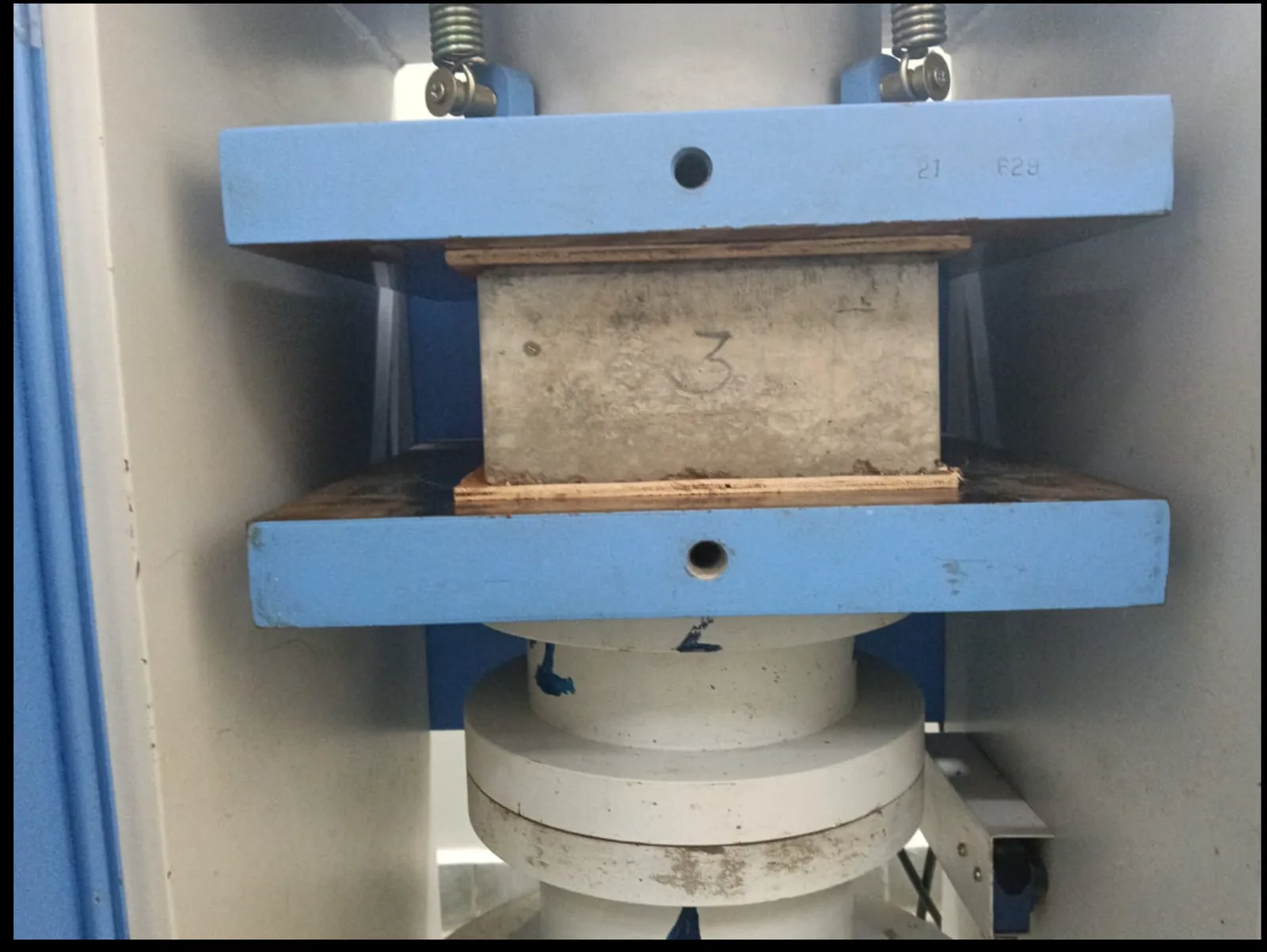
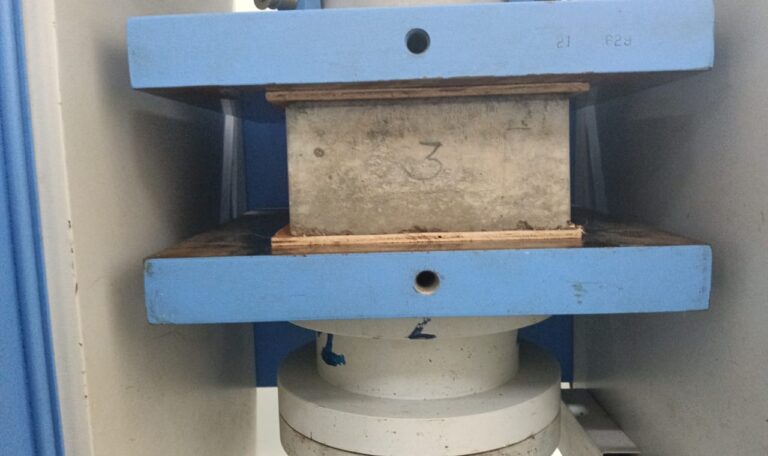
Paver blocks are capped with plaster of Paris, cement mortar, or plywood sheets to ensure uniform load distribution across the bearing faces. Each block is placed centrally between the CTM platens with the wearing face upward. Load is applied at a rate of 15 +/- 3 MPa per minute until failure. The compressive strength is calculated by dividing the maximum load by the plan area of the block. A minimum of 8 blocks are tested, and both individual and average strengths are reported against the specified grade (M30/M35/M50/M55).

5

Breaking Load (Splitting Tensile) Test

Day 4

The splitting tensile test evaluates the flexural resistance of paver blocks. Each block is placed on two parallel steel bearing bars spaced at a defined distance, and a single line load is applied along the centre through a third bearing bar. The load at failure is recorded as the breaking load in kN. Per IS 15658, a 60 mm thick block must achieve a minimum breaking load of 3.6 kN, and an 80 mm thick block must achieve at least 6.0 kN. This test is critical for blocks subjected to point loads from heavy vehicles.

6

Abrasion Resistance Test

Day 4-5

Three specimens cut from the wearing surface of the paver blocks are subjected to the wide-wheel abrasion test per IS 15658 Annex D. Each specimen is pressed against a rotating wide wheel with a standard corundum abrasive under 75 N load. After a fixed number of rotations, the volume loss (or mean wear depth in mm) is measured. Class A blocks (heavy traffic) must have mean wear not exceeding 3.0 mm, while Class B blocks (light traffic) must not exceed 4.0 mm.

7

Report Generation & Certification

Day 5

The final test report includes dimensional measurement data, water absorption values (individual and average), compressive strength results with grade compliance assessment, breaking load values, abrasion resistance classification, and visual inspection observations. Each parameter is reported against the IS 15658:2006 acceptance criteria. The NABL-accredited report is delivered in hard copy and digital format, suitable for submission to municipal corporations, CPWD, NHAI, and state PWD agencies.
Where Paver Block Testing Is Used

Concrete paving blocks are used extensively in urban infrastructure, commercial developments, and industrial facilities. Municipal corporations require IS 15658 compliance testing for all public footpaths, plazas, and parking areas. CPWD and state PWDs mandate testing for government building compounds and landscaping. The strength grade selection depends on the application: M30 for pedestrian areas, M35 for light vehicle parking, M50 for bus depots and commercial driveways, and M55 for container yards and port terminals. Cement quality testing ensures the raw material used in block manufacture meets IS 8112/IS 1489 standards. Aggregate testing verifies that sand and stone chips used in paver production comply with IS 383. NKMPV also provides concrete cube testing for verifying the mix design used in paver block production.
Municipal footpath and plaza construction per smart city and urban development projects Commercial parking lot and driveway paving under CPWD specifications Industrial container yard and port terminal heavy-duty pavement Residential township road and landscaping projects Bus depot and public transport terminal paving per IRC SP 63 Highway toll plaza and rest area construction per NHAI requirements Quality control testing for paver block manufacturers (factory acceptance)

Detailed Information

Paver Block Testing: Comprehensive Evaluation for Quality Assurance

Paver blocks, also referred to as precast concrete blocks, have revolutionized the way pavements, driveways, walkways, and parking areas are constructed. These blocks are manufactured using a mix of cement, sand, aggregates, and water, and are produced in various sizes, shapes, and colors, making them a versatile option for urban development projects. Paver blocks are increasingly favored for their aesthetic appeal, ease of installation, and durability. The quality of paver blocks plays a pivotal role in ensuring their functionality, safety, and long-term performance. To guarantee that the blocks are suitable for the intended application, it is essential to conduct rigorous testing to assess their strength, durability, and other mechanical properties. Among the most critical tests for evaluating paver blocks are the compressive strength test and the water absorption test. These tests help determine the blocks' ability to withstand loads, resist water penetration, and maintain structural integrity under varying environmental conditions. This report will provide a detailed overview of both tests, their procedures, purposes, benefits, and the importance of adhering to relevant standards, particularly the Indian Standard IS 15658:2006.
  1. Compressive Strength of Paver Blocks

1.1 Description

Compressive strength is defined as the ability of a material to withstand axial loads without failure. In the case of paver blocks, compressive strength is a critical factor that determines how well they can bear the loads imposed by pedestrian and vehicular traffic. When exposed to heavy traffic, paver blocks experience high compressive forces, and if their strength is inadequate, the blocks may crack, break, or fail prematurely. The compressive strength of paver blocks is typically tested by applying a gradually increasing load to the block using a compression testing machine. The load is applied uniformly until the block fails, and the point at which failure occurs is used to calculate the compressive strength. This property is crucial because it helps engineers and manufacturers assess the performance of the blocks under load-bearing conditions and their suitability for specific applications.

1.2 Purpose of Testing

1.2.1 Evaluate Strength

The primary purpose of the compressive strength test is to ensure that paver blocks have adequate strength to withstand the intended loads, whether from pedestrians, vehicles, or other external factors. For blocks used in driveways or roads, higher compressive strength is required to handle the weight of cars and trucks. This evaluation ensures the safety and reliability of the blocks over time.

1.2.2 Quality Assurance

By testing the compressive strength of paver blocks, manufacturers can confirm that their products meet the required strength standards as set out by relevant guidelines, such as IS 15658:2006. This test also helps identify inconsistencies in the manufacturing process and ensures that the blocks are made to the desired specifications.

1.2.3 Safety Assurance

Paver blocks subjected to heavy traffic and extreme weather conditions must be capable of withstanding significant forces. Compressive strength testing is essential to confirm that the blocks will not crack or fail, ensuring that the paved areas remain safe for use and that there is no risk of accidents due to block degradation.

1.3 Testing Procedure

1.3.1 Preparation

For accurate results, the selected paver blocks must be in good condition, free from cracks, air pockets, or defects that might skew the test results. To simulate real-world conditions and ensure that the blocks are saturated, the samples should be immersed in water for 24 hours prior to testing.

1.3.2 Test Setup

The compression testing machine must be calibrated before use. Once calibrated, the block is placed centrally on the machine's platen, which applies the load. It is important that the block is aligned properly so that the load is distributed evenly. The load is applied uniformly at a rate of 15 N/mm² per minute until the block fails.

1.3.3 Calculation

The compressive strength is determined by dividing the failure load by the cross-sectional area of the block. This can be represented as: Compressive Strength (N/mm²)=Failure Load (N)Area of the Block (mm²)\text{Compressive Strength (N/mm²)} = \frac{\text{Failure Load (N)}}{\text{Area of the Block (mm²)}}Compressive Strength (N/mm²)=Area of the Block (mm²)Failure Load (N)​ In this formula:
  • Failure Load (N)is the maximum load that the block can sustain before failure.
  • Area of the Block (mm²)is the cross-sectional area over which the load is applied.
The resulting compressive strength value is reported in N/mm², which is a standard unit of measurement for the material's strength.

1.3.4 Reporting

It is essential to perform the test on at least three different specimens from the same batch to account for any variability. The final compressive strength is calculated as the average of these tests, ensuring that the reported value is representative of the overall batch.

1.4 Benefits of Compressive Strength Testing

1.4.1 Durability Assurance

Paver blocks with sufficient compressive strength can withstand the rigors of external loads and environmental stresses. This durability helps reduce the likelihood of cracks, deformations, or failure due to traffic, pressure, or temperature fluctuations.

1.4.2 Compliance with Standards

Testing ensures that the paver blocks meet the standards specified in IS 15658:2006, ensuring that the blocks are suitable for use in public infrastructure and comply with industry safety requirements.

1.4.3 Enhanced Performance

Compressive strength testing helps categorize paver blocks into different grades based on their strength. This enables engineers to choose the most appropriate blocks for specific applications, such as M30 for pedestrian walkways or M40 for areas exposed to heavy traffic.

1.4.4 Economic Benefits

By ensuring that the paver blocks meet the strength requirements, manufacturers can minimize the likelihood of repairs or replacements, resulting in long-term cost savings for the project. This contributes to the overall economic viability of the paving solution.

1.5 Minimum Requirements

According to IS 15658:2006, paver blocks are classified into different strength grades, such as M30, M40, and so on. The number in each grade denotes the minimum compressive strength in N/mm², and the blocks must meet or exceed the specified value to be deemed suitable for use. For instance:
  • M30 Grade: Minimum compressive strength of 30 N/mm².
  • M40 Grade: Minimum compressive strength of 40 N/mm².
These classifications ensure that paver blocks are used in the appropriate applications, ensuring safety and performance over time.
  1. Paver Blocks Water Absorption Test

2.1 Description

The water absorption test measures the porosity of paver blocks, which is essential for determining how much water the blocks can absorb before they become prone to moisture-related damage. A high rate of water absorption indicates that the block has excessive porosity, which can weaken its structure over time and make it more susceptible to weathering and freeze-thaw damage. Water absorption is closely linked to the block’s resistance to environmental factors. Blocks with high absorption rates tend to lose strength faster and are more vulnerable to erosion, cracking, and other types of deterioration.

2.2 Purpose of Testing

2.2.1 Evaluate Durability

The water absorption test helps assess the block's overall resistance to moisture penetration, ensuring that it will not deteriorate when exposed to water or wet conditions. This is particularly important for areas exposed to frequent rain or freeze-thaw cycles.

2.2.2 Identify Defects

Excessive porosity or improper curing during the manufacturing process can lead to increased water absorption. By performing the water absorption test, manufacturers can detect these defects and correct any issues in the production process.

2.2.3 Ensure Quality

The water absorption test ensures that the blocks meet the requirements for density and moisture resistance as specified in IS 15658:2006, confirming that the blocks are made from high-quality materials and production methods.

2.3 Testing Procedure

2.3.1 Preparation

Prior to testing, the paver blocks are cleaned to remove any dust, dirt, or other surface contaminants that could affect the accuracy of the results.

2.3.2 Dry Weight Measurement

The blocks are oven-dried at 105 ± 5°C for at least 24 hours. This ensures that all moisture content is removed before the block is weighed. Once cooled to room temperature, the block is weighed (W1).

2.3.3 Immersion in Water

The blocks are then immersed in water at a temperature of 27 ± 2°C for 24 hours. This period allows the blocks to absorb water through their porous surface, simulating the exposure they would face in real-world conditions.

2.3.4 Wet Weight Measurement

After 24 hours of immersion, the blocks are removed from the water and any surface water is wiped off. The blocks are then weighed again (W2).

2.3.5 Calculation

The water absorption percentage is calculated using the formula: Water Absorption (%)=(W2−W1W1)×100\text{Water Absorption (\%)} = \left( \frac{W2 - W1}{W1} \right) \times 100Water Absorption (%)=(W1W2−W1​)×100 Where:
  • W1is the dry weight of the block.
  • W2is the wet weight of the block.

2.3.6 Reporting

The final water absorption value is the average of at least three test specimens. The result helps determine whether the block meets the maximum allowable absorption rate set by the relevant standards.

2.4 Benefits of Water Absorption Testing

2.4.1 Improved Weather Resistance

Blocks with low water absorption are less susceptible to damage caused by water infiltration. This enhances the block's ability to withstand adverse weather conditions, such as freezing and thawing cycles, which can cause cracks and other forms of damage.

2.4.2 Longevity Assurance

Low water absorption means the block is denser and less prone to deterioration over time. This leads to increased longevity and reduces the need for frequent repairs or replacements.

2.4.3 Compliance Verification

Water absorption testing confirms that the paver blocks meet the requirements set out in IS 15658:2006, ensuring that the blocks are suitable for various construction applications.

2.4.4 Structural Integrity

By verifying the porosity of the blocks, the water absorption test helps ensure that the blocks remain robust and structurally sound under environmental stresses.

2.5 Maximum Allowable Limit

According to IS 15658:2006, the water absorption of paver blocks should not exceed 6% by weight. Any blocks with higher absorption rates are considered unsuitable for most construction projects, as they are prone to rapid deterioration when exposed to moisture.
  1. Importance of Testing

3.1 Ensuring Quality and Performance

Regular testing of paver blocks ensures that each batch meets the necessary strength and durability standards. This guarantees that the blocks will perform as expected in the field, reducing the likelihood of failures or costly repairs.

3.2 Compliance with Standards

Adhering to IS 15658:2006 ensures that the blocks meet national standards for precast concrete products. This is critical for public safety, as substandard blocks can lead to infrastructure failures or accidents.

3.3 Reducing Maintenance Costs

By investing in quality control and testing, manufacturers can reduce the chances of premature failure of the paver blocks. This leads to long-term cost savings in maintenance, as high-quality blocks will require fewer repairs or replacements.

3.4 Promoting Sustainable Practices

Testing ensures that only blocks meeting strict quality standards are used in construction. This reduces waste and promotes sustainable resource management in the production of paver blocks.

Conclusion

Compressive strength and water absorption testing are indispensable tools for assessing the quality and suitability of paver blocks for construction applications. These tests not only help evaluate the strength and durability of the blocks but also ensure that they meet the strict performance standards set by IS 15658:2006. The compressive strength test helps verify that the blocks can withstand the anticipated loads from both pedestrian and vehicular traffic, preventing premature failure or damage. On the other hand, the water absorption test assesses the block's resistance to environmental factors, such as water infiltration, freeze-thaw cycles, and weathering, ensuring that the blocks remain structurally sound and durable over time. By adhering to the guidelines and standards outlined in IS 15658:2006, manufacturers can confidently produce paver blocks that are reliable, safe, and suitable for use in a wide range of infrastructure projects. Regular testing not only ensures compliance with industry standards but also helps identify potential manufacturing defects or inconsistencies in production processes, providing an opportunity for corrective measures before the blocks reach the market. Furthermore, consistent and rigorous testing contributes to significant economic benefits in the long run. High-quality paver blocks with optimal compressive strength and low water absorption require fewer repairs and replacements, reducing maintenance costs for property owners and municipalities. This leads to better resource allocation, cost efficiency, and enhanced project sustainability. From a broader perspective, these testing practices promote a more sustainable approach to urban development. By producing durable and high-performance paver blocks, the overall environmental impact of construction projects can be minimized, as fewer resources are consumed for repairs and replacements, and the need for waste management is reduced. In conclusion, the importance of compressive strength and water absorption testing cannot be overstated. These tests play a pivotal role in ensuring that paver blocks meet the required standards for structural integrity, weather resistance, and long-term durability. By continuing to prioritize quality control, manufacturers can guarantee that their products will serve their intended purpose effectively, contributing to safe, reliable, and aesthetically appealing infrastructure that will stand the test of time. Ultimately, these practices foster confidence among consumers, engineers, and policymakers, ensuring that paver blocks remain a cornerstone of modern construction in both residential and commercial settings. Contect Us for Paver Block Testing as per IS 15658.

Why Choose NKMPV for Paver Block Testing?

NABL Accredited Results

Our paver block test reports carry NABL accreditation (ISO/IEC 17025:2017), accepted by municipal corporations, CPWD, state PWDs, NHAI, and smart city project management consultants without additional verification.

Complete IS 15658 Test Suite

We perform all five mandatory tests — compressive strength, water absorption, abrasion resistance, breaking load, and dimensional tolerance — under one roof, eliminating the need to split samples across multiple labs.

2000 kN CTM Capacity

Our high-capacity Compression Testing Machine handles all paver block sizes including large-format blocks (300 x 300 mm) and thick blocks (100 mm) with uniform load distribution, ensuring accurate and repeatable results.

Fast 3-5 Day Turnaround

Standard paver block testing is completed within 3-5 working days including all five tests and report generation. Rush processing is available for urgent factory acceptance and project quality audits.

Manufacturer Quality Assurance

We work with paver block manufacturers as their designated third-party testing laboratory, providing routine batch testing and annual quality audit reports that help maintain product consistency and market credibility.

Frequently Asked Questions

IS 15658:2006 classifies paver blocks into four strength grades. M30 requires a minimum average compressive strength of 30 MPa (individual minimum 25 MPa). M35 requires 35 MPa average (30 MPa individual). M50 requires 50 MPa average (45 MPa individual). M55 requires 55 MPa average (50 MPa individual). The appropriate grade depends on the traffic loading — M30 for pedestrian areas, M50 and M55 for heavy vehicle and industrial applications.
Per IS 15658:2006 Clause 8.3, the average water absorption of a sample lot must not exceed 6%, and no individual block shall exceed 7%. For blocks used in frost-prone areas or regions with frequent freeze-thaw cycles, the limit is stricter at 5% average. Low water absorption indicates a dense, well-compacted block with good durability. Blocks exceeding these limits are likely to deteriorate rapidly from moisture ingress and efflorescence.
For a complete IS 15658 testing program, a minimum of 24-27 blocks is required from each production lot: 16 blocks for compressive strength (8 tested, 8 reserve), 8 blocks for water absorption, and 3 blocks for abrasion resistance. Dimensional measurement and visual inspection are performed on all blocks received. The same blocks used for compressive strength can first be measured for dimensions, so the total sample size is optimised.
M30 blocks (>= 30 MPa) are suitable for pedestrian footpaths, garden pathways, and light landscaping areas. M35 blocks (>= 35 MPa) are used for light vehicle parking and residential driveways. M50 blocks (>= 50 MPa) are specified for commercial driveways, bus depots, and petrol station forecourts. M55 blocks (>= 55 MPa) are designed for the heaviest applications — container yards, port terminals, and airport service roads per IRC SP 63.
The breaking load test (also called the splitting tensile test) measures the resistance of a paver block to flexural failure under a line load. The block is placed on two parallel support bars, and a central line load is applied until the block splits. Per IS 15658:2006, a 60 mm thick block must achieve a minimum breaking load of 3.6 kN, and an 80 mm thick block must achieve at least 6.0 kN. This test is important for evaluating performance under concentrated wheel loads.
A complete paver block testing program per IS 15658 takes 3-5 working days. Day 1 covers sampling, visual inspection, and dimensional measurement, and the water absorption drying cycle begins. Days 2-3 complete the water absorption test (24-hour immersion). Days 3-4 cover compressive strength and breaking load tests. Day 4-5 includes abrasion testing and final report generation. Rush processing can deliver results in 2-3 days for compressive strength and water absorption alone.

Need Paver Block Testing? Get a Quote Today.

+91-XXXXX-XXXXX