
Our team travels to your site
For field work, our engineers and instruments mobilise anywhere in India — highway corridors, bridges, plants and greenfield alignments included.
OPC and PPC cement testing to IS 4031 — fineness, consistency, setting time, soundness and compressive strength for RMC plants and highway, bridge and building projects
Cement is tested by the methods in IS 4031 — fineness, consistency, setting time, soundness and compressive strength — and checked against the grade specifications IS 269 (OPC 33/43/53) and IS 1489 (PPC). NKMPV performs OPC and PPC cement testing as a NABL-accredited laboratory.
Cement testing evaluates the physical and mechanical properties of Ordinary Portland Cement (OPC) and Portland Pozzolana Cement (PPC) to verify compliance with IS 8112, IS 12269, and IS 1489 before the material is used in concrete production. It is a mandatory quality control step for every construction project in India.
The following parameters are tested during cement evaluation. Acceptance limits shown are for OPC 43 Grade (IS 8112) and PPC (IS 1489 Part 1). OPC 53 Grade limits per IS 12269 are tighter for compressive strength.
| Parameter | Value / Range | Unit | Standard |
|---|---|---|---|
| Fineness (Blaine) | ≥ 225 m²/kg (OPC 43), ≥ 300 m²/kg (PPC) | m²/kg | IS 4031 Part 2 |
| Standard Consistency | 25-35% (typical range) | % | IS 4031 Part 4 |
| Initial Setting Time | ≥ 30 minutes | minutes | IS 4031 Part 5 |
| Final Setting Time | ≤ 600 minutes | minutes | IS 4031 Part 5 |
| Soundness (Le Chatelier) | ≤ 10 mm | mm | IS 4031 Part 3 |
| Compressive Strength (3 days) | ≥ 23 MPa (OPC 43), ≥ 16 MPa (PPC) | MPa | IS 4031 Part 6 |
| Compressive Strength (7 days) | ≥ 33 MPa (OPC 43), ≥ 22 MPa (PPC) | MPa | IS 4031 Part 6 |
| Compressive Strength (28 days) | ≥ 43 MPa (OPC 43), ≥ 33 MPa (PPC) | MPa | IS 4031 Part 6 |
| Specific Gravity | 3.10-3.25 (OPC), 2.90-3.15 (PPC) | IS 4031 Part 11 |
Methods of Physical Tests for Hydraulic Cement
Ordinary Portland Cement, 43 Grade — Specification
Ordinary Portland Cement, 53 Grade — Specification
Portland Pozzolana Cement — Specification (Fly Ash Based)
Standard Sand for Testing of Cement — Specification
Standard Sand for Testing Cement — Methods of Sampling
Reference Data
The physical requirements every cement grade must meet before it can be accepted on site. These are the figures a test report is judged against — reproduced here so you can check a mill certificate or a NABL report without opening the code.
| Cement grade | Governing standard | 3-day min (MPa) | 7-day min (MPa) | 28-day min (MPa) |
|---|---|---|---|---|
| OPC 33 Grade | IS 269:2015 | 16 | 22 | 33 |
| OPC 43 Grade | IS 269:2015 | 23 | 33 | 43 |
| OPC 53 Grade | IS 269:2015 | 27 | 37 | 53 |
| PPC (fly ash based) | IS 1489 Part 1:2015 | 16 | 22 | 33 |
| PSC (slag based) | IS 455:2015 | 16 | 22 | 33 |
Strength is determined on 70.6 mm cement-sand mortar cubes at 1:3 proportion, not on concrete cubes. IS 269:2015 consolidated OPC 33, 43 and 53 grades into a single standard, superseding the separate IS 8112 (43 grade) and IS 12269 (53 grade) references still quoted in many older specifications.
| Property | Test method | OPC requirement | PPC requirement |
|---|---|---|---|
| Fineness (specific surface) | IS 4031 Part 2 — Blaine | 225 m2/kg minimum | 300 m2/kg minimum |
| Initial setting time | IS 4031 Part 5 — Vicat | 30 minutes minimum | 30 minutes minimum |
| Final setting time | IS 4031 Part 5 — Vicat | 600 minutes maximum | 600 minutes maximum |
| Soundness — Le Chatelier | IS 4031 Part 3 | 10 mm maximum | 10 mm maximum |
| Soundness — autoclave | IS 4031 Part 3 | 0.8 % maximum | 0.8 % maximum |
| Drying shrinkage | IS 4031 Part 10 | Not specified | 0.15 % maximum |
Where the Le Chatelier expansion exceeds 10 mm, IS permits a re-test on cement aerated for 7 days; the aerated result must not exceed 5 mm. A soundness failure indicates free lime or magnesia and is grounds for outright rejection of the consignment.
| Item | Requirement |
|---|---|
| Minimum sample quantity | 5 kg per consignment, drawn per IS 3535 sampling procedure |
| Sampling frequency (IS 456) | One test per 100 tonnes or part thereof, per source and grade |
| Time to first result | 3-day strength plus setting time and fineness — approximately 4 days |
| Time to full report | 28 days, governed by the 28-day strength requirement |
| Storage before testing | Airtight container; cement that has absorbed moisture will fail fineness and strength |
| Report validity | Tied to the consignment sampled; a fresh consignment requires fresh testing |
The 28-day wait is a property of the standard, not of the laboratory. If a project needs earlier assurance, the 3-day and 7-day results are the accepted proxy — which is why we issue an interim report at 7 days and the final NABL report at 28.
Values are reproduced from the Indian Standards cited against each table and are given for reference. Codes are revised periodically — always confirm against the current edition of the standard, and treat presumptive or indicative figures as a starting point for investigation, never as a substitute for site-specific testing.
AIMIL AIM-401
Standard plunger (10 mm dia), initial set needle (1 mm), final set needle with annular attachment
CalibratedEIE Instruments
Measures specific surface area from 200 to 600 m²/kg, NABL-calibrated U-tube manometer
CalibratedStandard IS pattern (brass)
30 mm diameter split cylinder with indicator arms, least count 0.5 mm
CalibratedAIMIL AIM-302-E
2000 kN capacity, pace rate control as per IS 4031 Part 6
CalibratedStandard 70.6 mm three-gang moulds (cast iron)
3-gang mould producing three 70.6 mm cubes per filling, vibration table for compaction
CalibratedStandard borosilicate glass flask
250 ml capacity with graduated neck, kerosene as displacement fluid per IS 4031 Part 11
CalibratedAIMIL thermostatically controlled
27 ± 2°C maintained for curing cubes and Le Chatelier soundness test
CalibratedA representative cement sample of approximately 5 kg is collected per IS 3535 guidelines. For bagged cement, samples are drawn from at least 12 bags in a lot using a tube sampler, blended, and quartered down. For bulk cement (silos), the sample is drawn from the delivery pipe during discharge. The sample is sealed in an airtight polythene bag and delivered to the laboratory within 24 hours to prevent moisture absorption and aeration.
Fineness is determined using the Blaine air permeability apparatus — a weighed cement plug is placed in a permeability cell and the time for a fixed volume of air to pass through is measured against a reference cement. Standard consistency is found using the Vicat apparatus by determining the water percentage at which the plunger penetrates to 33-35 mm from the top. Specific gravity is measured by the Le Chatelier flask method using kerosene displacement. These three tests are completed on the day of sample receipt.
Cement paste is prepared at standard consistency and placed in the Vicat mould (80 mm diameter, 40 mm depth). For initial setting time, a 1 mm square needle is lowered onto the paste surface every 5 minutes; the initial set is recorded when the needle stops 5 mm from the base plate. For final setting time, the needle with annular attachment is used; the final set is when the needle makes an impression but the collar does not. The test room is maintained at 27 ± 2°C and 65% relative humidity.
Cement paste at standard consistency is filled into the Le Chatelier split brass mould and sandwiched between glass plates. The mould is submerged in water at 27 ± 2°C for 24 hours, and the distance between indicator arms is measured. The mould is then placed in a boiling water bath for 3 hours, cooled, and the arm distance re-measured. The expansion (difference in readings) must not exceed 10 mm. This test detects excess free lime or magnesia that would cause unsoundness in hardened concrete.
Cement mortar cubes are prepared using a 1:3 cement-to-standard-sand ratio (by weight) with a water-cement ratio of 0.40 for OPC 43 (as per IS 4031 Part 6). The mortar is mixed in a standard Hobart mixer, filled into 70.6 mm three-gang moulds, compacted on a vibration table, and levelled. After 24 hours of moist curing in the moulds, cubes are demoulded and transferred to a curing tank maintained at 27 ± 2°C. A minimum of 12 cubes are cast — three each for 3-day, 7-day, and 28-day testing, with three spare cubes.
At each specified age (3, 7, and 28 days from casting), three mortar cubes are removed from the curing tank, surface-dried, and tested in the compression testing machine at a loading rate of 35 ± 0.5 N/mm² per minute (as specified in IS 4031 Part 6). The load at failure is recorded and the compressive strength is calculated by dividing the failure load by the cube cross-sectional area (50 cm²). The average of three cubes is reported for each age.
All test results are compiled into an NABL-accredited test certificate that includes fineness, consistency, initial and final setting time, soundness expansion, specific gravity, and compressive strengths at 3, 7, and 28 days. The report references the applicable IS code for each test, states the cement type and grade, and provides a pass/fail assessment against the relevant specification (IS 8112, IS 12269, or IS 1489). Interim results for rapid tests are available within 48 hours; the final 28-day report is dispatched within 30 days.


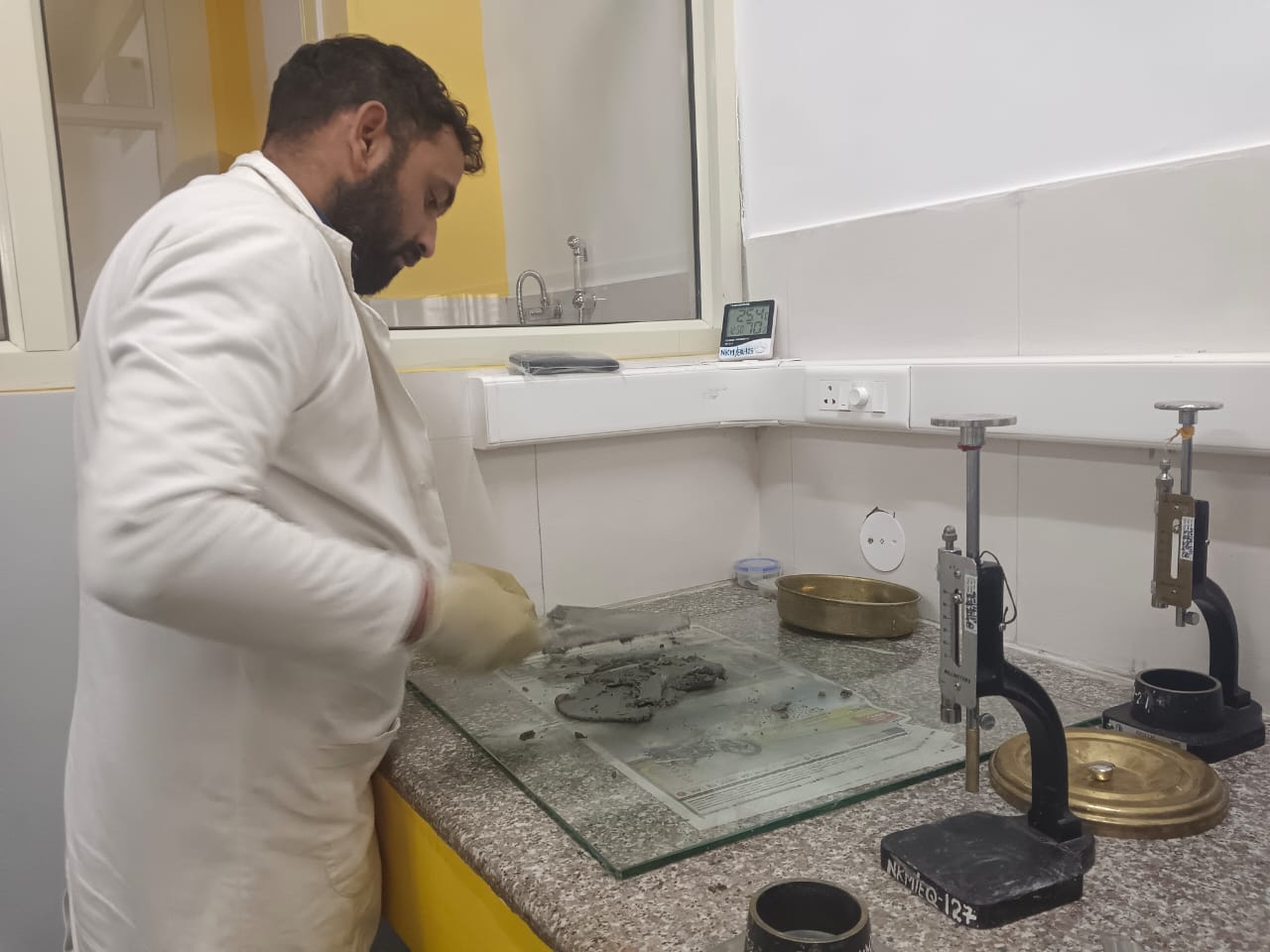
Our cement test certificates carry NABL accreditation under ISO/IEC 17025:2017, making them accepted without question by NHAI, state PWDs, CPWD, railways, municipal corporations, courts, and arbitration tribunals across India.
We perform the full range of cement physical tests — fineness, consistency, setting time, soundness, specific gravity, and compressive strength at all three ages — in a single engagement. No need to split samples across multiple labs.
Our curing tank and moist room are maintained at 27 ± 2°C with continuous temperature logging, ensuring cube curing conditions strictly comply with IS 4031 Part 6. Accurate curing is critical for reliable 28-day strength results.
We share 3-day and 7-day compressive strength results as soon as they are available, so you can take early corrective action if cement quality is suspect — rather than waiting the full 28 days for the final report.
For ready-mix plants and large infrastructure projects requiring routine cement testing, we offer contracted rates with scheduled sample pickup across Punjab, Haryana, and Himachal Pradesh.
IS 4031 Parts 1-15 governs cement physical testing. The mandatory acceptance test suite includes: (1) Fineness (Part 1, Blaine air-permeability) — minimum 225 m²/kg (OPC 33), 295 (OPC 53). (2) Consistency of standard paste (Part 4) — water content for 33-35% needle penetration. (3) Initial and final setting time (Part 5) — initial ≥30 min, final ≤600 min. (4) Soundness (Part 3, Le Chatelier & autoclave) — max 10 mm expansion. (5) Compressive strength (Part 6) — at 3, 7, 28 days on 70.6 mm mortar cubes. (6) Specific gravity (Part 11) — typically 3.10–3.16 for OPC, 2.85–2.95 for PPC. Chemical tests per IS 4032: loss on ignition, insoluble residue, MgO, SO₃, free lime. NABL-accredited cement testing reports accepted by NHAI, CPWD, RMC plants.
OPC (Ordinary Portland Cement) per IS 269 is clinker + 5% gypsum, available in grades 33, 43, 53 based on minimum 28-day compressive strength (33, 43, 53 N/mm²). High early strength; suitable for fast-track construction. PPC (Portland Pozzolana Cement) per IS 1489 Part 1 is clinker + gypsum + 15–35% pozzolana (fly ash or calcined clay). Slower early strength but higher long-term strength and durability; better resistance to chemical attack, alkali-aggregate reaction, and chloride ingress. Use cases: OPC 53 for high-strength concrete (M40+), pre-stressed concrete, fast-track work. PPC for mass concrete, marine structures, sewage works, and durability-critical applications. PPC produces ~15% less CO₂ — preferred for green construction.
Per IS 269:2015 for OPC: Grade 33: 33 N/mm², Grade 43: 43 N/mm², Grade 53: 53 N/mm² — minimum mean of three 70.6 mm mortar cubes tested at 28 days per IS 4031 Part 6. Per IS 1489 Part 1 for PPC: minimum 33 N/mm² at 28 days regardless of pozzolana content. Per IS 8112 for OPC 43: 7-day strength minimum 33 N/mm². Site-cured cubes typically achieve 90–95% of laboratory cube strength because field curing is rarely as controlled as laboratory water curing. Acceptance per IS 456: average ≥ specified, no individual cube below specified − 5 N/mm².
Coverage
Wherever your project is, there are two ways to work with NKMPV on Cement Testing.
For field work, our engineers and instruments mobilise anywhere in India — highway corridors, bridges, plants and greenfield alignments included.
Distance is not a constraint for laboratory testing. Send samples to our Pinjore laboratory and receive the digital report on completion — the route most of our out-of-region clients use.
These are locations where we have completed projects — not the boundary of our service area. We mobilise across India on request. See full coverage & project locations →
Cement Testing is carried out to IS 4031 (Parts 1-15), IS 8112:2013, IS 12269:2013 and IS 1489 Part 1:2015, as listed in the Applicable Standards section of this page. Tell us the specification your project must comply with and the quotation will state the standard the work follows.
Our laboratory is at Pinjore, Haryana, within same-day reach of Chandigarh, Panchkula, Mohali, Ambala and the wider Tri-City. If you are further away, distance is not a constraint: our field team travels to site anywhere in India for on-site work, and for laboratory tests you can courier samples to the Pinjore lab and receive the report digitally. Clients across Punjab, Haryana, Himachal Pradesh, Delhi-NCR, Uttarakhand, Rajasthan, Uttar Pradesh, Jammu and Kashmir and Ladakh already work with us this way.
Yes. NKMPV operates pan-India. We have delivered projects across Chandigarh, Panchkula, Mohali, Ambala, Karnal, Kurukshetra, Yamunanagar, Hisar and beyond, and we mobilise to greenfield and remote corridors on request. The 18 locations listed on our site are the places we have already worked — not the limit of where we go.
Send us the project details — location, quantity, and the standard you need to comply with — and you get a written quotation, usually within one working day. Pricing depends on sample count, site access and mobilisation distance, so we quote per project rather than publishing a fixed rate. Call +91-82953-60108 or use the quote form; every quotation states the applicable IS/IRC standard.
Need Cement Testing for your project?