
Our team travels to your site
For field work, our engineers and instruments mobilise anywhere in India — highway corridors, bridges, plants and greenfield alignments included.
Coarse and fine aggregate testing to IS 2386 — grading, specific gravity, water absorption, impact, crushing and abrasion values for source approval, RMC plants and GSB/WMM
Aggregates are tested by the methods in IS 2386 (Parts 1–8) — gradation, specific gravity, water absorption, impact, abrasion, flakiness/elongation and soundness — and assessed against the specification in IS 383. NKMPV performs coarse and fine aggregate testing as a NABL-accredited laboratory.
Coarse and fine aggregate testing evaluates the physical, mechanical, and grading properties of natural and manufactured aggregates used in concrete, road bases, and bituminous mixes. These tests ensure that aggregates meet the requirements of IS 383:2016 and IS 2386 (Parts 1 through 4) before they enter the construction supply chain.
The following parameters are evaluated during aggregate testing. Acceptance limits are drawn from IS 383:2016 for concrete aggregates and MoRTH 5th Revision for road construction aggregates. Project-specific specifications may impose tighter limits.
| Parameter | Value / Range | Unit | Standard |
|---|---|---|---|
| Sieve Analysis (Particle Size Distribution) | Grading per IS 383 Table 7/8/9 | % passing | IS 2386 Part 1 |
| Fineness Modulus (Fine Aggregate) | 2.2 - 3.3 (Zone I to IV) | IS 2386 Part 1 | |
| Specific Gravity (Coarse Aggregate) | 2.5 - 3.0 (typical) | IS 2386 Part 3 Cl. 3 | |
| Specific Gravity (Fine Aggregate) | 2.5 - 2.8 (typical) | IS 2386 Part 3 Cl. 4 | |
| Water Absorption | < 2% (desirable for concrete) | % | IS 2386 Part 3 |
| Aggregate Impact Value (AIV) | < 30% (road base), < 45% (wearing course limit) | % | IS 2386 Part 4 Cl. 5 |
| Aggregate Crushing Value (ACV) | < 30% (concrete), < 45% (maximum) | % | IS 2386 Part 4 Cl. 3 |
| Los Angeles Abrasion Value (LAA) | < 30% (wearing course), < 40% (base course) | % | IS 2386 Part 4 Cl. 7 |
| Elongation Index | < 25% (preferred), < 35% (maximum) | % | IS 2386 Part 1 Cl. 5 |
| Flakiness Index | < 25% (preferred), < 35% (maximum) | % | IS 2386 Part 1 Cl. 4 |
| Silt Content (Fine Aggregate) | < 3% (uncrushed), < 15% (crushed) | % | IS 2386 Part 2 Cl. 5 |
Methods of Test for Aggregates for Concrete — Particle Size and Shape
Methods of Test for Aggregates for Concrete — Estimation of Deleterious Materials and Organic Impurities
Methods of Test for Aggregates for Concrete — Specific Gravity, Density, Voids, Absorption, and Bulking
Methods of Test for Aggregates for Concrete — Mechanical Properties
Coarse and Fine Aggregate for Concrete — Specification (Third Revision)
Specifications for Road and Bridge Works — Section 400 (Sub-Base, Base, and Surface Courses)
AIMIL AIM-450
Standard set: 80 mm, 40 mm, 20 mm, 10 mm, 4.75 mm, 2.36 mm, 1.18 mm, 600 micron, 300 micron, 150 micron, 75 micron IS sieves
CalibratedEIE Instruments
15 blows of 14 kg hammer from 380 mm height as per IS 2386 Part 4
CalibratedAIMIL AIM-276
400 kN load applied at a rate of 40 kN/min over 10 minutes
CalibratedEIE Instruments
500 or 1000 revolutions at 30-33 rpm, accommodates grading A/B/C/D charges
CalibratedBrass pycnometer, IS pattern
1000 ml capacity for specific gravity determination of fine aggregate
CalibratedStainless steel, IS pattern
For specific gravity and water absorption of coarse aggregate by buoyancy method
CalibratedStandard IS gauges for elongation and flakiness
Full set covering 6.3 mm to 63 mm size fractions
CalibratedEssae DS-252
30 kg capacity, least count 1 g (NABL calibrated)
CalibratedRepresentative aggregate samples are collected from the quarry, crusher plant, or project stockpile using the quartering method per IS 2430. A minimum of 30-50 kg of coarse aggregate (depending on nominal maximum size) and 10-15 kg of fine aggregate is required. Samples are tagged with source, date, and project details upon receipt at our Pinjore laboratory.
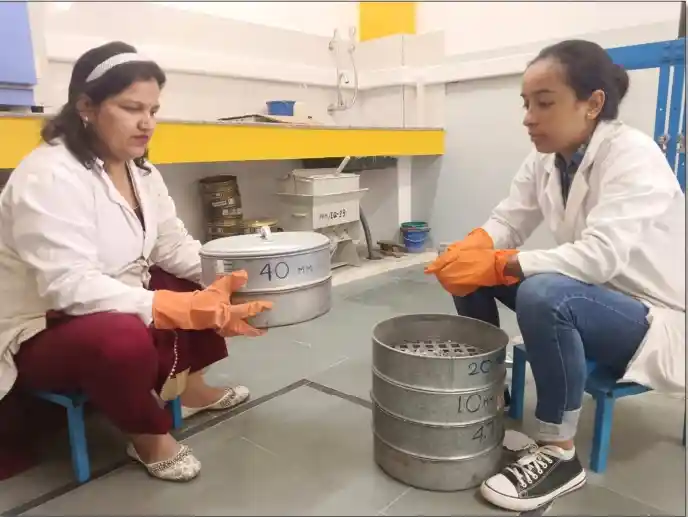
Coarse and fine aggregate samples are oven-dried to constant mass at 100-110 degrees Celsius. The dried samples are passed through a nest of standard IS sieves on a motorised shaker. Individual size fractions are weighed and cumulative passing percentages are calculated. Separately, each fraction of coarse aggregate is tested for elongation using a length gauge and flakiness using a thickness gauge per IS 2386 Part 1.
Coarse aggregate specific gravity is determined using the wire basket buoyancy method — oven-dried, saturated surface-dry, and submerged weights are recorded. For fine aggregate, the pycnometer method is used, where the aggregate is placed in a calibrated flask and water is added to eliminate entrapped air. Apparent and bulk specific gravities and water absorption percentages are calculated from the recorded weights.
For Aggregate Impact Value, a standard 14 kg hammer is dropped 15 times onto aggregate packed in a steel cup, and the percentage passing 2.36 mm is recorded. For Aggregate Crushing Value, aggregate in a steel cylinder is loaded to 400 kN over 10 minutes, and fines passing 2.36 mm are weighed. For Los Angeles Abrasion, aggregate and steel charge balls are rotated in a drum for 500 or 1000 revolutions, and abrasion loss passing the 1.70 mm sieve is measured.
Fine aggregate silt content is determined by the wet-sieving method — the sample is washed through a 75-micron sieve until the wash water runs clear, and the percentage of material lost is recorded. Where required, organic impurity testing is conducted using the sodium hydroxide colour method per IS 2386 Part 2 to detect harmful organic matter that could affect concrete setting.
All raw data is entered into our LIMS (Laboratory Information Management System). Grading curves are plotted and checked against IS 383:2016 envelopes. Mechanical properties are compared against MoRTH and project-specific limits. A senior engineer reviews all results and verifies calculations before the report is approved for issue.
The final test certificate includes sieve analysis with grading curve, fineness modulus, specific gravity, water absorption, AIV, ACV, LAA, elongation and flakiness indices, and silt content. Reports are issued under NABL accreditation with unique certificate numbers and are delivered as digitally signed PDFs along with hard copies if requested.

For quality control and compliance in construction projects, coarse and fine aggregate testing must be carried out strictly as per Indian Standards. Tests such as sieve analysis, impact value, crushing value, abrasion value, water absorption, and specific gravity are defined under IS 2386 (part 1 - 5), which governs the physical and mechanical properties of aggregates used in concrete, pavement layers, and structural works.
Contact Us for Coarse and Fine Aggregate Testing


Our aggregate test reports carry NABL accreditation (ISO/IEC 17025:2017), making them accepted by NHAI, state PWDs, RMC plant auditors, and arbitration tribunals without requiring additional verification.
We perform the entire range of tests under IS 2386 Parts 1 through 4 and IS 383:2016 in a single engagement — sieve analysis, specific gravity, water absorption, AIV, ACV, LAA, elongation, flakiness, and silt content — eliminating the need to visit multiple labs.
We have tested aggregates from over 50 quarry and crusher sources across the Shivalik belt, Chandigarh periphery, and Himachal Pradesh. Our engineers understand the geological characteristics of regional aggregate sources and can advise on suitability for specific applications.
Our sieve shakers, AIV apparatus, and LA abrasion machine can process multiple samples simultaneously. For large highway projects requiring source approval of several aggregate sizes, we deliver complete results within 3-5 working days.
Aggregate test data feeds directly into our concrete mix design and GSB/WMM mix design services. Clients who bundle aggregate testing with mix design receive a cohesive material characterisation package with consistent data across reports.
IS 2386 Parts 1-8 governs aggregate physical testing. The mandatory acceptance suite: (1) Particle size distribution / sieve analysis (Part 1) — gradation envelope per IS 383. (2) Specific gravity and water absorption (Part 3) — typically SG 2.55-2.75, absorption ≤ 2%. (3) Bulk density and voids (Part 3). (4) Aggregate impact value (Part 4) — max 30% (BC/SDBC), 35% (BM/DBM), 45% (WMM). (5) Aggregate crushing value (Part 4) — max 30%. (6) Los Angeles abrasion (Part 4) — max 30% (BC), 40% (DBM/BM). (7) Flakiness and elongation index (Part 1) — max 35% combined for road work. (8) Soundness with sodium/magnesium sulphate (Part 5) — max 12% loss for highway work. (9) Stripping value for bituminous mixes (Part 6) — min 95% coating retained.
The Aggregate Impact Value (AIV) test per IS 2386 Part 4:1963 measures aggregate resistance to sudden impact / shock loading. Procedure: 14 mm passing / 10 mm retained aggregate is filled into the impact testing machine in three layers, each tamped 25 times. The hammer (13.5–14.0 kg) drops from 380 mm onto the sample 15 times at one-second intervals. The resulting fines passing 2.36 mm sieve are weighed. AIV (%) = (Weight passing 2.36 mm / Total Weight) × 100. Acceptance limits per IRC SP 53 / MoRTH: BC and SDBC ≤ 24%, BM and DBM ≤ 27%, WMM and GSB ≤ 30%, sub-base granular ≤ 35%. Higher AIV indicates aggregate susceptible to crushing under traffic loading.
Both measure aggregate strength but apply different loads: Aggregate Impact Value (AIV) applies sudden impact via a falling hammer (high-rate dynamic load) — simulates the type of load aggregates experience under moving traffic. Aggregate Crushing Value (ACV) applies a gradually-increasing static load (40 tonnes over 10 minutes) — simulates compressive loads aggregates experience under static structures. Both tests use 12.5–10 mm aggregate. Typical correlation: ACV is usually 5-10% lower than AIV for the same aggregate. MoRTH and IRC specifications use AIV as the primary acceptance criterion for road work; ACV is acceptable when AIV apparatus is unavailable. NKMPV runs both tests as part of the standard aggregate acceptance suite.
Coverage
Wherever your project is, there are two ways to work with NKMPV on Aggregate Testing.
For field work, our engineers and instruments mobilise anywhere in India — highway corridors, bridges, plants and greenfield alignments included.
Distance is not a constraint for laboratory testing. Send samples to our Pinjore laboratory and receive the digital report on completion — the route most of our out-of-region clients use.
These are locations where we have completed projects — not the boundary of our service area. We mobilise across India on request. See full coverage & project locations →
Aggregate Testing is carried out to IS 2386 Part 1, IS 2386 Part 2, IS 2386 Part 3 and IS 2386 Part 4, as listed in the Applicable Standards section of this page. Tell us the specification your project must comply with and the quotation will state the standard the work follows.
Our laboratory is at Pinjore, Haryana, within same-day reach of Chandigarh, Panchkula, Mohali, Ambala and the wider Tri-City. If you are further away, distance is not a constraint: our field team travels to site anywhere in India for on-site work, and for laboratory tests you can courier samples to the Pinjore lab and receive the report digitally. Clients across Punjab, Haryana, Himachal Pradesh, Delhi-NCR, Uttarakhand, Rajasthan, Uttar Pradesh, Jammu and Kashmir and Ladakh already work with us this way.
Yes. NKMPV operates pan-India. We have delivered projects across Chandigarh, Panchkula, Mohali, Ambala, Karnal, Kurukshetra, Yamunanagar, Hisar and beyond, and we mobilise to greenfield and remote corridors on request. The 18 locations listed on our site are the places we have already worked — not the limit of where we go.
Send us the project details — location, quantity, and the standard you need to comply with — and you get a written quotation, usually within one working day. Pricing depends on sample count, site access and mobilisation distance, so we quote per project rather than publishing a fixed rate. Call +91-82953-60108 or use the quote form; every quotation states the applicable IS/IRC standard.
Need Aggregate Testing for your project?