
Our team travels to your site
For field work, our engineers and instruments mobilise anywhere in India — highway corridors, bridges, plants and greenfield alignments included.
Soaked and unsoaked CBR testing to IS 2720 Part 16 — subgrade strength, swell and IRC 37 design inputs for highway, airport and industrial pavements
CBR stands for California Bearing Ratio — the load-penetration strength of a subgrade or pavement layer expressed as a percentage of a standard crushed-stone value. It is measured (soaked or unsoaked) per IS 2720 (Part 16) and is the key input for flexible pavement thickness design under IRC 37. NKMPV performs the CBR test as a NABL-accredited laboratory.
The California Bearing Ratio (CBR) test measures the strength of a soil subgrade or sub-base material relative to a standard crushed stone. It is the primary input for flexible pavement thickness design in India.
The following parameters are evaluated during CBR testing. Acceptance criteria vary by project specification — MoRTH, IRC, and state PWD norms are the most common references.
| Parameter | Value / Range | Unit | Standard |
|---|---|---|---|
| CBR Value (Soaked) | 2-80% | % | IS 2720 Part 16 |
| CBR Value (Unsoaked) | 5-100% | % | IS 2720 Part 16 |
| Penetration at 2.5 mm | Load recorded | kN | IS 2720 Part 16 Cl. 5.3 |
| Penetration at 5.0 mm | Load recorded | kN | IS 2720 Part 16 Cl. 5.3 |
| Swell on Soaking | < 2% (typical specification) | % | IS 2720 Part 16 Cl. 5.2 |
| Dry Density of Specimen | At OMC (97-100% MDD) | g/cc | IS 2720 Part 8 |
| Subgrade CBR (MoRTH Minimum) | ≥ 8% for NH/SH | % | MoRTH 5th Rev. Cl. 301.3 |
Methods of Test for Soils — Laboratory Determination of CBR
Methods of Test for Soils — Determination of Water Content-Dry Density Relation Using Heavy Compaction
Guidelines for Design of Flexible Pavements
Specifications for Road and Bridge Works — Section 300 (Earthwork)
Methods of Test for Soils — Determination of Water Content-Dry Density Relation Using Light Compaction
AIMIL AIM-304-1
50 kN capacity with motorized loading frame
CalibratedAIMIL 5 kN / 10 kN
Least count 1 N, NABL-calibrated
CalibratedStandard IS moulds (150 mm dia x 175 mm height)
Set of 6 moulds with spacer discs, perforated base plates, and surcharge weights
Calibrated4.89 kg rammer, 450 mm drop height
As per IS 2720 Part 8 (Modified Proctor)
CalibratedCustom fabricated stainless steel
Accommodates 12 moulds simultaneously for 96-hour immersion
CalibratedMitutoyo 25 mm travel
Least count 0.01 mm
CalibratedApproximately 50 kg of representative disturbed soil is collected from the project site at the required depth. The sample is air-dried, pulverised, and sieved through a 19 mm IS sieve. Oversize material is replaced with an equal weight of material retained between 4.75 mm and 19 mm sieves as per IS 2720 Part 16.
Before compacting CBR specimens, the Optimum Moisture Content (OMC) and Maximum Dry Density (MDD) are determined using the heavy compaction test per IS 2720 Part 8 (Modified Proctor). The soil is compacted in 5 layers with 56 blows per layer. This establishes the target moisture and density for CBR specimen preparation.
Three CBR specimens are compacted in standard 150 mm diameter moulds at OMC. Each mould is compacted with 56 blows per layer in 5 layers using the heavy rammer. A spacer disc is placed at the bottom to create a void for surcharge application. After compaction, the collar is removed and the specimen is levelled flush with the mould top.
For soaked CBR, a perforated base plate with filter paper is attached to the bottom of the mould. A surcharge weight simulating the anticipated pavement thickness is placed on top. A swell gauge is set to zero, and the specimen is submerged in a soaking tank for 96 hours (4 days). Swell readings are recorded before removal.
After soaking, excess surface water is drained for 15 minutes. The mould is placed on the CBR testing machine, surcharge weights are re-applied, and a standard plunger (50 mm diameter) is driven into the soil at 1.25 mm/min. Load readings are recorded at penetration depths of 0.5, 1.0, 1.5, 2.0, 2.5, 3.0, 4.0, 5.0, 7.5, 10.0, and 12.5 mm.
Load-penetration curves are plotted. If the curve is concave upward initially, a corrected zero is established. CBR values are calculated at both 2.5 mm and 5.0 mm penetration as a percentage of the standard loads (13.24 kN and 19.96 kN respectively). The higher of the two values is reported as the CBR. The test certificate includes CBR percentage, dry density, moisture content, and swell percentage.
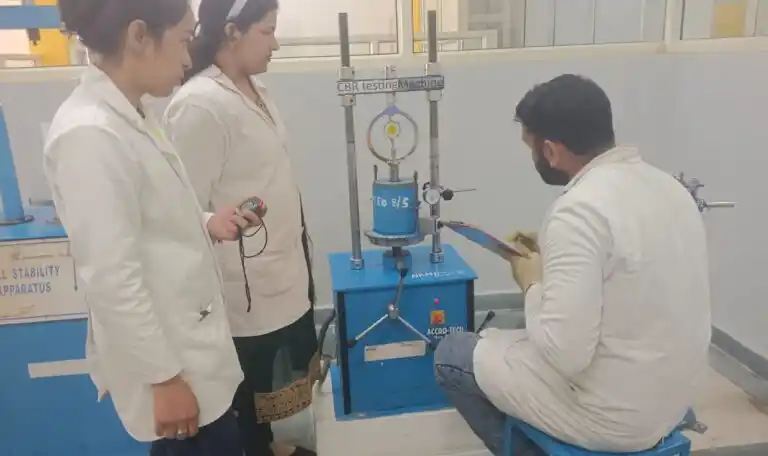
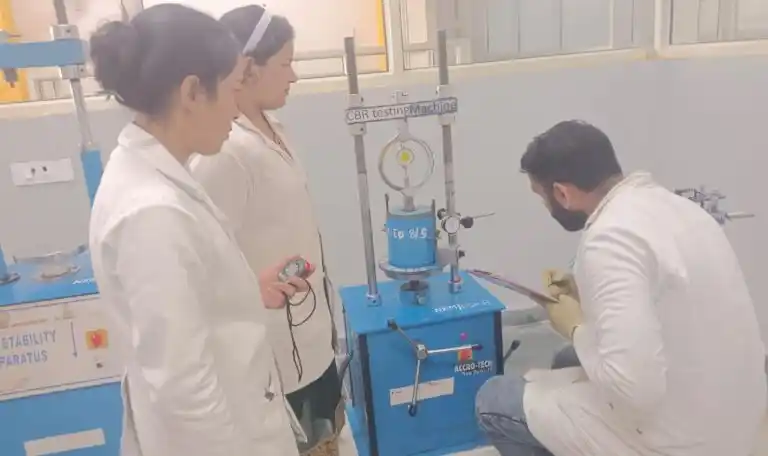
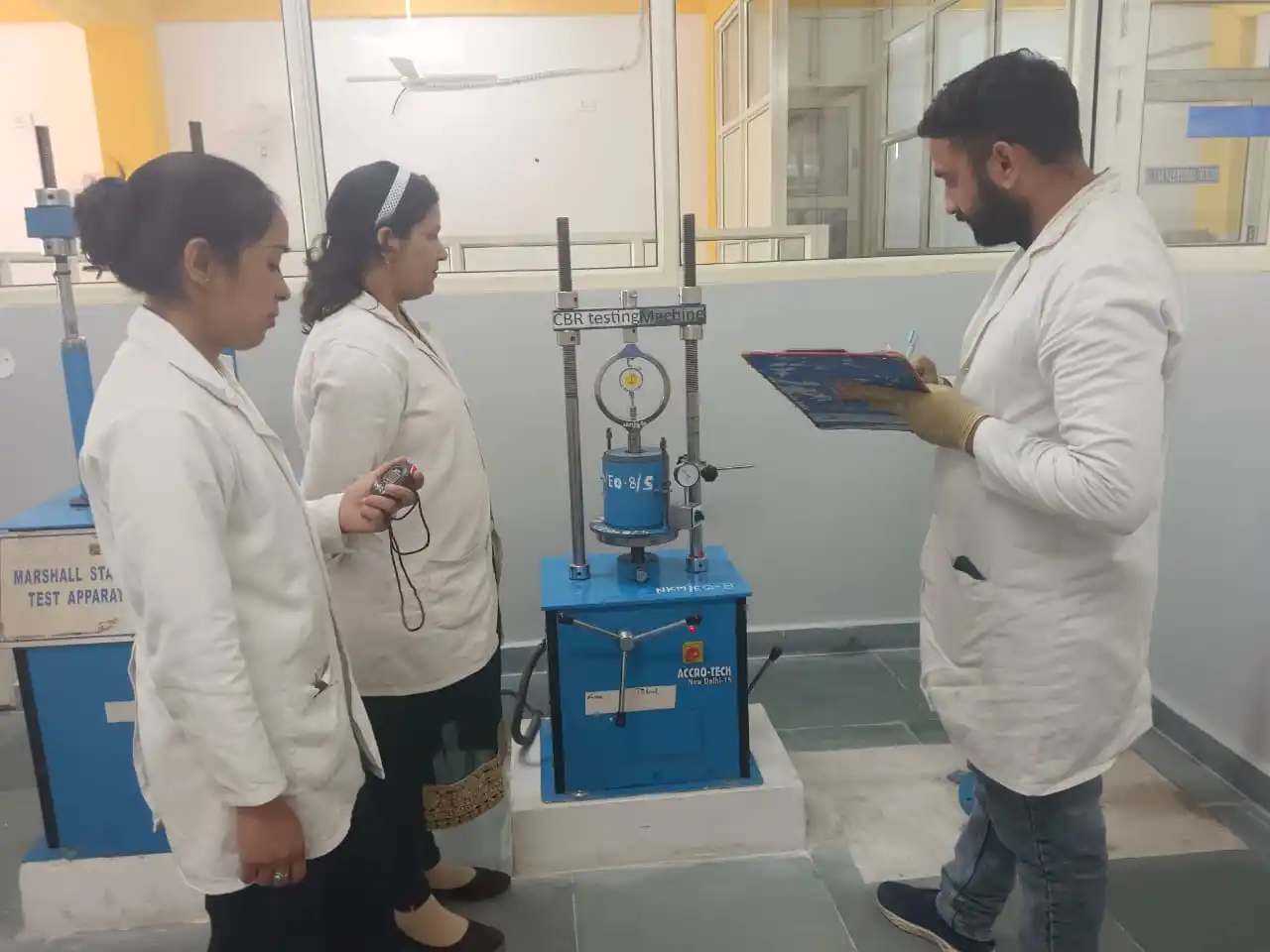
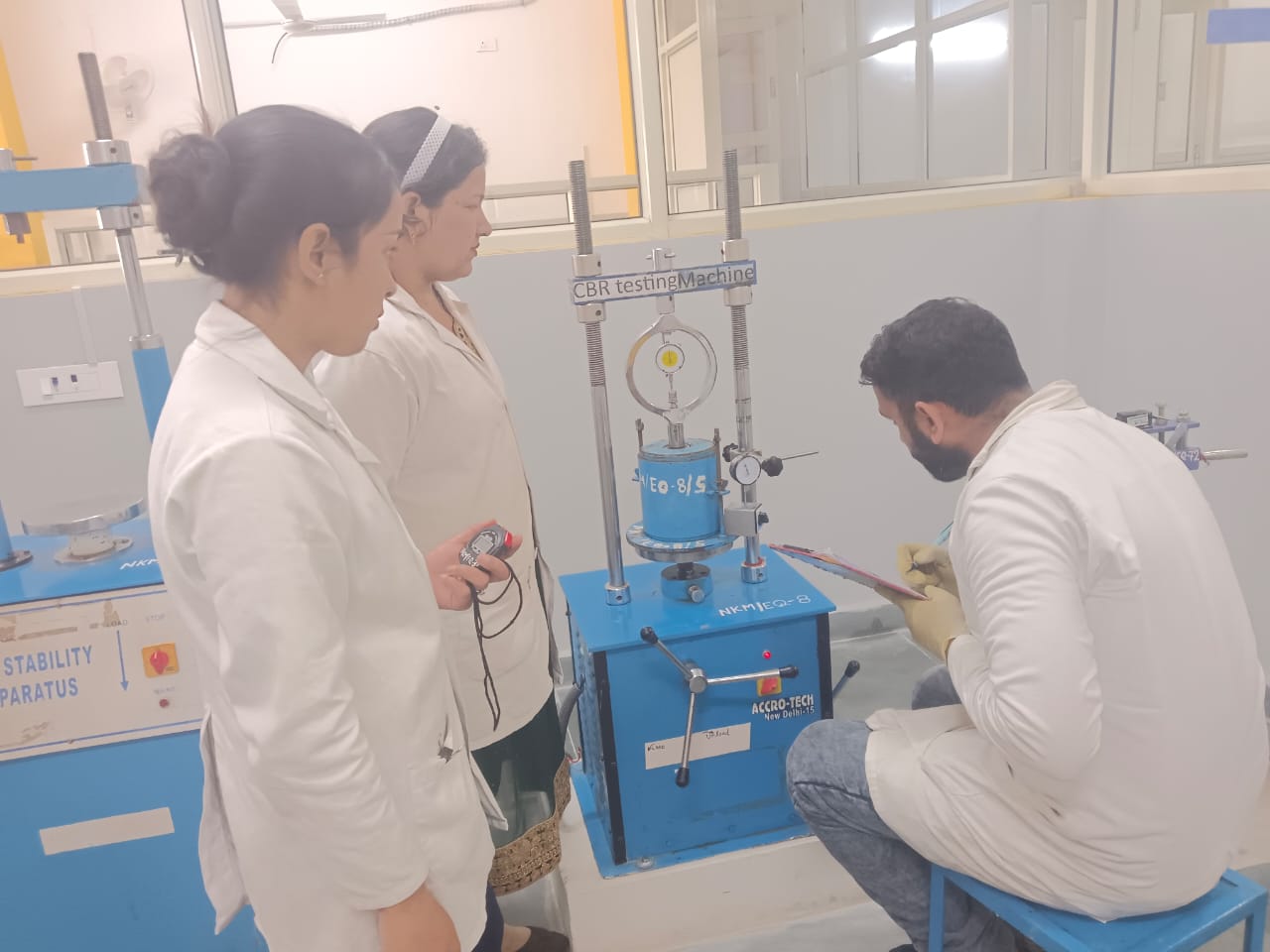
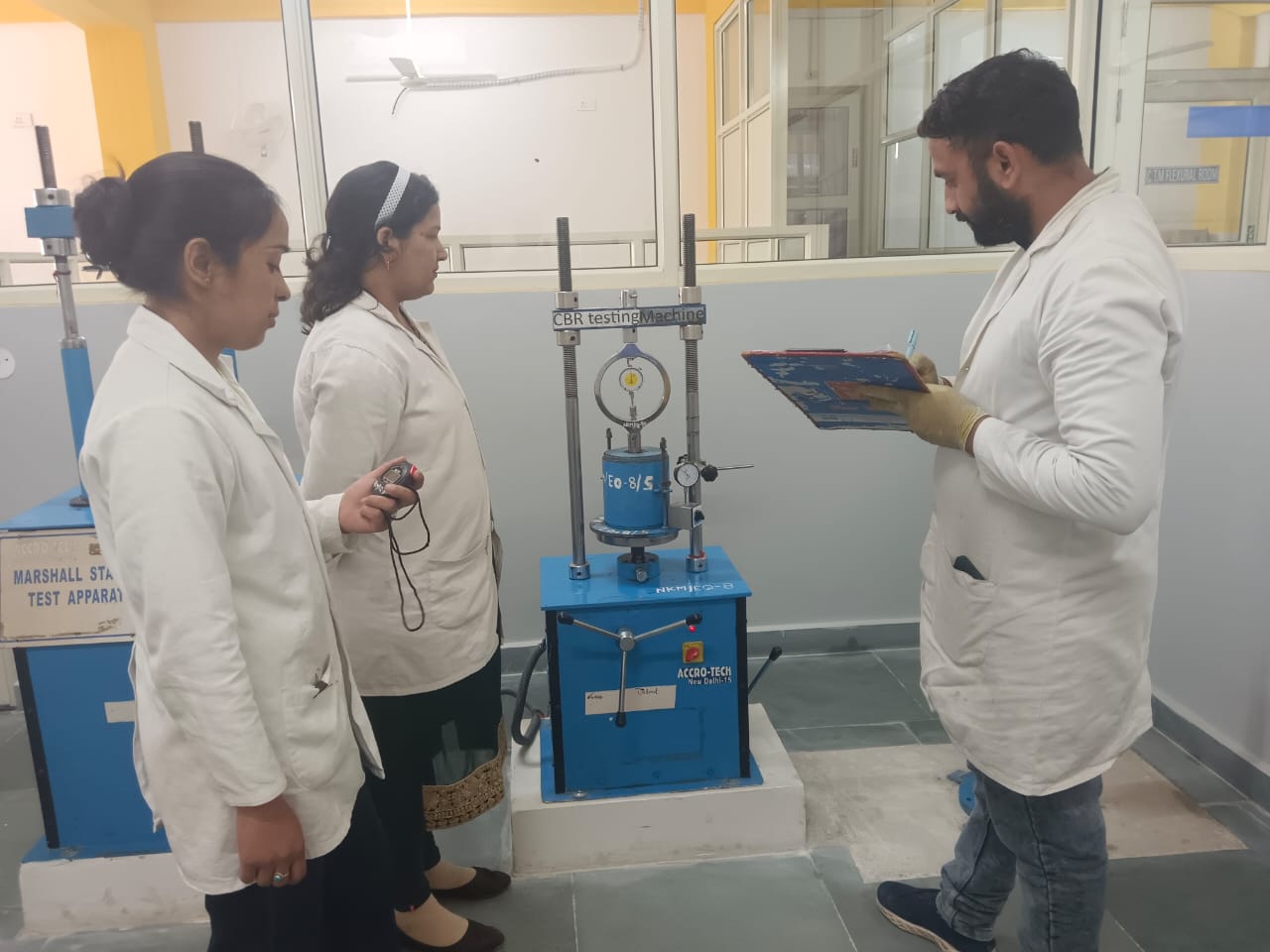

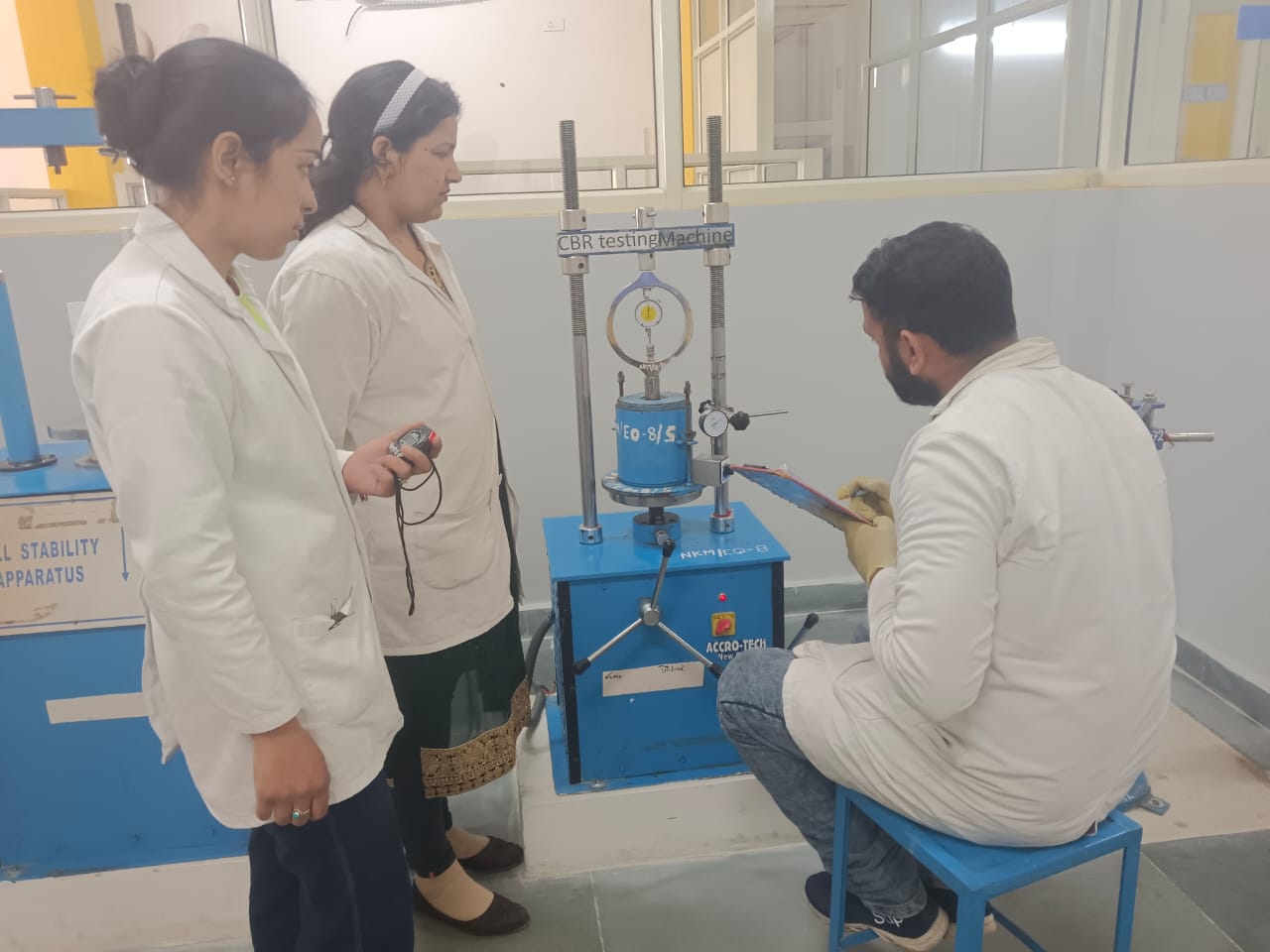
Our CBR test reports carry NABL accreditation (ISO/IEC 17025:2017), making them accepted by NHAI, state PWDs, courts, and arbitration tribunals without additional verification.
Our field technicians collect soil samples directly from your project site across Punjab, Haryana, and Himachal Pradesh, ensuring representative sampling as per IS code procedures.
We routinely perform MDD/OMC, grain size analysis, Atterberg limits, and free swell index alongside CBR — giving you a complete subgrade characterisation in a single engagement.
Our soaking tank accommodates 12 specimens simultaneously, allowing us to process multiple chainage points in a single 4-day soaking cycle — faster results for large highway projects.
Every CBR report includes load-penetration curves, corrected CBR values at both 2.5 mm and 5.0 mm penetration, dry density achieved, moisture content, and swell data — everything your pavement designer needs.
The California Bearing Ratio (CBR) test per IS 2720 Part 16:1987 measures the resistance of compacted soil to penetration by a standard plunger, expressed as a percentage of the resistance offered by a standard crushed stone. CBR (%) = (Test Load / Standard Load) × 100. The test is the primary input to IRC 37 flexible pavement design — CBR value of the sub-grade determines the required pavement thickness. Sample is compacted in a 150 mm diameter mould to the design MDD at OMC, optionally soaked for 96 hours (representing the most adverse moisture condition), and penetrated at 1.25 mm/min. CBR is read at 2.5 mm and 5.0 mm penetration; the higher value is reported.
Typical soaked CBR values from Indian highway practice: Sandy soils (SP, SM): CBR 8–15%; Silty soils (ML, MH): CBR 3–8%; Lean clay (CL): CBR 2–7%; Fat clay (CH): CBR 1–4%; Black cotton soil: CBR <3% (often requires sub-grade replacement or lime stabilisation); Well-graded GSB: CBR 30–50%; WMM base course: CBR 60–80%. Per IRC 37, sub-grade with CBR < 4% requires improvement before pavement construction; CBR ≥ 8% is preferred. Sub-base CBR must be ≥30%, base CBR ≥80% as per MoRTH Section 401.
Unsoaked CBR tests the sample at its compaction moisture content (OMC). Quick result, used for early-stage feasibility studies. Soaked CBR (4-day soaking) simulates the worst-case moisture condition — sample is immersed in water with the surcharge weight in place for 96 hours before penetration testing. Soaked CBR is typically 30–60% lower than unsoaked for cohesive soils. IRC 37 and MoRTH specifications mandate soaked CBR for all pavement design work because pavements must perform under monsoon-saturated conditions. Use unsoaked only for cohesionless soils (no significant difference) or initial reconnaissance.
A complete soaked CBR test takes 7–10 working days: Day 1 — sample preparation, OMC/MDD determination (IS 2720 Part 7 or Part 8), compaction of CBR specimens. Days 2–5 — 96-hour soaking with surcharge in place; daily swell readings (IS 2720 Part 16). Day 5 — penetration test at 1.25 mm/min, CBR computation. Days 6–8 — NABL-accredited report preparation with CBR curves, IS classification, and IRC 37 design recommendation. Unsoaked CBR can be completed in 3–4 working days. NKMPV runs CBR with NABL accreditation (TC-14144) — reports accepted by NHAI, state PWDs, and World Bank-funded projects.
Coverage
Wherever your project is, there are two ways to work with NKMPV on CBR Test.
For field work, our engineers and instruments mobilise anywhere in India — highway corridors, bridges, plants and greenfield alignments included.
Distance is not a constraint for laboratory testing. Send samples to our Pinjore laboratory and receive the digital report on completion — the route most of our out-of-region clients use.
These are locations where we have completed projects — not the boundary of our service area. We mobilise across India on request. See full coverage & project locations →
CBR Test is carried out to IS 2720 Part 16, IS 2720 Part 8, IRC 37:2018 and MoRTH 5th Revision, as listed in the Applicable Standards section of this page. Tell us the specification your project must comply with and the quotation will state the standard the work follows.
Our laboratory is at Pinjore, Haryana, within same-day reach of Chandigarh, Panchkula, Mohali, Ambala and the wider Tri-City. If you are further away, distance is not a constraint: our field team travels to site anywhere in India for on-site work, and for laboratory tests you can courier samples to the Pinjore lab and receive the report digitally. Clients across Punjab, Haryana, Himachal Pradesh, Delhi-NCR, Uttarakhand, Rajasthan, Uttar Pradesh, Jammu and Kashmir and Ladakh already work with us this way.
Yes. NKMPV operates pan-India. We have delivered projects across Chandigarh, Panchkula, Mohali, Ambala, Karnal, Kurukshetra, Yamunanagar, Hisar and beyond, and we mobilise to greenfield and remote corridors on request. The 18 locations listed on our site are the places we have already worked — not the limit of where we go.
Send us the project details — location, quantity, and the standard you need to comply with — and you get a written quotation, usually within one working day. Pricing depends on sample count, site access and mobilisation distance, so we quote per project rather than publishing a fixed rate. Call +91-82953-60108 or use the quote form; every quotation states the applicable IS/IRC standard.
Need CBR Test for your project?