
Our team travels to your site
For field work, our engineers and instruments mobilise anywhere in India — highway corridors, bridges, plants and greenfield alignments included.
GSB and WMM mix design to MoRTH Clauses 401 and 404 — gradation, CBR, abrasion and plasticity of fines for granular sub-base and base layers
GSB = Granular Sub-Base and WMM = Wet Mix Macadam — unbound granular pavement layers laid above the subgrade. Their gradation, density and CBR requirements follow MoRTH Section 401 (GSB) and Section 406 (WMM). NKMPV designs and tests GSB and WMM mixes in a NABL-accredited laboratory.
GSB (Granular Sub-Base) and WMM (Wet Mix Macadam) mix design is the laboratory process of proportioning and verifying aggregate blends to meet MoRTH grading and strength requirements for pavement sub-base and base layers. A properly designed GSB/WMM mix ensures structural adequacy, effective drainage, and long-term pavement performance.
The following parameters are evaluated during GSB and WMM mix design. Acceptance criteria are drawn from MoRTH 5th Revision Section 400 and IRC SP 89. All individual aggregate tests are performed per the relevant IS standards.
| Parameter | Value / Range | Unit | Standard |
|---|---|---|---|
| GSB Grading (Table 400.1) | Grading I to VI (close-graded and coarse-graded) | % passing | MoRTH Cl. 401.2.2 |
| WMM Grading (Table 400.4) | Single grading envelope (53 mm nominal max size) | % passing | MoRTH Cl. 404.2.3 |
| CBR of Blended GSB Material (Soaked) | ≥ 30% | % | MoRTH Cl. 401.2.1 |
| Los Angeles Abrasion Value | ≤ 40% (GSB), ≤ 40% (WMM) | % | MoRTH Cl. 401.2.1 / Cl. 404.2.2 |
| Plasticity Index of Fines | ≤ 6 (GSB), Non-plastic (WMM) | MoRTH Cl. 401.2.1 / Cl. 404.2.2 | |
| Liquid Limit of Fines | ≤ 25% | % | MoRTH Cl. 401.2.1 |
| Flakiness & Elongation Index (WMM) | ≤ 35% (combined) | % | MoRTH Cl. 404.2.2 |
| Maximum Dry Density (MDD) | Determined from Modified Proctor | g/cc | IS 2720 Part 8 |
| Field Compaction Requirement | ≥ 98% of lab MDD | % | MoRTH Cl. 401.5 / Cl. 404.3.4 |
Specifications for Road and Bridge Works — Section 400: Granular Sub-Base
Specifications for Road and Bridge Works — Section 400: Wet Mix Macadam
Guidelines for Soil and Granular Material Stabilisation Using Cement, Lime & Fly Ash
Methods of Test for Soils — Determination of Water Content-Dry Density Relation Using Heavy Compaction
Methods of Test for Aggregates for Concrete (Sieve Analysis, Abrasion, Impact, Shape)
Methods of Test for Soils — Laboratory Determination of CBR
Methods of Test for Soils — Determination of Liquid and Plastic Limit
AIMIL brass frame sieves (75 mm to 75 micron)
Full set: 75, 53, 45, 26.5, 19, 9.5, 4.75, 2.36, 0.425, 0.075 mm per MoRTH Table 400.1 / 400.4
CalibratedAIMIL AIM-481
300 mm diameter sieves, motorised with timer for 10-minute cycles
CalibratedAIMIL AIM-085
500 mm diameter drum, 30-33 RPM, with standard charge of steel balls per IS 2386 Part 4
CalibratedAIMIL AIM-304-1
50 kN capacity with motorised loading frame and proving ring
Calibrated4.89 kg rammer, 450 mm drop height, 150 mm mould
5-layer compaction at 56 blows per layer per IS 2720 Part 8
CalibratedCasagrande liquid limit device with grooving tool
For determining Liquid Limit, Plastic Limit, and Plasticity Index per IS 2720 Part 5
CalibratedStandard IS gauges (thickness and length)
For aggregate fractions 6.3 mm to 63 mm per IS 2386 Part 1
CalibratedRepresentative samples of each aggregate fraction are collected from the crusher or stockpile at the project hot mix plant or quarry site. Typically 3-4 fractions are sampled: coarse aggregate (53-26.5 mm, 26.5-9.5 mm), fine aggregate (crusher dust or natural sand), and filler (stone dust passing 0.075 mm). Each fraction requires approximately 50-60 kg for the full test program. Samples are bagged, labelled with source and fraction size, and transported to the laboratory.
Each aggregate fraction is dried to constant weight and subjected to sieve analysis using the full IS sieve set per IS 2386 Part 1. The gradation curve of each fraction is plotted. Simultaneously, aggregate quality tests are initiated — Los Angeles Abrasion value (IS 2386 Part 4), Aggregate Impact Value, Flakiness and Elongation Index (IS 2386 Part 1), Water Absorption, and Specific Gravity. For fines, Liquid Limit and Plastic Limit are determined per IS 2720 Part 5.
Using the individual gradation data, a trial-and-error or analytical blending approach is used to determine the proportions of each fraction that produce a combined gradation falling within the target MoRTH envelope. For GSB, the blend is checked against Table 400.1 (Grading I through VI as specified by the project). For WMM, the blend must satisfy the single grading envelope of Table 400.4. Multiple trial blends are evaluated until the optimum proportions are established.
The blended aggregate at the designed proportions is subjected to Modified Proctor compaction testing per IS 2720 Part 8. The material is compacted in a 150 mm mould in 5 layers with 56 blows per layer at varying moisture contents. The Maximum Dry Density (MDD) and Optimum Moisture Content (OMC) are determined from the compaction curve. These values establish the field compaction target — MoRTH requires a minimum 98% of laboratory MDD.
For GSB mix design, the blended material at OMC is compacted in CBR moulds and subjected to 4-day soaking per IS 2720 Part 16. After soaking, penetration testing is performed to determine the soaked CBR value. MoRTH Clause 401 requires the blended GSB material to have a minimum soaked CBR of 30%. If the CBR falls short, the blend proportions are adjusted and retested.
The final mix design report includes: individual and combined gradation charts showing the blend within the MoRTH envelope, blending proportions by weight, aggregate quality test results (LA Abrasion, Flakiness, Plasticity Index, Water Absorption), compaction parameters (MDD and OMC), CBR results (for GSB), and field mixing instructions. The report is issued as a signed document with recommendations for crusher settings and stockpile management.
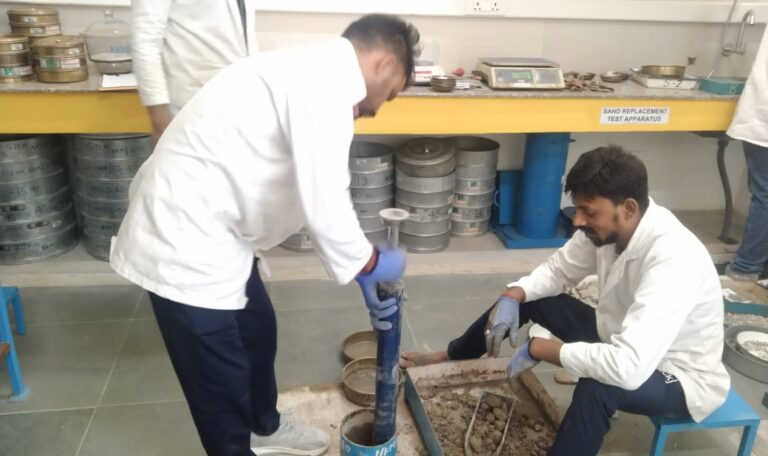


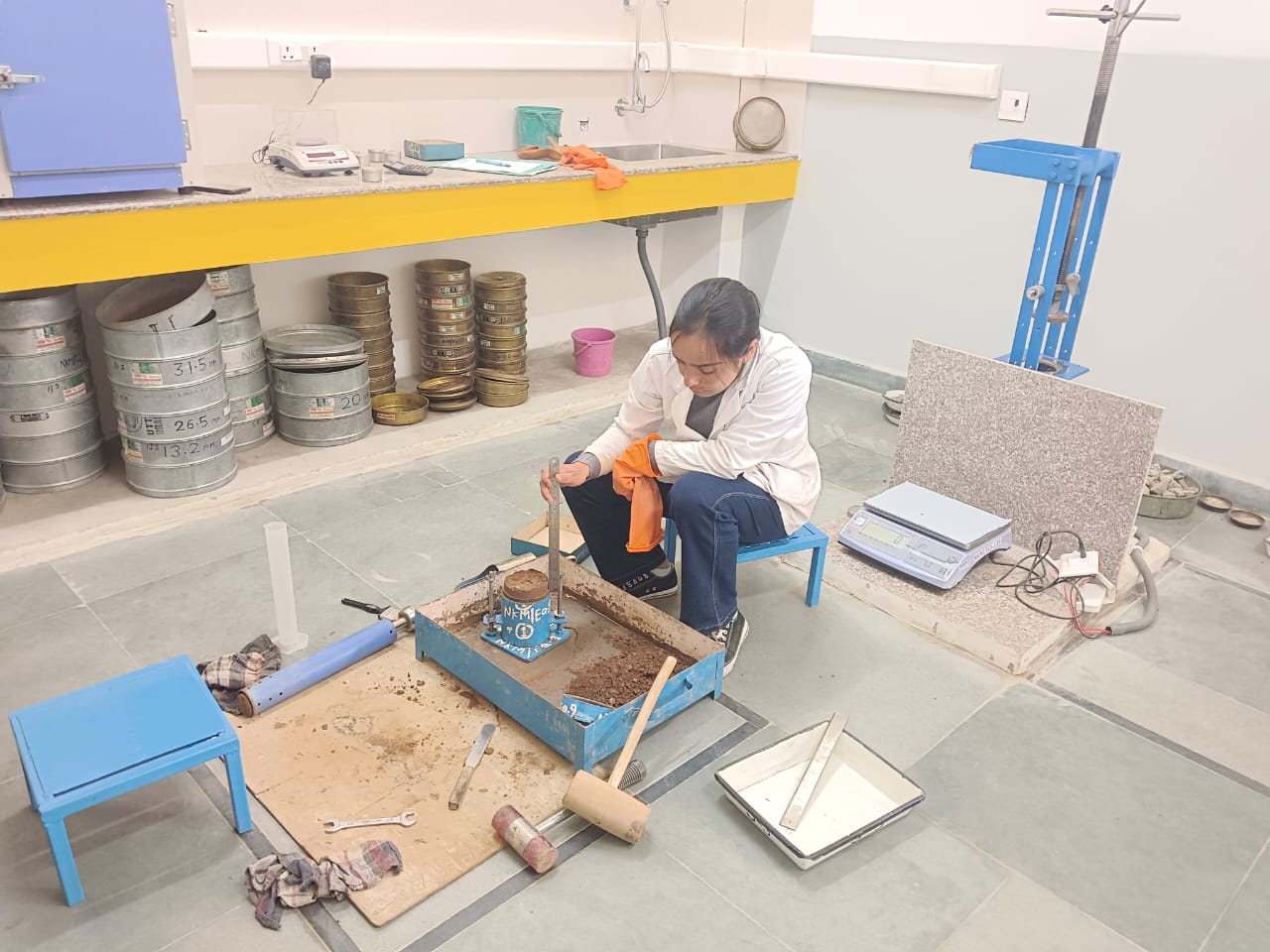

Our GSB and WMM mix design reports carry NABL accreditation (ISO/IEC 17025:2017), accepted by NHAI, state PWDs, and independent design consultants as the basis for layer construction approval.
Every mix design includes the full suite of aggregate quality tests — sieve analysis, LA Abrasion, Impact Value, Flakiness Index, Water Absorption, Specific Gravity, and Atterberg Limits — all performed in-house at our Pinjore laboratory.
We design mixes that are achievable with your actual crusher output and locally available materials. Our engineers optimise blending proportions considering your stockpile fractions, minimising wastage and ensuring site-implementable designs.
CBR testing of the blended GSB material and Modified Proctor compaction parameters are included as part of the mix design package — no need for separate engagements or labs.
If material source changes during construction, we provide rapid re-evaluation and revised mix design within 5 working days, ensuring minimum disruption to your project schedule.
GSB (Granular Sub-Base) per MoRTH Section 401 is the lower granular layer of flexible pavement — a well-graded mix of natural or crushed aggregate (25-37.5 mm max size), placed directly on the sub-grade. Provides drainage, working platform, and load distribution. CBR ≥30%, max liquid limit 25, max PI 6. Typical layer thickness 200-300 mm. WMM (Wet Mix Macadam) per MoRTH Section 406 is the upper granular layer — a more rigorously graded mix of crushed aggregate only (40 mm max size, no natural sand), mixed with optimum water and placed in 75-100 mm compacted layers. CBR ≥80%, aggregate impact value ≤30. Higher strength, lower voids than GSB. Together they form the granular base for flexible pavement under IRC 37.
GSB gradation (MoRTH 401.2.1.1, Grading-II envelope): 100% passing 53 mm, 65-95% through 26.5 mm, 50-80% through 9.5 mm, 25-55% through 2.36 mm, 5-30% through 425 μm, 1-10% through 75 μm. WMM gradation (MoRTH 406.2.1.1): 100% passing 53 mm, 95-100% through 45 mm, 65-90% through 22.4 mm, 30-50% through 4.75 mm, 10-20% through 600 μm, <5% through 75 μm. Both envelopes are precisely specified to balance compactability with strength and drainage. Trial proportioning determines the blend of available aggregate fractions to meet the envelope — this is the core of GSB/WMM mix design.
GSB/WMM mix design per MoRTH 401/406: (1) Aggregate source acceptance — IS 2386 tests (impact value, water absorption, los angeles abrasion, flakiness index) on each aggregate fraction (typically 40-20, 20-10, 10-down, dust). (2) Gradation envelope check — sieve analysis at agreed proportions; iterate proportions until the combined gradation falls within MoRTH envelope. (3) Plasticity check on fines — for GSB, ensure passing 425 μm fraction LL ≤25, PI ≤6. (4) Modified Proctor per IS 2720 Part 8 — determine OMC and MDD. (5) Soaked CBR per IS 2720 Part 16 — verify ≥30% (GSB) or ≥80% (WMM). (6) Field control parameters — mixing water tolerance, compaction roller pass count. Deliverable in 7-10 working days.
Coverage
Wherever your project is, there are two ways to work with NKMPV on GSB and WMM Mix Design.
For field work, our engineers and instruments mobilise anywhere in India — highway corridors, bridges, plants and greenfield alignments included.
Distance is not a constraint for laboratory testing. Send samples to our Pinjore laboratory and receive the digital report on completion — the route most of our out-of-region clients use.
These are locations where we have completed projects — not the boundary of our service area. We mobilise across India on request. See full coverage & project locations →
GSB and WMM Mix Design is carried out to MoRTH 5th Revision — Cl. 401, MoRTH 5th Revision — Cl. 404, IRC SP 89:2018 and IS 2720 Part 8, as listed in the Applicable Standards section of this page. Tell us the specification your project must comply with and the quotation will state the standard the work follows.
Our laboratory is at Pinjore, Haryana, within same-day reach of Chandigarh, Panchkula, Mohali, Ambala and the wider Tri-City. If you are further away, distance is not a constraint: our field team travels to site anywhere in India for on-site work, and for laboratory tests you can courier samples to the Pinjore lab and receive the report digitally. Clients across Punjab, Haryana, Himachal Pradesh, Delhi-NCR, Uttarakhand, Rajasthan, Uttar Pradesh, Jammu and Kashmir and Ladakh already work with us this way.
Yes. NKMPV operates pan-India. We have delivered projects across Chandigarh, Panchkula, Mohali, Ambala, Karnal, Kurukshetra, Yamunanagar, Hisar and beyond, and we mobilise to greenfield and remote corridors on request. The 18 locations listed on our site are the places we have already worked — not the limit of where we go.
Send us the project details — location, quantity, and the standard you need to comply with — and you get a written quotation, usually within one working day. Pricing depends on sample count, site access and mobilisation distance, so we quote per project rather than publishing a fixed rate. Call +91-82953-60108 or use the quote form; every quotation states the applicable IS/IRC standard.
Need GSB and WMM Mix Design for your project?