
Maximum Dry Density and Optimum Moisture Content (Proctor Test)
Compaction control parameters for earthwork, embankments, and subgrade construction
What is MDD and OMC in soil testing?
MDD stands for Maximum Dry Density and OMC for Optimum Moisture Content — the moisture content at which a soil reaches its maximum dry density for a given compaction effort. Both are found together by the Proctor compaction test: IS 2720 (Part 7) for light (standard) and IS 2720 (Part 8) for heavy (modified) compaction. NKMPV performs the MDD–OMC test in a NABL-accredited laboratory.
The Maximum Dry Density (MDD) and Optimum Moisture Content (OMC) test, commonly known as the Proctor test, establishes the relationship between soil dry density and moisture content under controlled compaction. It determines the exact moisture level at which a given soil achieves its highest possible density — the two values that govern every earthwork compaction specification in India.
What Is the Maximum Dry Density and Optimum Moisture Content (Proctor) Test?
Test Parameters & Acceptance Criteria
The following parameters are determined and reported during the Proctor compaction test. Acceptance criteria for field compaction typically reference MDD values from these laboratory tests. Specific compaction requirements vary by project — MoRTH, IRC, and state PWD specifications are the most common references.
| Parameter | Value / Range | Unit | Standard |
|---|---|---|---|
| Maximum Dry Density (MDD) — Standard Proctor | 1.4 - 2.1 (depending on soil type) | g/cc | IS 2720 Part 7 |
| Maximum Dry Density (MDD) — Modified Proctor | 1.6 - 2.3 (depending on soil type) | g/cc | IS 2720 Part 8 |
| Optimum Moisture Content (OMC) — Standard Proctor | 8 - 25 (depending on soil type) | % | IS 2720 Part 7 |
| Optimum Moisture Content (OMC) — Modified Proctor | 6 - 20 (depending on soil type) | % | IS 2720 Part 8 |
| Field Compaction Requirement (Embankment) | ≥ 95% of lab MDD | % | MoRTH 5th Rev. Cl. 305.3 |
| Field Compaction Requirement (Subgrade) | ≥ 97% of lab MDD | % | MoRTH 5th Rev. Cl. 305.3 |
| Degree of Compaction | Field dry density / Lab MDD x 100 | % | IS 2720 Part 28/29 |
| Mould Size (Standard/Modified) | 100 mm dia or 150 mm dia based on particle size | mm | IS 2720 Part 7/8 |
Applicable Indian Standards
Methods of Test for Soils — Determination of Water Content-Dry Density Relation Using Light Compaction (Standard Proctor)
Methods of Test for Soils — Determination of Water Content-Dry Density Relation Using Heavy Compaction (Modified Proctor)
Methods of Test for Soils — Determination of Dry Density of Soils In-Place by the Core Cutter Method
Methods of Test for Soils — Determination of Dry Density of Soils In-Place by the Sand Replacement Method
Specifications for Road and Bridge Works — Section 300 (Earthwork) and Section 305 (Compaction Requirements)
Methods of Test for Soils — Determination of Water Content (Oven Drying Method)
Equipment Used
Proctor Mould (100 mm diameter)
AIMIL standard pattern
1000 cc volume, 100 mm internal diameter x 127.3 mm height, with detachable base plate and collar
CalibratedProctor Mould (150 mm diameter)
AIMIL standard pattern
2250 cc volume, 150 mm internal diameter x 127.3 mm height, for soils with particles up to 40 mm
CalibratedLight Compaction Rammer (Standard Proctor)
IS pattern, 2.6 kg
2.6 kg rammer, 310 mm free-fall height, 25 blows per layer in 3 layers per IS 2720 Part 7
CalibratedHeavy Compaction Rammer (Modified Proctor)
IS pattern, 4.89 kg
4.89 kg rammer, 450 mm free-fall height, 56 blows per layer in 5 layers per IS 2720 Part 8
CalibratedThermostatically Controlled Oven
EIE Instruments
Maintains 105-110 degrees Celsius for moisture content determination, capacity for 20+ samples simultaneously
CalibratedElectronic Weighing Balances
Essae DS-852 and DS-252
15 kg (least count 0.1 g) and 30 kg (least count 1 g), NABL calibrated
CalibratedSample Extruder
Hydraulic, AIMIL pattern
For extracting compacted specimen from the mould without disturbing the sample
CalibratedTesting Process
Sample Collection & Preparation
Day 1 (2-4 hours)Approximately 20-25 kg of representative disturbed soil is collected from the project site at the required depth. Upon receipt at our Pinjore laboratory, the soil is air-dried, pulverised using a wooden mallet (without breaking individual grains), and sieved through a 19 mm IS sieve for the 150 mm mould or a 4.75 mm sieve for the 100 mm mould. The appropriate mould size is selected based on the maximum particle size present in the sample.
Initial Moisture Content Determination
Day 1 (overnight oven-drying for moisture content)The natural moisture content of the received sample is determined by oven-drying a sub-sample at 105-110 degrees Celsius per IS 2720 Part 2. This baseline value helps in planning the range of moisture contents for the compaction trials. A minimum of five sub-samples at different moisture levels (typically spanning OMC minus 6% to OMC plus 6%) are prepared by adding calculated quantities of water and mixing thoroughly.
Compaction at Varying Moisture Contents
Day 1-2 (30-45 minutes per specimen, 5-6 specimens total)For Standard Proctor (IS 2720 Part 7), each sub-sample is compacted in the mould in 3 layers with 25 blows per layer using the 2.6 kg rammer falling from 310 mm. For Modified Proctor (IS 2720 Part 8), compaction is in 5 layers with 56 blows per layer using the 4.89 kg rammer falling from 450 mm. After compaction, the collar is removed, the soil is trimmed flush with the mould top, and the mould with soil is weighed. A sub-sample is taken from the centre of the compacted specimen for moisture content determination.
Moisture Content Determination of Each Specimen
Day 2 (overnight oven-drying)The representative sub-samples extracted from each compacted specimen are placed in pre-weighed moisture tins and dried in the oven at 105-110 degrees Celsius for a minimum of 16-24 hours until constant mass is achieved. The moisture content of each specimen is then calculated as the ratio of mass of water to mass of dry soil, expressed as a percentage.
Compaction Curve Plotting & MDD/OMC Determination
Day 2-3 (1-2 hours)Dry density for each specimen is calculated from the bulk density and moisture content. A graph is plotted with moisture content on the x-axis and dry density on the y-axis. A smooth curve is drawn through the data points. The peak of this curve gives the Maximum Dry Density (MDD), and the corresponding moisture content at the peak is the Optimum Moisture Content (OMC). The zero-air-void line is also plotted as a theoretical upper bound for reference.
NABL-Accredited Report Generation
Day 3The final test certificate includes the compaction curve plot, tabulated density and moisture content data for each specimen, MDD value (g/cc), OMC value (%), soil description, method used (Standard or Modified Proctor), and mould size. Reports are issued under NABL accreditation with unique certificate numbers and delivered as digitally signed PDFs. Hard copies are dispatched on request. Results are typically used alongside field density test reports for compaction compliance verification.
Where This Test Is Used
Detailed Information
Theoretical Background
2.1 Maximum Dry Density (MDD) MDD represents the highest achievable density of soil under specific compaction energy while maintaining a dry condition. It signifies the point at which soil particles are packed most efficiently, with minimal voids between them. Achieving MDD is crucial for ensuring that the soil can support structural loads without significant deformation. 2.2 Optimum Moisture Content (OMC) OMC is the moisture level at which MDD occurs. Adding water to dry soil reduces friction between particles, making them easier to compact. However, beyond a certain moisture level, the excess water acts as a lubricant, reducing the dry density. OMC provides the ideal balance between moisture and compaction energy for maximum efficiency. 2.3 Relationship Between MDD and OMC The relationship between MDD and OMC is typically represented by a compaction curve. The curve shows that dry density increases with moisture content until it peaks at OMC, after which it decreases due to the lubricating effect of excess water. This relationship is critical for understanding soil behavior and optimizing field compaction processes. 2.4 Importance of MDD and OMC in Construction- Load-bearing capacity:Ensuring adequate compaction reduces the risk of foundation settlement.
- Seepage control:Properly compacted soil has low permeability, which prevents water infiltration in earth structures like dams.
- Slope stability:In embankments and slopes, achieving MDD reduces the likelihood of slope failure.
Principles of Soil Compaction
Soil compaction involves applying mechanical energy to reduce the air voids within soil, thereby increasing its density. Unlike consolidation, which is a time-dependent process caused by water expulsion under a load, compaction is instantaneous and involves the rearrangement of soil particles. 3.1 Types of Soil Compaction- Static Compaction:Achieved by applying a heavy load over the soil surface.
- Dynamic Compaction:Involves dropping a heavy object or using vibratory rollers to compact soil.
- Impact Compaction:Utilizes mechanical rammers to compact soil in small areas.
- Kneading Compaction:Involves shearing and kneading actions, commonly used for cohesive soils.
- Reduces compressibility, minimizing long-term settlement.
- Improves shear strength, enhancing stability under load.
- Prevents soil erosion by reducing permeability.
Laboratory Determination
4.1 Proctor Test Overview The Proctor test, developed by R.R. Proctor in the 1930s, remains the most widely used method for determining MDD and OMC. Two variations are commonly employed:- Standard Proctor Test:Uses a 2.5 kg rammer dropped from a height of 30 cm, suitable for general construction projects.
- Modified Proctor Test:Utilizes a 4.5 kg rammer dropped from a height of 45 cm, simulating higher compaction energy required for heavy-duty constructions.
- A cylindrical mold with a detachable base (volume: 1000 cm³ or 0.001 m³).
- A rammer with a flat circular face.
- A balance accurate to 0.01g.
- Drying oven, mixing tools, and graduated cylinders for water measurement.
- Sample Preparation:
- Collect a representative soil sample and dry it in an oven at 105°C.
- Sieve the soil to remove particles larger than 4.75 mm.
- Adding Water:
- Gradually add water to the soil to achieve different moisture levels.
- Mix thoroughly to ensure uniform moisture distribution.
- Compaction:
- Fill the mold in three equal layers.
- Compact each layer using the rammer with 25 evenly distributed blows.
- Remove excess soil and weigh the compacted sample.
- Calculation of Dry Density:
- Compute bulk density (ρb\rho_bρb) as: ρb=Mass of compacted soilVolume of mold\rho_b = \frac{\text{Mass of compacted soil}}{\text{Volume of mold}}ρb=Volume of moldMass of compacted soil
- Calculate dry density (ρd\rho_dρd) as: ρd=ρb1+w\rho_d = \frac{\rho_b}{1 + w}ρd=1+wρb where www is the moisture content.
- Graphical Analysis:
- Plot dry density against moisture content to identify MDD and OMC.
- Use consistent compaction energy for all samples.
- Avoid over-drying or over-wetting the soil.
- Ensure proper calibration of equipment.
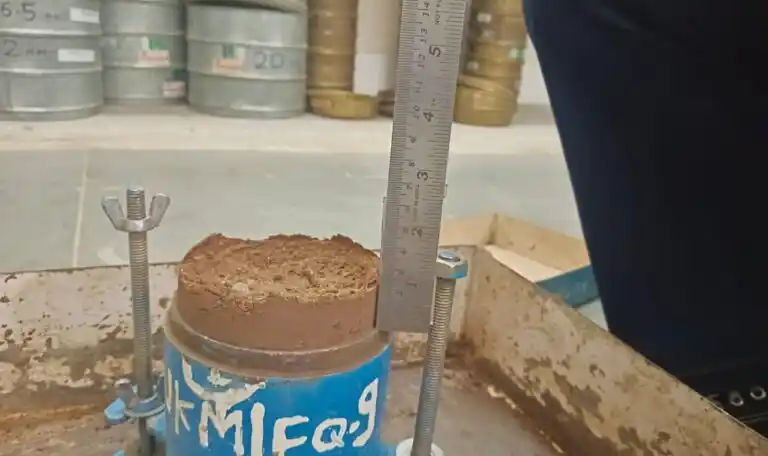
Analysis and Results
The results of the Proctor test are presented as a compaction curve. The key observations include:- Peak Dry Density:Indicates the MDD, achieved at OMC.
- Shape of the Curve:Steeper curves are typical for coarse-grained soils, while flatter curves indicate fine-grained soils.
- Soil Type Influence:
- Sandy soils exhibit higher MDD and lower OMC.
- Clayey soils display lower MDD and higher OMC due to their plasticity and water retention characteristics.
Factors Influencing MDD and OMC
6.1 Soil Type- Granular Soils:Achieve higher MDD due to low water absorption and easy rearrangement of particles.
- Cohesive Soils:Require higher OMC to achieve adequate lubrication for compaction.
Applications in Engineering
7.1 Earthworks and Embankments In highway and railway projects, achieving MDD ensures that the subgrade can support vehicular and train loads without excessive deformation. 7.2 Dams and Levees Compaction to MDD minimizes seepage and ensures the stability of water-retaining structures. 7.3 Pavements and Airfields Runways and roads require high compaction levels to prevent rutting and cracking under traffic loads. 7.4 Foundation Stability Compaction improves the bearing capacity of the soil, ensuring safe load transfer from superstructures to the ground.Relevant Standards and Codes
8.1 ASTM Standards- ASTM D698:Standard Proctor Test.
- ASTM D1557:Modified Proctor Test for higher compaction energy.
- IS 2720 (Part 7):Specifies the procedure for the Standard Proctor Test.
- IS 2720 (Part 8):Describes the Modified Proctor Test.
- IS 2720 (Part 17):Details methods for calculating compaction energy.
Benefits of MDD and OMC Testing
Understanding the Maximum Dry Density (MDD) and Optimum Moisture Content (OMC) through laboratory testing provides numerous advantages, which directly impact the quality and longevity of engineering projects. These benefits can be categorized into technical, economic, and environmental aspects, making MDD and OMC testing a cornerstone in geotechnical and civil engineering practices.- Example:In constructing retaining walls, achieving MDD ensures resistance against lateral forces from the soil behind the structure.
- Example:In highway construction, preventing uneven settlement ensures smooth road surfaces, reducing maintenance costs and improving user safety.
- Example:Airport runways, which bear heavy loads from aircraft, rely on soil compacted to MDD to ensure durability.
- Example:Earth dams and levees are designed using compacted soil to resist water seepage and erosion, ensuring their stability during floods.
- Example:During road construction, field density tests such as the sand cone method are used to compare with laboratory-determined MDD values, ensuring compliance with project standards.
- Example:In landfill construction, compacted soil layers act as barriers, preventing leachate from contaminating groundwater.
- Example:Efficient water usage during compaction in arid regions is critical, and OMC testing helps avoid unnecessary wastage.
- Example:Foundations of buildings in earthquake-prone areas are compacted to MDD to ensure they remain stable during seismic activity.
- Example:Railways and highways compacted to MDD experience less rutting and cracking, lowering the frequency of maintenance.
- Example:The choice of equipment and compaction energy for constructing a dam embankment is determined based on MDD and OMC results.
- Example:In slope stabilization projects, achieving the right compaction reduces soil erosion, preserving nearby ecosystems.
- Example:Sandy soils may require less moisture and energy for compaction, whereas clayey soils demand higher moisture levels and compaction energy.
Conclusion
The determination of Maximum Dry Density (MDD) and Optimum Moisture Content (OMC) is an indispensable part of soil mechanics and geotechnical engineering. These parameters play a pivotal role in ensuring the stability, strength, and longevity of soil-based structures. Through laboratory testing methods such as the Proctor test, engineers can simulate field conditions and derive critical compaction characteristics that guide the design and execution of construction projects. MDD and OMC testing offer a wide range of benefits, including enhanced structural stability, reduced settlement, increased load-bearing capacity, and improved construction quality control. These advantages translate directly into safer, more durable infrastructure and cost-effective project management. By achieving the desired compaction, engineers can prevent potential issues such as foundation failure, erosion, and excessive deformation, which are common causes of project delays and increased maintenance costs. Moreover, understanding the relationship between MDD, OMC, and soil type allows for tailored solutions that meet the specific requirements of different engineering projects. Whether it is constructing highways, embankments, retaining walls, or earth dams, the data provided by MDD and OMC testing ensures the optimal performance of soil as a foundation material. Furthermore, adhering to standardized testing protocols, such as ASTM D698, ASTM D1557, and IS 2720, guarantees the reliability and reproducibility of results, fostering consistency in construction practices across diverse geographical regions. In conclusion, MDD and OMC testing represent the cornerstone of modern geotechnical engineering. Their integration into project planning and execution not only enhances the structural integrity of soil-based systems but also promotes environmental sustainability by optimizing resource utilization. For engineers and construction professionals, understanding and applying the principles of soil compaction is essential for achieving success in any project involving earthworks. By continuing to innovate and refine compaction techniques, the field of geotechnical engineering can meet the challenges of future infrastructure development with confidence and precision.- References
- ASTM D698 and D1557 Standards for Laboratory Compaction.
- IS 2720 Parts 7, 8, and 17 - Indian Standards for Soil Testing.
- Bowles, J. E. (1996). Foundation Analysis and Design. McGraw-Hill.
- Lambe, T. W., & Whitman, R. V. (1979). Soil Mechanics. Wiley.
- Terzaghi, K., Peck, R. B., & Mesri, G. (1996). Soil Mechanics in Engineering Practice. Wiley.
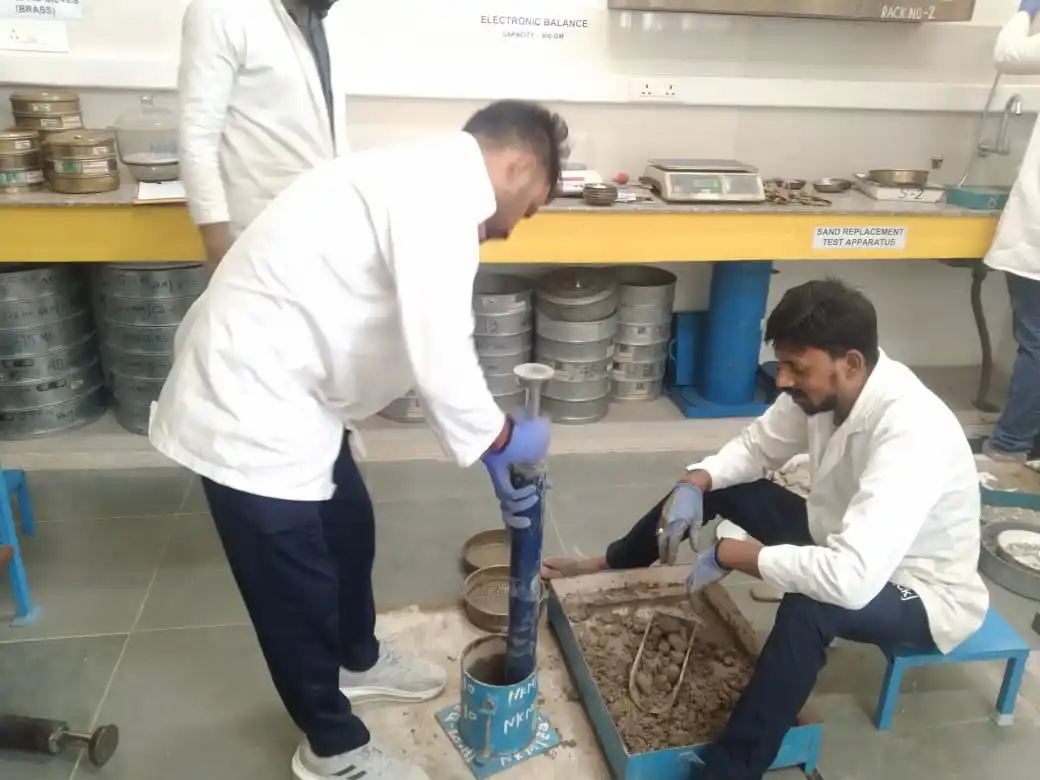
Photos & Lab Images
Why Choose NKMPV for MDD & OMC (Proctor) Testing?
NABL Accredited Results
Our MDD/OMC test reports carry NABL accreditation (ISO/IEC 17025:2017) and are accepted by NHAI, state PWDs, irrigation departments, and railway authorities without requiring additional verification.
Both Standard and Modified Proctor
We perform both IS 2720 Part 7 (Standard/Light Proctor) and IS 2720 Part 8 (Modified/Heavy Proctor) as required by your project specification. Most highway projects require Modified Proctor, while building sites may specify Standard Proctor — we cover both.
Companion Testing Package
We routinely pair MDD/OMC with CBR testing, grain size analysis, Atterberg limits, and natural moisture content determination — providing a complete soil characterisation package in a single engagement, saving you time and coordination effort.
Fast 2-3 Day Turnaround
With dedicated oven capacity for 20+ moisture content samples simultaneously and multiple Proctor mould sets, we process MDD/OMC tests efficiently. Standard turnaround is 2-3 working days from sample receipt, with rush processing available for urgent highway project deadlines.
Field Correlation Support
Our engineers understand that MDD/OMC results must correlate with field density tests. We ensure the same soil classification and preparation method is used consistently across Proctor and field density testing, giving you defensible compaction compliance data.
Frequently Asked Questions
MDD stands for Maximum Dry Density. It is the highest dry unit weight that a soil can attain through compaction at the Optimum Moisture Content (OMC), measured per IS 2720 Part 8 (Standard Proctor) or Part 7 (Modified Proctor). In road construction, the MDD value is the laboratory benchmark against which field compaction is checked — for example, an embankment specification of "95% compaction" means field dry density must reach 95% of the laboratory MDD. Without MDD, there is no quantitative way to verify that subgrade, sub-base, or base layers have been properly compacted.
IS 2720 Part 8 does not prescribe a fixed MDD value — the MDD of any given soil depends on its grain-size distribution, plasticity, and mineralogy and must be determined experimentally for each soil. Typical ranges observed in Indian highway practice are: well-graded gravelly soils: MDD 2.10–2.30 g/cc, silty sands and SM-SC: MDD 1.85–2.05 g/cc, lean clays (CL): MDD 1.60–1.85 g/cc, fat clays (CH): MDD 1.40–1.65 g/cc, and black cotton soils: MDD 1.30–1.55 g/cc. These ranges are indicative — actual MDD must be tested for the specific borrow source used in the project. IS 2720 Part 8 and IRC 36 require MDD/OMC to be re-tested whenever the borrow material changes.
Two IS codes govern the MDD/OMC determination: IS 2720 Part 7 (1980, reaffirmed 2011) for the Light Compaction (Standard Proctor) test using 2.6 kg rammer and 310 mm drop, and IS 2720 Part 8 (1983, reaffirmed 2015) for the Heavy Compaction (Modified Proctor) test using 4.89 kg rammer and 450 mm drop. Modified Proctor is the standard used for highway pavement construction under IRC 36 and MoRTH specifications, because the higher compactive effort is closer to what field rollers deliver. Standard Proctor remains in use for general earthworks and embankments below pavement layers.
The OMC (Optimum Moisture Content) and MDD (Maximum Dry Density) are the two outputs of the same test — they correspond to the peak of the compaction curve. OMC is the water content at which maximum dry density is achieved, expressed as percentage of dry weight, typically 8–20% for Indian soils. MDD is the dry density achieved at that moisture content, expressed in g/cc or kN/m³. In field compaction, water is added to bring the soil to its OMC (with a tolerance of ±2%), then rolled until the field density reaches the specified percentage of MDD. Departure from OMC on either side reduces achievable density — too dry produces voids, too wet produces shear failure under the roller.
OMC (Optimum Moisture Content) is the water content at which soil reaches its Maximum Dry Density (MDD) under a specified compactive effort. In road construction, OMC is determined per IS 2720 Part 8 (Modified Proctor) or Part 7 (Standard Proctor) and is the laboratory target moisture for field compaction of subgrade, sub-base, base, and embankment layers. Typical OMC values: well-graded gravels 5-8%, silty sands 8-12%, lean clays 12-18%, fat clays 16-25%, black cotton soils 18-30%. Field compaction is acceptable when moisture is within ±2% of OMC and dry density reaches the specified percentage (typically 95-98%) of MDD.
OMC stands for Optimum Moisture Content — the water content (expressed as percentage of dry soil weight) at which a soil achieves its maximum dry density when compacted at a specified compactive effort. In Indian highway construction (MoRTH, IRC 36, IRC 37), OMC is determined in the lab per IS 2720 Part 8 (Modified Proctor, used for pavement layers) or Part 7 (Standard Proctor, used for embankment fill). The OMC value sets the field moisture target during compaction; deviation by more than ±2% reduces achievable density.
IS 2720 Part 8 does not specify a fixed MDD value — MDD is a measured property that depends on soil grain size, plasticity, and mineralogy. Typical MDD ranges: well-graded gravelly soils 2.10-2.30 g/cc; silty sands 1.85-2.05 g/cc; lean clays (CL) 1.60-1.85 g/cc; fat clays (CH) 1.40-1.65 g/cc; black cotton soils 1.30-1.55 g/cc. Each borrow source must be tested separately. MoRTH and IRC 36 require field density to reach 95-98% of MDD depending on layer (97% for sub-grade; 98% for sub-base under flexible pavement).