Soil and Rock Testing

Grain Size Analysis (Dry, Wet & Hydrometer)

Complete particle size distribution by sieve and hydrometer methods per IS 2720 Part 4

IS 2720 Part 4:1985 IS 1498:1970 IS 2720 Part 3:1980
Grain size analysis determines the distribution of particle sizes within a soil sample, from coarse gravel down to fine silt and clay. It is the primary test for classifying soils under the Indian Standard (IS) soil classification system and the Unified Soil Classification System (USCS), and is indispensable for foundation design, filter design, and earthwork material selection.

What Is Grain Size Analysis?

Every soil is a mixture of particles ranging from boulders and gravel to microscopic clay platelets. The proportion of each size fraction governs the soil's engineering behaviour — its permeability, shear strength, compressibility, and workability. Grain size analysis quantifies this distribution using three complementary techniques specified in IS 2720 Part 4. For the coarse fraction (particles larger than 4.75 mm), dry sieve analysis is performed by shaking the soil through a stack of standard IS sieves. For the fine fraction (particles between 75 micron and 4.75 mm), wet sieve analysis removes clay coatings that cause fine particles to clump together, yielding an accurate separation. For the silt and clay fraction (particles finer than 75 micron), hydrometer analysis uses Stokes' Law to determine the particle size distribution based on the settling velocity of suspended particles in a sodium hexametaphosphate solution. The combined results produce a particle size distribution curve from which key parameters are derived: D10 (effective size), D30, D60, Coefficient of Uniformity (Cu), and Coefficient of Curvature (Cc). These values feed directly into soil classification per IS 1498, filter design criteria, and material suitability assessments for embankments, subgrades, and drainage layers. NKMPV performs the complete grain size analysis — dry sieve, wet sieve, and hydrometer — at our NABL-accredited laboratory in Pinjore, providing moisture content and specific gravity determinations as companion tests for a thorough soil characterisation.

Test Parameters & Acceptance Criteria

The following parameters are determined from grain size analysis. There are no universal pass/fail values — results are interpreted based on the project's material specifications, soil classification requirements, and design criteria for filters, drains, and embankments.

Parameter Value / Range Unit Standard
Gravel Fraction (> 4.75 mm) Percentage retained above 4.75 mm IS sieve % IS 2720 Part 4
Sand Fraction (4.75 mm - 75 micron) Percentage between 4.75 mm and 75 micron IS sieves % IS 2720 Part 4
Silt & Clay Fraction (< 75 micron) Percentage passing 75 micron IS sieve % IS 2720 Part 4
D10 (Effective Size) Size at which 10% of soil is finer mm IS 2720 Part 4
D30 Size at which 30% of soil is finer mm IS 2720 Part 4
D60 Size at which 60% of soil is finer mm IS 2720 Part 4
Coefficient of Uniformity (Cu) Cu = D60 / D10 IS 1498
Coefficient of Curvature (Cc) Cc = (D30)² / (D10 x D60) IS 1498
IS/USCS Soil Classification GW, GP, GM, GC, SW, SP, SM, SC, ML, CL, etc. IS 1498 / USCS

Applicable Indian Standards

IS 2720 Part 4:1985

Methods of Test for Soils — Grain Size Analysis (Second Revision)

IS 1498:1970

Classification and Identification of Soils for General Engineering Purposes (First Revision)

IS 2720 Part 3:1980

Methods of Test for Soils — Determination of Specific Gravity (Section 1: Fine-Grained Soils)

IS 460:1962

Specification for Test Sieves

IS 2720 Part 5:1985

Methods of Test for Soils — Determination of Liquid and Plastic Limit

Equipment Used

IS Sieve Set (Coarse and Fine)

Brass frame IS sieves as per IS 460

200 mm diameter; sizes from 80 mm to 75 micron (including 4.75 mm, 2.36 mm, 1.18 mm, 600 micron, 300 micron, 150 micron, 75 micron)

Calibrated

Sieve Shaker (Mechanical)

Motorised sieve shaker with timer

Accommodates 8-10 sieves (200 mm dia), vibration and rotary motion for uniform sieving

Calibrated

Hydrometer (IS Pattern)

IS 152H type hydrometer calibrated at 27°C

Range 0.995 to 1.030 specific gravity, least count 0.0005

Calibrated

Electronic Weighing Balance

Shimadzu / Essae precision balance

5 kg capacity, least count 0.01 g

Calibrated

Sedimentation Cylinders

Glass measuring cylinders, 1000 ml capacity

Set of 6 cylinders for hydrometer analysis with constant temperature bath

Calibrated

Thermostatically Controlled Drying Oven

Laboratory hot air oven with digital controller

Maintains 105-110°C for sample drying, capacity for 30+ trays

Calibrated

Testing Process

1

Sample Collection & Preparation

Day 1

A representative soil sample of at least 5-10 kg is collected from the project site. At the laboratory, the sample is air-dried, lumps are broken without crushing individual particles, and the total dry mass is recorded. The sample is then divided into a coarse fraction (retained on 4.75 mm sieve) and a fine fraction (passing 4.75 mm sieve). The mass of each fraction is recorded. For soils with significant fines, a sub-sample of 100-200 g of the fine fraction is set aside for hydrometer analysis.

2

Dry Sieve Analysis (Coarse Fraction)

Day 1-2

The coarse fraction retained on the 4.75 mm sieve is oven-dried at 105-110°C to constant mass, weighed, and placed on a stack of IS sieves arranged in descending order (80 mm, 40 mm, 20 mm, 10 mm, 4.75 mm). The sieve stack is placed on the mechanical shaker and agitated for 10-15 minutes. The mass retained on each sieve and in the pan is recorded. The cumulative percentage passing each sieve is calculated relative to the total sample mass.

3

Wet Sieve Analysis (Fine Fraction)

Day 2

A representative portion of the fine fraction (passing 4.75 mm) is oven-dried and weighed. The specimen is soaked in water with sodium hexametaphosphate (dispersing agent) for at least 12 hours to separate individual particles. The slurry is then washed through the 75 micron IS sieve under a gentle stream of water until the wash water runs clear. The material retained on the 75 micron sieve is dried, and then sieved through a stack of fine sieves (2.36 mm, 1.18 mm, 600 micron, 300 micron, 150 micron, 75 micron). The mass retained on each sieve is recorded.

4

Hydrometer Analysis (Silt & Clay Fraction)

Day 2-3 (24 hours)

For the fraction finer than 75 micron, approximately 50 g of oven-dried soil is pre-treated with sodium hexametaphosphate (33 g/L solution) and left to soak for 24 hours. The mixture is stirred for 15 minutes using a mechanical stirrer, transferred to a 1000 ml glass cylinder, and topped up to the mark with distilled water. After thorough agitation, hydrometer readings are taken at intervals of 0.5, 1, 2, 4, 8, 15, 30, 60, 120, and 1440 minutes. Using Stokes' Law, the diameter of particles remaining in suspension at each time interval is calculated along with the corresponding percentage finer.

5

Particle Size Distribution Curve & Classification

Day 3-4

The cumulative percentage finer values from all three analyses (dry sieve, wet sieve, and hydrometer) are combined and plotted on a semi-logarithmic graph — particle size on the log scale (x-axis) and percentage finer on the arithmetic scale (y-axis). From this curve, D10, D30, and D60 values are read, and the Coefficient of Uniformity (Cu = D60/D10) and Coefficient of Curvature (Cc = D30²/D10 x D60) are calculated. The soil is classified as per IS 1498 using these gradation parameters together with Atterberg limits if the fines content exceeds 5-12%.

6

NABL Report Generation & Delivery

Day 4-5

A comprehensive NABL-accredited test report is prepared containing the mass retained on each sieve, cumulative percentage passing and retained, the particle size distribution curve, D10, D30, D60 values, Cu and Cc coefficients, percentage of gravel, sand, silt, and clay fractions, and the IS/USCS soil classification. The report follows IS 2720 Part 4 format requirements. Reports are delivered digitally via email and as hard copies on request within 3-5 working days.

Where This Test Is Used

Grain size analysis is essential across the full spectrum of geotechnical and construction engineering. For highway projects governed by MoRTH specifications, gradation testing verifies that sub-base materials (GSB, WMM) meet the prescribed grading envelopes. In foundation design, the grain size distribution helps predict soil permeability and drainage behaviour. Filter design for earth dams and retaining walls relies on the D15 and D85 particle sizes derived from the gradation curve. NKMPV performs grain size analysis as a key input for CBR testing programmes and Atterberg limits testing for complete soil classification. For compaction-related projects, grain size data combined with soil moisture content and specific gravity provides the complete characterisation needed for earthwork design.
Soil classification per IS 1498 and USCS for geotechnical site investigations Verification of sub-base material gradation (GSB/WMM) per MoRTH specifications Filter design for earth dams, retaining walls, and drainage systems Subgrade material assessment for highway and railway embankment design Borrow area investigation — suitability of fill material for earthwork Permeability estimation using empirical correlations with D10 (Hazen's formula) Liquefaction susceptibility assessment for seismic zones Quality control of backfill and drainage blanket materials

Detailed Information

Grain Size Analysis: Dry, Wet & Hydrometer

1. Introduction to Grain Size Analysis

Grain size analysis is a critical test performed in soil mechanics and geotechnical engineering to classify soil materials based on their particle size distribution. The analysis helps in understanding the soil's behavior under different conditions, such as compaction, permeability, drainage, and load-bearing capacity. By analyzing the grain size distribution, engineers can select appropriate construction materials, estimate soil stability, and predict the soil's response to different types of stresses and environmental conditions. Grain size analysis methods include dry sieve analysis, wet sieve analysis, and the hydrometer test. Each of these methods provides important insights into the composition of soil or other granular materials. These tests are essential in the classification of soils, understanding their mechanical properties, and assessing their suitability for various engineering applications. The tests for grain size analysis are standardized by various international codes, including ASTM (American Society for Testing and Materials), AASHTO (American Association of State Highway and Transportation Officials), and IS (Indian Standards). These standards ensure consistency and reliability of the results. The following report discusses these methods, their purpose, benefits, and provides code references for each test.

2. Dry Sieve Analysis

2.1 Description of Dry Sieve Analysis
Dry sieve analysis is a physical method used to determine the particle size distribution of coarse-grained soils. This technique involves separating the granular material through a series of sieves with progressively smaller mesh sizes. The soil sample is dried, and then it is passed through the sieve stack. The material retained on each sieve is weighed and recorded. The percentage of the material retained on each sieve is calculated relative to the total weight of the sample. The sieves typically range in size from 4.75 mm (No. 4 sieve) to 0.075 mm (No. 200 sieve), with each sieve having specific openings to separate particles based on their size. The dry sieve analysis primarily determines the amount of sand and gravel in a sample and is not effective for fine-grained materials such as clay and silt.
2.2 Purpose of Dry Sieve Analysis
The primary objective of the dry sieve analysis is to evaluate the granular composition of the sample, specifically identifying the proportion of coarse particles. This is useful for the classification of soils and understanding their suitability for construction, road building, and foundation work. By determining the relative proportions of sand, gravel, and larger particles, engineers can assess how the soil will behave under load, how well it will compact, and its drainage characteristics. Dry sieve analysis is typically used for coarse soils that contain significant amounts of sand or gravel. It is also an essential test for materials used in concrete, asphalt, and other construction processes.
2.3 Benefits of Dry Sieve Analysis
  • Soil Classification:Provides clear data on the size distribution of particles, essential for classifying soil according to standard systems such as the Unified Soil Classification System (USCS) or AASHTO soil classification.
  • Quality Control:Helps in ensuring the quality of materials, especially in construction projects where the proper gradation of materials affects the overall integrity of structures.
  • Predicting Soil Behavior:The particle size distribution influences the compaction, permeability, and load-bearing capacity of the soil, which are vital for the design of foundations and other structures.
2.4 Procedure and Code Reference
The dry sieve analysis procedure follows standard practices outlined in ASTM D6913 (Standard Test Methods for Particle-Size Distribution (Gradation) of Soils Using Sieve Analysis) and IS 2720 Part 4 (Indian Standard for Determination of Grain Size Distribution).
  1. Step 1:A representative sample of soil is obtained and dried in an oven at 105°C to 110°C to remove moisture. This ensures that the test results are not influenced by the presence of water.
  2. Step 2:The sample is placed on a sieve stack, with sieves arranged from the coarsest at the top (4.75 mm sieve) to the finest at the bottom (0.075 mm sieve).
  3. Step 3:The sieve stack is mechanically shaken for a specified time (usually 10 to 15 minutes), allowing the particles to be separated based on size.
  4. Step 4:The amount of material retained on each sieve is weighed to the nearest gram. The data is recorded, and the percentage of the total mass retained on each sieve is calculated.
  5. Step 5:The results are presented in a particle size distribution curve or table, which provides a clear representation of the soil's gradation.
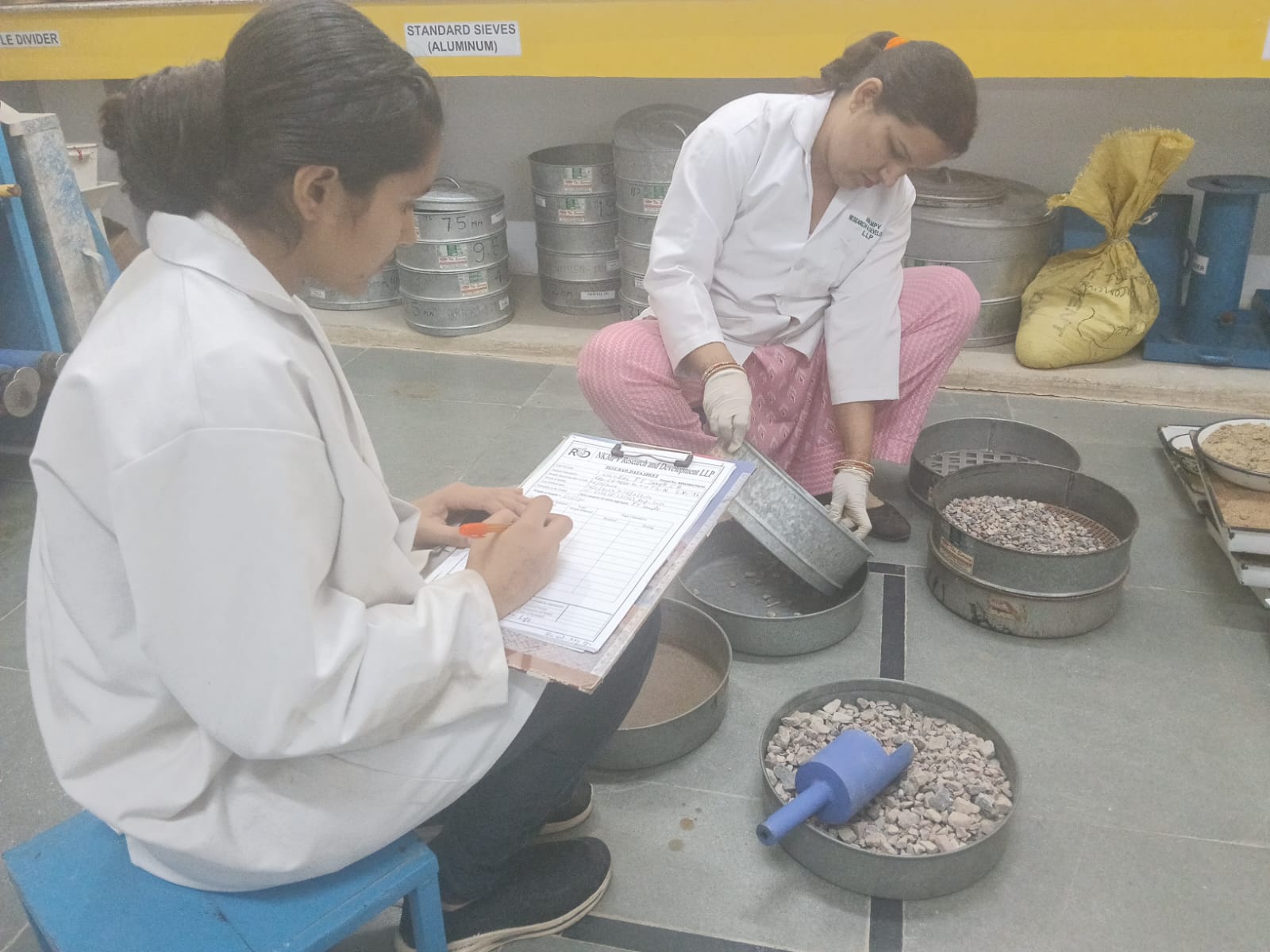
Grain size analysis of soil using dry sieve analysis with standard sieves for sand and gravel classification
Manual dry sieve grain size analysis of soil to evaluate coarse particle distribution.

3. Wet Sieve Analysis

3.1 Description of Wet Sieve Analysis
Wet sieve analysis is a modified version of dry sieve analysis, used for soils that contain fine particles, typically those smaller than 0.075 mm (No. 200 sieve). This test is performed by suspending the soil sample in water, which allows for the separation of fine particles that cannot be adequately separated using dry sieving alone. In this method, the soil sample is washed through a series of sieves, with water acting as the medium to carry away the fine particles. The coarse particles that remain on the sieve are collected, dried, and weighed. The amount of fine particles that pass through the sieve is measured by subtracting the amount of coarse material from the total mass.
3.2 Purpose of Wet Sieve Analysis
The wet sieve analysis is used primarily for fine-grained soils, such as silts and clays, that are not easily separated through dry sieving. This method helps in determining the amount of fine material in a soil sample, which can significantly affect its properties, including plasticity, cohesion, and workability. By identifying the fine fraction of the soil, engineers can better understand the soil’s behavior in terms of permeability, compaction, and water retention. Wet sieve analysis is also important for determining the soil's suitability for various construction activities, such as earthworks, foundation design, and drainage systems.
3.3 Benefits of Wet Sieve Analysis
  • Accurate Measurement of Fine Particles:It provides a reliable way to quantify fine particles, which is particularly important for the design of foundations and pavements where fine particles influence load distribution.
  • Improved Soil Classification:The analysis helps classify soils with significant fine fractions, which are important for soil behavior prediction, particularly in geotechnical engineering.
  • Identification of Cohesion and Plasticity:Fine materials such as clay and silt have distinct behavior under loading and moisture conditions, and this test helps in predicting such behavior.
3.4 Procedure and Code Reference
The procedure for wet sieve analysis follows the standards outlined in ASTM D1140 (Standard Test Methods for Amount of Material in Soils Finer than the No. 200 Sieve by Washing) and IS 2720 Part 4 (Indian Standard for Determination of Grain Size Distribution).
  1. Step 1:A sample of soil is mixed with water in a container to create a slurry. The slurry ensures that the fine particles are suspended in the water, allowing for easier separation.
  2. Step 2:The slurry is poured through a sieve (usually a 0.075 mm sieve), and the soil particles are washed with water to separate the fines.
  3. Step 3:The material retained on the sieve is collected, dried in an oven, and weighed.
  4. Step 4:The percentage of fine particles is calculated by subtracting the amount of coarse material from the total sample mass.

4. Hydrometer Test

4.1 Description of the Hydrometer Test
The hydrometer test is an advanced method used to measure the distribution of fine particles (typically less than 0.075 mm) in a soil sample. The test is based on Stokes' Law, which describes the settling velocity of particles in a fluid medium. By measuring the density of the soil-water suspension at different time intervals, the particle size distribution can be determined. The hydrometer test is primarily used for soils that contain a significant amount of fine particles, such as silts and clays. It is particularly useful when these fine particles are too small to be effectively analyzed using sieves alone.
4.2 Purpose of the Hydrometer Test
The hydrometer test is designed to analyze the finer fractions of the soil sample. It is typically used when the amount of clay and silt in the sample is significant, and it provides detailed information on the particle size distribution of these fine-grained materials. This test is essential for accurately determining the particle size distribution of soils that pass through the 0.075 mm sieve. The results of the hydrometer test are useful for evaluating the soil’s plasticity, cohesion, and workability. Additionally, it helps in assessing the permeability and drainage properties of fine soils, which are critical for foundation and earthwork designs.
4.3 Benefits of the Hydrometer Test
  • Precise Measurement of Fine Particles:The hydrometer test allows for accurate measurement of fine particles, which is crucial for soils with a significant proportion of clays and silts.
  • Comprehensive Soil Analysis:It complements sieve analysis by providing detailed information on the fine fraction, offering a complete understanding of the soil's gradation.
  • Enhanced Soil Behavior Prediction:The hydrometer test helps predict the soil's response to water flow, load application, and compaction, which is essential for infrastructure and foundation design.
4.4 Procedure and Code Reference
The procedure for the hydrometer test follows the guidelines set in ASTM D422 (Standard Test Method for Particle-Size Analysis of Soils) and IS 2720 Part 5 (Indian Standard for Determination of Particle Size Distribution by Hydrometer Method).
  1. Step 1:A soil sample is mixed with water to form a suspension. The suspension must be prepared in a way that the particles are dispersed evenly and prevent clumping.
  2. Step 2:The suspension is stirred to ensure a uniform mixture.
  3. Step 3:The hydrometer is inserted into the suspension at specified intervals, and readings are taken to measure the density of the suspension.
  4. Step 4:The readings are recorded over time, and the settling velocity of the particles is calculated based on Stokes' Law.
  5. Step 5:A particle size distribution curve is plotted, and the results are analyzed to determine the percentage of soil that falls within each size range.
Grain size analysis of soil using wet sieve method for separation of fine particles below 75 micron
Wet sieve grain size analysis of soil to determine silt and clay fraction.

5. Comparison of Testing Methods

Test Method Particle Size Range Sample Preparation Typical Use Benefits
Dry Sieve Analysis Coarse (4.75 mm - 0.075 mm) Dry sample Sand and gravel Quick, cost-effective, ideal for coarse soils.
Wet Sieve Analysis Fine (less than 0.075 mm) Sample mixed with water Clayey and silty soils Accurate measurement of fines, good for cohesive soils.
Hydrometer Test Fine (< 0.075 mm) Sample mixed with water Fine-grained soils (clays, silts) Provides detailed analysis of fine particles, complements sieve tests.

6. Applications of Grain Size Analysis

Grain size analysis has a wide range of applications in civil and environmental engineering, including:
  • Soil Classification:Essential for determining the appropriate classification of soils, which is crucial for the design and construction of buildings, roads, and bridges.
  • Geotechnical Engineering:Grain size distribution helps predict the compaction behavior, permeability, and shear strength of soils.
  • Environmental Engineering:Used to assess the suitability of soil for filtration, water retention, and contamination control.
  • Construction and Infrastructure:In concrete, asphalt, and earthwork projects, accurate gradation is necessary for the material to perform optimally.

7. Conclusion

In conclusion, grain size analysis test is an essential in geotechnical engineering, providing crucial insights into the composition and behaviour of soils. By performing dry sieve, wet sieve, and hydrometer tests, engineers can accurately classify soils based on their particle size distribution. Each of these methods has its specific purpose and is tailored to different soil types dry sieve analysis is ideal for coarse-grained soils, wet sieve analysis is useful for soils with significant fine particles, and the hydrometer test is essential for analyzing the fine fraction of soils, particularly clays and silts. Understanding the soil’s gradation is fundamental to predicting its physical properties, including permeability, compaction, and load-bearing capacity, which are all critical factors in the design and construction of infrastructure. This knowledge is not only valuable for ensuring the safety and stability of structures but also for optimizing material selection and construction processes. Proper classification of soils helps engineers make informed decisions regarding the most suitable construction techniques and materials, ensuring durability and cost-efficiency. The benefits of grain size analysis extend beyond geotechnical applications into environmental engineering, where soil composition impacts water filtration, drainage, and erosion control. It also plays a significant role in agricultural engineering, where soil texture influences crop growth and water retention. Moreover, adherence to standardized testing procedures, as outlined in codes such as ASTM D6913, ASTM D1140, ASTM D422, IS 2720 Part 4, and IS 2720 Part 5, guarantees the reliability and consistency of results. These standards ensure that the data obtained from grain size analysis can be used confidently for decision-making and design purposes. As construction projects continue to evolve and become more complex, the importance of precise soil analysis remains a cornerstone of successful project outcomes. In the end, grain size analysis is not just a technical requirement but an indispensable tool for understanding and optimizing soil properties, thus ensuring the safety, sustainability, and efficiency of civil engineering projects worldwide.

Why Choose NKMPV for Grain Size Analysis?

NABL Accredited Results

Our grain size analysis reports carry NABL accreditation (ISO/IEC 17025:2017), accepted by NHAI, state PWDs, courts, and arbitration tribunals. Each report includes full traceability to calibrated sieves and instruments.

Complete Three-Method Analysis

We perform all three methods — dry sieve, wet sieve, and hydrometer — as specified in IS 2720 Part 4. Many labs skip wet sieving or hydrometer analysis. Our complete approach ensures accurate particle size distribution across the entire range from gravel to clay.

IS 460 Certified Sieve Sets

Our IS sieves are certified as per IS 460 and regularly verified for aperture accuracy. Calibrated sieves are critical for reproducible gradation results, especially at the 75 micron boundary that separates coarse-grained and fine-grained soil classifications.

Fast Turnaround for Bulk Samples

Standard turnaround is 3-5 working days for the complete analysis including hydrometer. For projects requiring only dry and wet sieve analysis (without hydrometer), results are available within 2-3 days. We can process multiple samples in parallel for large geotechnical investigations.

Integrated Soil Characterisation Packages

We combine grain size analysis with Atterberg limits, specific gravity, water content, MDD/OMC, and CBR testing into bundled packages. This provides a complete soil characterisation in one engagement — saving time, cost, and coordination for your geotechnical project.

Frequently Asked Questions

The standard method for grain size analysis in India is IS 2720 Part 4:1985 (Methods of Test for Soils — Grain Size Analysis). This standard covers both mechanical sieve analysis (for particles coarser than 75 micron) and hydrometer analysis (for particles finer than 75 micron). For soil classification using the gradation results, IS 1498:1970 (Classification and Identification of Soils for General Engineering Purposes) is the governing standard.
In dry sieve analysis, an oven-dried soil sample is shaken through a stack of sieves mechanically. This method works well for clean, coarse-grained soils with little or no clay. In wet sieve analysis, the soil is first soaked with a dispersing agent and washed through the 75 micron sieve to remove clay coatings that cause fine particles to clump together. Wet sieving gives a more accurate separation, especially for soils with significant fines content. IS 2720 Part 4 recommends wet sieving when the fines content is expected to be significant.
Hydrometer analysis is required when a significant portion of the soil passes the 75 micron IS sieve (typically more than 10-15% fines). Sieve analysis cannot distinguish between silt and clay particles since both pass the 75 micron sieve. The hydrometer method uses Stokes' Law of sedimentation to determine the particle size distribution in the silt (75-2 micron) and clay (below 2 micron) range. This distinction is critical for soil classification and for predicting properties like plasticity, swelling, and permeability.
The required sample quantity depends on the maximum particle size. As per IS 2720 Part 4: for soils with maximum particle size up to 4.75 mm, 200 g is sufficient; for soils up to 10 mm, 500 g; for soils up to 20 mm, 1 kg; and for soils up to 40 mm, 2 kg. For hydrometer analysis, approximately 50-100 g of the fine fraction (passing 2 mm or 75 micron sieve) is needed. We recommend collecting at least 5-10 kg from the field to ensure adequate representative sub-samples.
The Coefficient of Uniformity (Cu = D60/D10) indicates how well-graded or uniform the soil is. A Cu greater than 4 (for gravels) or 6 (for sands) suggests a well-graded soil. The Coefficient of Curvature (Cc = D30²/(D10 x D60)) indicates the shape of the gradation curve. A well-graded soil requires Cc between 1 and 3 in addition to the Cu criterion. Soils that meet both criteria are classified as GW (well-graded gravel) or SW (well-graded sand) per IS 1498, which are desirable for embankments and structural fills.
The complete grain size analysis including dry sieve, wet sieve, and hydrometer takes 3-5 working days. The hydrometer analysis itself requires 24 hours of sedimentation readings. If only sieve analysis (dry and wet) is required — for example, for granular sub-base or sand classification — results can be provided within 2-3 working days. For large geotechnical investigations with multiple samples, we process samples in parallel to maintain the same turnaround.

Need Grain Size Analysis? Get a Quote Today.

+91-XXXXX-XXXXX