
Liquid Limit and Plastic Limit Testing (Atterberg Limits)
Comprehensive consistency limits for soil classification and geotechnical design
What is IS 2720 Part 5 (liquid and plastic limit)?
IS 2720 (Part 5) is the Indian Standard method for determining the liquid limit (LL) and plastic limit (PL) of soil — the Atterberg limits. The difference between them gives the plasticity index (PI), used to classify fine-grained soils for foundations and pavements. NKMPV performs the complete Atterberg limits test (LL, PL and PI) in a NABL-accredited laboratory.
Atterberg limits define the moisture content boundaries at which a fine-grained soil transitions between solid, semi-solid, plastic, and liquid states. These consistency limits — Liquid Limit (LL), Plastic Limit (PL), and Shrinkage Limit (SL) — form the basis of soil classification and are essential inputs for foundation design, earthwork specifications, and slope stability analysis.
What Are Atterberg Limits?
Test Parameters & Acceptance Criteria
The following parameters are determined during Atterberg limits testing. Acceptance criteria are project-specific, but IS 1498 classification and MoRTH specifications provide standard benchmarks for highway and building construction.
| Parameter | Value / Range | Unit | Standard |
|---|---|---|---|
| Liquid Limit (LL) | 20-120% (depending on soil type) | % | IS 2720 Part 5 |
| Plastic Limit (PL) | 10-60% (depending on soil type) | % | IS 2720 Part 5 |
| Plasticity Index (PI = LL - PL) | 0-70% (NP if soil is non-plastic) | % | IS 2720 Part 5 |
| Shrinkage Limit (SL) | 8-30% (typical range) | % | IS 2720 Part 6 |
| Liquidity Index (LI) | 0 to 1.0 (field moisture basis) | Derived from LL, PL, NMC | |
| Consistency Index (CI) | 0 to 1.0 (field moisture basis) | Derived from LL, PL, NMC | |
| Flow Index (Casagrande Method) | Slope of flow curve | IS 2720 Part 5 Cl. 4 | |
| LL for Subgrade (MoRTH Limit) | < 50% for embankment fill | % | MoRTH 5th Rev. Cl. 305 |
Applicable Indian Standards
Methods of Test for Soils — Determination of Liquid Limit and Plastic Limit
Methods of Test for Soils — Determination of Shrinkage Factors
Classification and Identification of Soils for General Engineering Purposes
Methods of Test for Soils — Grain Size Analysis
Specifications for Road and Bridge Works — Section 300 (Earthwork)
Equipment Used
Casagrande Liquid Limit Device
Standard brass cup apparatus with hard rubber base
Mechanical counter for blow count, drop height calibrated to 10 mm as per IS 2720 Part 5
CalibratedCone Penetrometer Apparatus
Standard 80 g, 30-degree stainless steel cone
Penetration measured with dial gauge (least count 0.1 mm), automatic release mechanism
CalibratedGlass Plate for Plastic Limit
Ground glass plate (300 mm x 300 mm x 10 mm thick)
Smooth, non-porous surface for rolling soil threads to 3 mm diameter
CalibratedIS Sieves (425 micron)
Stainless steel frame, brass mesh
425 micron aperture for preparing soil fraction used in Atterberg limits testing
CalibratedThermostatically Controlled Oven
AIMIL / Tanco
Maintained at 105-110 °C for moisture content determination of all test specimens
CalibratedDigital Weighing Balance
Shimadzu / Mettler Toledo
Least count 0.01 g, NABL-calibrated, for moisture content determination at each trial point
CalibratedTesting Process
Sample Preparation
Day 1 (24-hour maturing)Approximately 500 g of air-dried soil is pulverised and passed through the 425-micron IS sieve. The fraction passing the sieve is thoroughly mixed with distilled water to form a uniform paste and allowed to mature for at least 24 hours in a sealed container. This maturing period ensures uniform moisture distribution throughout the soil mass, which is critical for consistent results in both liquid limit and plastic limit tests.
Liquid Limit — Casagrande Cup Method
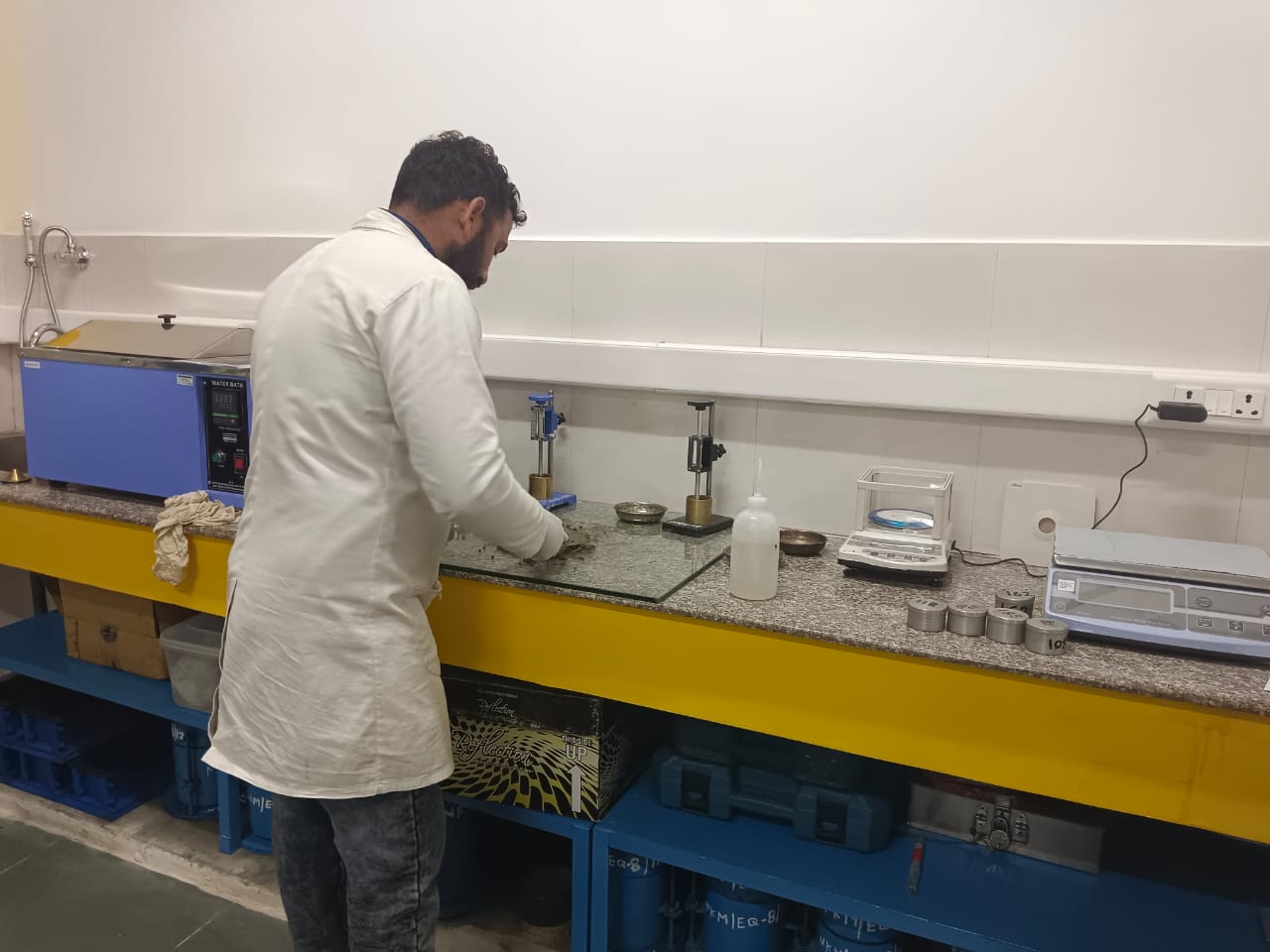
Day 2A portion of the prepared paste is placed in the Casagrande brass cup, spread to a uniform thickness of about 12 mm, and a groove is cut through the centre using the standard grooving tool. The cup is dropped repeatedly from a height of 10 mm until the groove closes over a length of 12 mm. The number of blows is recorded and a moisture content sample is taken. This procedure is repeated at four or more different moisture contents spanning 15 to 35 blows. The LL is the moisture content at exactly 25 blows, determined from the semi-logarithmic flow curve.
Liquid Limit — Cone Penetrometer Verification
Day 2For verification or when the Casagrande cup method is ambiguous, the cone penetrometer method is employed. A standard 80 g, 30-degree cone is released from contact with the surface of the soil paste in a standard cup. The depth of penetration after 5 seconds is recorded. Tests are performed at four or more moisture contents spanning 14 mm to 28 mm penetration. The LL corresponds to 20 mm penetration depth, determined from the moisture content versus penetration graph.
Plastic Limit Determination
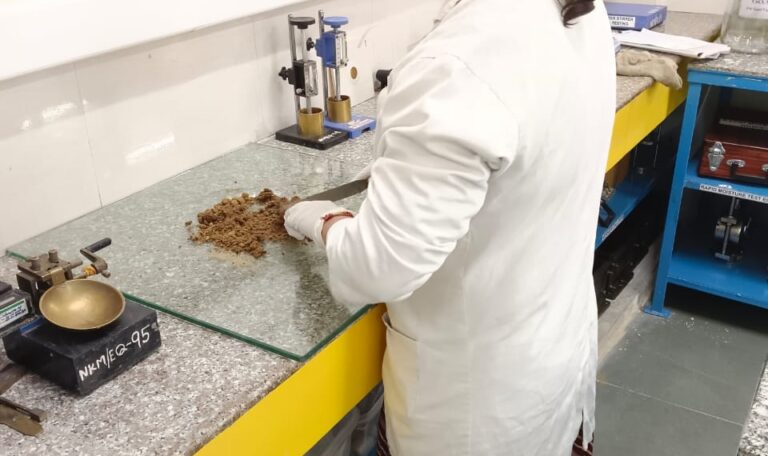
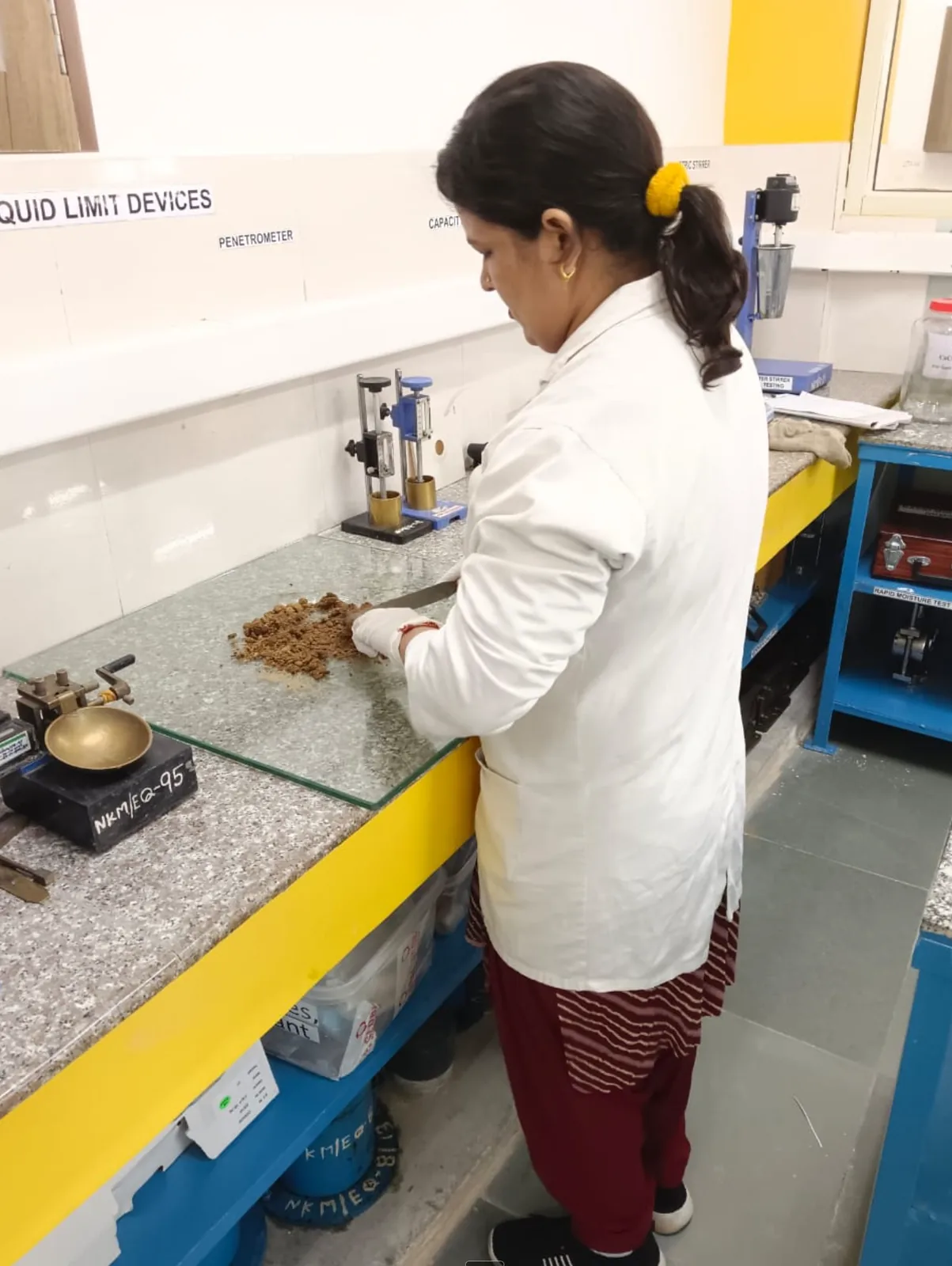
Day 2A small ball (approximately 8 g) of the prepared soil paste is taken and rolled on the ground glass plate using the palm until it forms a thread of 3 mm diameter. If the thread does not crumble at 3 mm, it is re-kneaded into a ball and rolled again. The process is repeated until the thread begins to crumble and break at exactly 3 mm diameter. The crumbled portions are immediately placed in a moisture content container and weighed. A minimum of three determinations are performed and the average moisture content is reported as the Plastic Limit.
Oven Drying & Moisture Content Calculation
Day 2-3All moisture content samples collected during liquid limit and plastic limit testing are dried in the thermostatically controlled oven at 105-110 °C for a minimum of 16-24 hours until constant mass is achieved. The dry weights are recorded and the moisture content for each trial point is calculated. These values form the data points for the flow curve and the final PL computation.
Plasticity Index & Soil Classification
Day 3The Plasticity Index is calculated as PI = LL - PL. The LL and PI values are plotted on the Casagrande Plasticity Chart to determine the soil classification — above the A-line indicates clay, below indicates silt. The position relative to the U-line serves as a data quality check. The soil is classified as CL, CI, CH, ML, MI, or MH as per IS 1498. Derived parameters such as Liquidity Index and Consistency Index are also computed if the natural moisture content is available.
Report Generation & Delivery
Day 3-4The NABL-accredited test report includes individual trial data for both LL and PL, the semi-logarithmic flow curve, plasticity chart plot showing the soil's position relative to the A-line, the IS 1498 classification symbol, and all derived indices. Reports are delivered as signed PDF documents with QR-code verification. Hard copies with NABL stamp are available upon request.
Where This Test Is Used
Detailed Information
Liquid Limit and Plastic Limit Testing
1. Introduction
The study of soil properties is central to geotechnical engineering and construction. Soil behavior, particularly its response to moisture variations, directly affects the performance of structures such as roads, embankments, and foundations. Two of the most important properties of soil in this context are the Liquid Limit (LL) and Plastic Limit (PL), collectively known as Atterberg Limits. These parameters define the boundaries of soil consistency states and provide critical data for soil classification and behavior analysis. The Liquid Limit (LL) is the moisture content at which soil transitions from a plastic to a liquid state, while the Plastic Limit (PL) is the moisture content at which soil changes from a semi-solid to a plastic state. The difference between these values, the Plasticity Index (PI), represents the range of water content over which soil exhibits plastic behavior. These tests are standardized in IS: 2720 (Part 5) - 1985 (Reaffirmed 2020) and play a pivotal role in geotechnical investigations. This report provides an in-depth explanation of LL and PL testing, including their theoretical basis, detailed methodology, significance, and real-world applications.2. Objectives of the Test
The primary objectives of determining the Liquid Limit and Plastic Limit of soil are as follows:- Classifying Soil Properties: LL and PL are used in systems like the Unified Soil Classification System (USCS) or the Indian Standard Soil Classification System (ISSCS).
- Assessing Soil Behavior: These limits help predict soil responses to moisture changes, such as swelling, shrinkage, and deformation.
- Foundation Suitability: LL and PL testing identifies whether the soil can safely support structures, particularly in expansive soils.
- Calculating Plasticity Index (PI): The PI is a measure of soil plasticity, helping engineers differentiate between cohesive and non-cohesive soils.
- Optimizing Construction Techniques: These tests guide soil compaction, stabilization, and improvement methods.
3. Theoretical Background
3.1 Atterberg Limits and Soil States
Atterberg Limits define the water content at which soil changes from one state to another:- Solid State: Soil is rigid, brittle, and breaks under stress.
- Semi-Solid State: Soil deforms but does not return to its original shape.
- Plastic State: Soil is moldable without cracking.
- Liquid State: Soil flows like a viscous liquid under its own weight.
3.2 Liquid Limit (LL)
The Liquid Limit (LL) is the moisture content at which soil transitions from a plastic to a liquid state. At this moisture content, the soil has minimal shear strength and can no longer hold its shape. LL is determined using the Casagrande liquid limit device, where controlled impacts are applied to a soil sample in a metal cup to simulate flow conditions. Relevance:- LL helps classify fine-grained soils (e.g., clays and silts).
- It indicates the soil's water retention and sensitivity to changes in moisture.
3.3 Plastic Limit (PL)
The Plastic Limit (PL) is the moisture content at which soil transitions from a semi-solid to a plastic state. Below the PL, soil crumbles when rolled into thin threads. This property represents the lowest moisture content at which soil exhibits plasticity. Relevance:- PL reflects the minimum moisture content required for soil to be workable.
- It provides insight into the soil’s compressibility and strength.
3.4 Plasticity Index (PI)
The Plasticity Index (PI) is defined as: PI=LL−PLPI = LL - PLPI=LL−PL- A high PIindicates a highly plastic and cohesive soil, such as clay.
- A low PIindicates non-cohesive soils like silts or sands.
4. Apparatus Required
The following equipment is essential for conducting LL and PL tests as per IS: 2720 (Part 5):- Casagrande Liquid Limit Device: Measures LL by simulating soil flow under mechanical impacts.
- Grooving Tools: Creates grooves in soil for LL testing.
- Glass Plate: Provides a smooth surface for rolling soil threads during PL testing.
- IS Sieve (425 Microns): Ensures soil particle uniformity for accurate results.
- 3 mm Diameter Rod: Verifies thread diameter during PL testing.
- Spatula: For mixing and transferring soil.
- Balance (0.01 g Sensitivity): Precisely measures soil and water content.
- Drying Oven: Maintains consistent temperature for moisture determination.
- Distilled Water: Prevents contamination or ion exchange.
- Desiccator: Prevents moisture loss before weighing.
- Graph Paper: For plotting LL flow curves.
5. Testing Procedures
5.1 Liquid Limit Test
Step-by-Step Methodology:- Device Calibration:
- Adjust the Casagrande device using a grooving tool gauge to ensure the cup drops exactly 1 cm.
- Soil Preparation:
- Take 120 g of air-dried soil, sieve it through a 425-micron sieve, and mix with distilled water to form a uniform paste.
- Groove Formation:
- Place the soil paste in the Casagrande cup and smooth it to 1 cm depth.
- Cut a groove along the center using the grooving tool.
- Blow Counting:
- Turn the handle at 2 revolutions per second and record the number of blows required for the groove to close along a 10 mm length.
- Moisture Content Determination:
- Transfer a portion of soil from the closed groove into a container and determine its moisture content using an oven.
- Repeat Testing:
- Perform the test with varying moisture contents to obtain at least four sets of readings.
- Flow Curve Plotting:
- Plot moisture content against the logarithm of blows. The LL corresponds to the moisture content at 25 blows.
5.2 Plastic Limit Test
Step-by-Step Methodology:- Sample Preparation:
- Pass 30 g of soil through a 425-micron sieve.
- Mix it with distilled water until it forms a moldable ball.
- Thread Rolling:
- Roll the soil into threads on a glass plate using palms, ensuring uniform diameter reduction.
- Thread Crumbling:
- Stop rolling when the threads begin to crumble at a diameter of 3 mm.
- Moisture Content Determination:
- Collect the crumbled threads and determine their moisture content using an oven.
- Repeat Testing:
- Conduct the test on at least three fresh soil samples to ensure accuracy.
5.3 Precautions
- Use distilled water to avoid impurities.
- Prevent excessive drying of soil samples before testing.
- Ensure even and thorough mixing of soil and water.
- Clean all tools after each test to avoid contamination.
- Perform the test at standard room temperature for consistency.
6. Benefits of LL and PL Testing
Here are the primary benefits: 6.1. Soil Classification and Identification- Liquid limit and plastic limitvalues are used to classify soils into groups such as clays, silts, or a combination. This classification is critical for predicting soil behavior in engineering applications.
- The plasticity index (PI), derived from LL and PL (PI=LL−PLPI = LL - PLPI=LL−PL), indicates the plasticity and cohesion characteristics of the soil.
- Strength and Stability:Soils with high plasticity (high PI) may exhibit significant shrink-swell behavior, which can affect foundation stability.
- Compressibility:LL and PI are indicators of a soil's compressibility, helping engineers predict settlement potential.
- Shear Strength:These limits provide insights into the soil's shear strength in wet conditions.
- Helps determine the suitability of soil as a construction material for roads, dams, embankments, and foundations.
- Assists in designing appropriate soil stabilization methods if the soil exhibits undesirable properties (e.g., high shrink-swell potential).
- LL and PL values help assess how sensitive the soil is to changes in moisture content, which is vital for projects exposed to varying weather conditions.
- These tests aid in understanding how soil will behave under different loading conditions, ensuring proper safety and durability in construction.
- High plasticity soils (high PI) tend to exhibit shrinkage or swelling when moisture content changes. Knowing this helps engineers mitigate risks in construction projects.
- The LL and PL can indicate the potential for soil erosion and its permeability, influencing drainage and erosion control strategies.
- These tests ensure consistency and reliability of soil properties during construction projects, reducing risks of failure.
7. Advantages of Testing
- Early Problem Detection:
- Identifies problematic soils, reducing risks of settlement, cracking, or instability.
- Cost Optimization:
- Provides accurate soil classification, preventing overdesign.
- Environmental Sustainability:
- Helps select materials and methods that minimize environmental impact.
8. Applications
- Road Subgrade Design:
- Ensures the stability of roads under traffic loads.
- Dam Construction:
- Assesses soil impermeability for water retention.
- Slope Stability:
- Predicts landslide risks in hilly terrains.
- Pavements:
- Guides material selection for long-lasting surfaces.
Code Reference:
- ASTM Standards
- ASTM D4318: Standard Test Methods for Liquid Limit, Plastic Limit, and Plasticity Index of Soils.
- Widely used in the United States and internationally.
- Covers both the Casagrande cup method and the fall cone method for determining liquid limits.
- AASHTO Standards
- AASHTO T89: Standard Method of Test for Determining the Liquid Limit of Soils.
- AASHTO T90: Standard Method of Test for Determining the Plastic Limit and Plasticity Index of Soils.
- Commonly used for transportation and highway projects in the U.S.
- British Standards (BS)
- BS 1377-2: Methods of Test for Soils for Civil Engineering Purposes – Part 2: Classification Tests.
- Includes the liquid limit, plastic limit, and plasticity index tests.
- Often used in Europe and Commonwealth countries.
- Indian Standards (IS)
- IS 2720 (Part 5): 1985: Determination of Liquid and Plastic Limits.
- Used extensively in India for soil classification and geotechnical analysis.
- International Organization for Standardization (ISO)
- ISO 17892-12:2018: Geotechnical investigation and testing – Laboratory testing of soil – Part 12: Determination of liquid and plastic limits.
- Provides a global reference for soil testing.
- These codes outline step-by-step procedures, equipment requirements, and calculation methods.
- They provide tolerance limits and specify reporting formats to ensure consistency and accuracy.
- The choice of standard depends on regional practices, project specifications, and contractual requirements.
Conclusion
The determination of Liquid Limit (LL) and Plastic Limit (PL) is a fundamental aspect of soil mechanics and geotechnical engineering. These tests not only provide a scientific basis for classifying soils but also offer critical insights into their behavior under varying moisture conditions. By understanding these properties, engineers can accurately predict how soils will perform in real-world construction scenarios, reducing the risk of structural failures and ensuring long-term stability. The Liquid Limit (LL) test measures the moisture content at which soil transitions from a plastic to a liquid state, helping identify the soil’s water retention capacity and sensitivity. The Plastic Limit (PL) test, on the other hand, determines the lowest moisture content at which soil behaves plastically, offering insights into its workability and cohesion. Together, these parameters define the Plasticity Index (PI), a key indicator of soil plasticity and compressibility. These tests have far-reaching applications in civil engineering, from designing stable foundations and embankments to constructing roads and retaining structures. The data derived from LL and PL testing enable engineers to:- Select appropriate soil types for construction.
- Design mitigation strategies for expansive or weak soils.
- Optimize soil stabilization and compaction techniques.
- Develop sustainable and cost-effective infrastructure solutions.
Broader Implications
The LL and PL tests are vital in regions prone to extreme weather, where soil moisture conditions fluctuate significantly. For instance:- In arid regions, the low water retention of soils can lead to challenges in maintaining structural stability, which these tests help address.
- In wet regions, LL and PL data help in mitigating risks of excessive swelling or liquefaction.
Improved Decision-Making
By following standardized procedures such as IS: 2720 (Part 5), the results of LL and PL tests are both reliable and reproducible, forming a basis for sound engineering decisions. These tests empower project teams to:- Anticipate challenges in soil behavior.
- Reduce maintenance costs by building stable structures.
- Improve project efficiency through accurate soil classification and analysis.
Future Directions
Advancements in technology offer promising opportunities to enhance LL and PL testing:- Automation: Automated liquid limit devices and precision instruments can reduce human errors and improve accuracy.
- Digital Analysis: Incorporating AI and machine learning can allow faster interpretation of soil data, improving decision-making in large-scale projects.
- Field Adaptations: Portable LL and PL testing equipment can provide real-time insights during field investigations.
Final Thoughts
In conclusion, the Liquid Limit and Plastic Limit Tests remain cornerstones of geotechnical investigations, offering valuable data for designing safe, durable, and sustainable infrastructure. The ability to classify soils, predict their behavior, and design around their limitations ensures that engineers can address challenges posed by natural soils effectively. As engineering demands evolve and environmental factors become increasingly unpredictable, the importance of such standardized tests will only grow. By embracing advancements in testing methods and continuing to refine their application, the field of geotechnical engineering can rise to meet the demands of modern construction and environmental sustainability.Photos & Lab Images
Why Choose NKMPV for Atterberg Limits Testing?
NABL Accredited Results
Our Atterberg limits reports carry NABL accreditation (ISO/IEC 17025:2017), accepted by NHAI, state PWDs, courts, and arbitration tribunals. Every result is backed by traceable calibration and quality management procedures.
Dual Liquid Limit Methods
We perform both the Casagrande cup percussion method and the cone penetrometer method per IS 2720 Part 5. The cone penetrometer is preferred for soils where operator judgement on groove closure is difficult, giving you a more reproducible result.
Complete Classification Package
We combine Atterberg limits with grain size analysis (sieve + hydrometer), specific gravity, and natural moisture content to deliver a complete IS 1498 soil classification in a single report — saving you time and multiple lab engagements.
24-Hour Sample Maturing Protocol
We strictly follow the IS code requirement of 24-hour maturing after mixing the soil with water. This ensures uniform moisture distribution and prevents artificially low LL values that can occur when testing freshly mixed samples.
Experienced Technicians
The plastic limit test in particular depends on operator skill. Our NABL-trained technicians have performed thousands of PL determinations, ensuring consistent 3 mm thread rolling and reliable results across sample batches.
Frequently Asked Questions
The Atterberg limits are three specific water-content values that define soil consistency boundaries: Liquid Limit (LL) — the water content at which soil transitions from plastic to liquid behaviour; Plastic Limit (PL) — the water content at which soil transitions from semi-solid to plastic; Shrinkage Limit (SL) — the water content below which further drying causes no volume change. The Plastic Limit is therefore one of the three Atterberg limits, not separate from them. The difference between LL and PL is the Plasticity Index (PI = LL − PL) — a critical input to soil classification under IS 1498 and to subgrade strength estimation. NKMPV determines all three Atterberg limits per IS 2720 Part 5 (LL/PL) and IS 2720 Part 6 (SL).
IS 2720 Part 5:1985 (Reaffirmed 2015) — "Determination of Liquid Limit and Plastic Limit" — is the Bureau of Indian Standards (BIS) document governing Atterberg limits testing. The official PDF is available for paid download from the BIS portal (standardsbis.bsbedge.com); many institutional libraries and engineering colleges provide free access. For practical interpretation and application, our laboratory follows the IS 2720 Part 5 procedure verbatim — Casagrande cup method for liquid limit (or cone-penetrometer alternate), thread-rolling method for plastic limit. Test reports include a copy of the relevant clause and reference the IS code edition used. For specific clause interpretation in your project context, contact our technical team.
Typical liquid limit ranges observed in Indian highway and foundation practice: well-graded sandy soils (SM, SC): LL 20–35% (low plasticity); lean clays (CL, CL-ML): LL 30–50% (medium plasticity); fat clays (CH): LL 50–80% (high plasticity); black cotton soils (CH, expansive): LL 60–110% (very high plasticity with expansion potential). The IS 1498 classification chart maps LL and PI to USCS soil groups. LL > 50% with PI > 35% is typically the threshold flagging black-cotton / expansive soils requiring special design treatment (lime stabilisation, sub-grade replacement, or geosynthetic separation). NKMPV reports LL and PI with the relevant IS 1498 classification on every soil test certificate.