Soil and Rock Testing

Cohesion and Angle of Internal Friction Test (Direct Shear)

Shear strength parameters for foundation design and slope stability analysis

IS 2720 Part 13 IS 6403:1981 IS 1904:1986
The direct shear test determines the two fundamental shear strength parameters of soil — cohesion (c) and angle of internal friction (phi) — by shearing a soil specimen along a predetermined plane under controlled normal stress. These parameters are essential for bearing capacity calculations, slope stability analysis, and earth pressure computations.

What Is the Direct Shear Test for Cohesion and Angle of Internal Friction?

Every foundation, retaining wall, and earth slope in civil engineering relies on the shear strength of the underlying soil. The direct shear test, governed by IS 2720 Part 13, is the most widely used laboratory method to measure this strength. A soil specimen is placed in a split shear box (60 mm x 60 mm at NKMPV), a known normal stress is applied vertically, and a horizontal shear force is applied until the specimen fails along the plane between the two halves of the box. By testing a minimum of three specimens from the same soil sample under different normal stresses, the Mohr-Coulomb failure envelope is constructed. The y-intercept of this straight-line envelope gives the cohesion (c) — the shear strength component independent of normal stress — while the slope gives the angle of internal friction (phi) — the component that increases with confining pressure. Together, c and phi define the complete shear strength behaviour of the soil. These parameters feed directly into Terzaghi's bearing capacity equation for foundation design, Rankine's and Coulomb's earth pressure theories for retaining wall design, and Bishop's method for slope stability analysis. At NKMPV, we perform the test under drained conditions on both undisturbed and remoulded specimens, reporting peak and residual strength values. Our results serve geotechnical consultants, structural engineers, and government agencies working on projects across Haryana, Punjab, and Himachal Pradesh. We also offer companion Atterberg limits testing and plate load tests for comprehensive soil characterisation.

Test Parameters & Acceptance Criteria

The following parameters are measured and reported during the direct shear test. Values are specific to the tested soil and are used as design inputs rather than pass/fail criteria.

Parameter Value / Range Unit Standard
Cohesion (c) 0-100 (typical range) kPa IS 2720 Part 13
Angle of Internal Friction (phi) 0-45 (typical range) degrees IS 2720 Part 13
Peak Shear Stress Maximum shear stress at failure kPa IS 2720 Part 13 Cl. 6
Residual Shear Stress Post-peak steady-state shear stress kPa IS 2720 Part 13 Cl. 6
Normal Stress Applied 50, 100, 150 (typical set) or as specified kPa IS 2720 Part 13 Cl. 4.4
Shear Displacement at Failure Recorded for each specimen mm IS 2720 Part 13 Cl. 5
Shear Box Specimen Size 60 x 60 x 25 mm IS 2720 Part 13 Cl. 3.1

Applicable Indian Standards

IS 2720 Part 13

Methods of Test for Soils — Direct Shear Test

IS 6403:1981

Code of Practice for Determination of Bearing Capacity of Shallow Foundations

IS 1904:1986

Code of Practice for Design and Construction of Foundations in Soils — General Requirements

IS 2720 Part 11

Methods of Test for Soils — Determination of Shear Strength Parameters by Triaxial Compression Test

Equipment Used

Direct Shear Testing Machine

AIMIL AIM-131

Motorised strain-controlled, shear rate 0.2 mm/min to 2.0 mm/min adjustable

Calibrated

Shear Box Assembly (60 mm x 60 mm)

Standard IS split shear box with porous stones

Upper and lower halves with locking screws, grid plates, and porous stones for drainage

Calibrated

Proving Ring (Shear Force Measurement)

AIMIL 2 kN

Least count 1 N, NABL-calibrated

Calibrated

Dead Weight Loading System

Slotted weights with lever arm (1:10 ratio)

Normal stress application up to 600 kPa on 60 mm x 60 mm specimen

Calibrated

Dial Gauges (Horizontal & Vertical Displacement)

Mitutoyo 25 mm travel

Least count 0.01 mm, two gauges per test — one for shear displacement, one for vertical deformation

Calibrated

Sample Trimming and Preparation Tools

Specimen cutter, trimming knife, and straight edge

For preparing undisturbed and remoulded specimens to 60 mm x 60 mm x 25 mm dimensions

Calibrated

Testing Process

1

Sample Collection & Receipt

Day 1

Undisturbed soil samples are collected from the project site using core cutters (100 mm diameter) or thin-wall Shelby tubes at the foundation or investigation depth. Samples are sealed with wax to preserve natural moisture content during transport. For remoulded tests, approximately 10-15 kg of disturbed soil is collected. The samples are logged with depth, location, and project details upon receipt at the laboratory.

2

Specimen Preparation

Day 1-2

Three specimens measuring 60 mm x 60 mm x 25 mm are trimmed from the undisturbed sample using a specimen cutter and trimming knife. Care is taken to maintain the natural structure and moisture content. For remoulded specimens, the soil is compacted to the required density and moisture content. Initial dimensions, weight, and moisture content of each specimen are recorded. Each specimen is tested under a different normal stress.

3

Shear Box Assembly & Normal Load Application

Day 2

The specimen is placed in the split shear box between two porous stones and grid plates. The upper half is secured with locking screws during setup. The shear box assembly is placed on the loading frame, and the predetermined normal stress is applied through the lever arm and dead weights. For a standard three-specimen set, normal stresses of 50 kPa, 100 kPa, and 150 kPa are typically used. The locking screws are then removed and a gap of approximately 1 mm is created between the two halves.

4

Shearing the Specimen

Day 2-3

The motorised drive applies a horizontal shear force at a constant strain rate (typically 1.25 mm/min for drained conditions per IS 2720 Part 13). Shear force readings from the proving ring and horizontal displacement readings from the dial gauge are recorded at regular intervals — every 0.5 mm of displacement. Vertical deformation (compression or dilation) is simultaneously monitored. Shearing continues until the shear stress reaches a peak and then drops to a residual value, or until a displacement of 20% of the specimen length is achieved.

5

Repeat for Remaining Specimens

Day 3

The second and third specimens are tested under progressively higher normal stresses following the same procedure. After each test, the specimen is removed and its final moisture content is determined by oven drying. This gives three data points — each a pair of normal stress and corresponding peak shear stress at failure — which are essential for plotting the failure envelope.

6

Mohr-Coulomb Failure Envelope Construction

Day 3-4

The shear stress at failure (peak value) is plotted against the corresponding normal stress for all three specimens. A best-fit straight line is drawn through the three data points using the least-squares method. The y-intercept of this line gives the cohesion (c) in kPa, and the angle this line makes with the horizontal axis gives the angle of internal friction (phi) in degrees. Shear stress versus displacement curves and vertical displacement versus horizontal displacement curves are also plotted for each specimen.

7

Report Generation & Delivery

Day 4-5

The NABL-accredited test report includes individual shear stress vs displacement curves for all three specimens, the Mohr-Coulomb failure envelope plot, values of cohesion (c) and angle of internal friction (phi) for both peak and residual conditions, specimen dimensions, moisture content, and dry density. The report is delivered digitally and as a stamped hard copy with the NABL logo and unique certificate number.

Where This Test Is Used

The direct shear test provides fundamental shear strength parameters used throughout geotechnical and structural engineering. The cohesion (c) and angle of internal friction (phi) values are the primary inputs for soil bearing capacity calculations per IS 6403 — without these values, foundation design is not possible. In slope stability analysis, these parameters determine whether a natural hillside, road cutting, or embankment will remain stable under its own weight and applied loads. Retaining wall designers use c and phi to calculate active and passive earth pressures using Rankine's or Coulomb's theories. The test is also essential for comprehensive soil characterisation alongside Atterberg limits and grain size analysis. For bridge and highway projects, shear strength data guides embankment design and abutment foundation sizing, complementing plate load test results from the field.
Bearing capacity calculation for shallow foundations per IS 6403 Slope stability analysis for road cuttings and natural hillsides Earth pressure computation for retaining wall design Embankment design for highways and railway formations Dam and levee foundation assessment Geotechnical investigation reports for building plan approvals Forensic geotechnical analysis for slope failures and foundation distress

Detailed Information

Cohesion and Angle of Internal Friction Test of Soil

Soil, as a fundamental material in geotechnical engineering, exhibits a wide range of mechanical behaviors depending on its composition, structure, and moisture content. Two key parameters that describe the shear strength of soil are cohesion and the angle of internal friction. These parameters govern how soil resists shear forces, which are critical in determining the stability of foundations, slopes, embankments, retaining walls, and other civil engineering structures. Cohesion (c) and the angle of internal friction (φ) are critical for understanding soil's ability to withstand external forces without failing. The failure of soil under shear stress can lead to disastrous consequences such as landslides, foundation settlement, or embankment collapse. By performing laboratory tests that measure these properties, engineers are able to design safer and more cost-effective structures. The purpose of this report is to provide an in-depth explanation of the tests used to determine cohesion and the angle of internal friction, the standards that guide these tests, the benefits of such tests, and the wide array of applications in geotechnical engineering.

2. Definitions and Importance

Cohesion (c): Cohesion refers to the attractive forces between soil particles that resist their separation when subjected to shear stress. These forces are more significant in fine-grained soils such as clays, where electrostatic, Van der Waals forces, and hydrogen bonding contribute to the attraction between particles. Cohesion is essentially the "stickiness" of soil, and it plays a crucial role in retaining the structural integrity of soils under low stress. Cohesion is typically measured in kilopascals (kPa) and is an essential property in the design of structures like embankments, retaining walls, and foundations, particularly in clayey soils. Angle of Internal Friction (φ): The angle of internal friction represents the resistance to sliding between soil particles, which occurs due to frictional forces. It is particularly relevant for coarse-grained soils, such as sands and gravels, where particle interlocking and frictional resistance govern soil behavior under shear stress. The angle of internal friction is typically represented in degrees and is related to the soil's ability to resist lateral movement under applied loads. Granular soils generally exhibit a higher friction angle, which allows them to bear heavy loads without failure. Together, cohesion and internal friction define the shear strength of soil, which is crucial in understanding how soil behaves under various loading conditions. The shear strength is expressed through the Mohr-Coulomb failure criterion, which models the shear stress (τ) as a function of cohesion and normal stress (σ): τ=c+σ⋅tan⁡(ϕ)\tau = c + \sigma \cdot \tan(\phi)τ=c+σ⋅tan(ϕ) Where:
  • τis the shear stress,
  • cis the cohesion,
  • σis the normal stress,
  • φis the angle of internal friction.
The shear strength parameters are fundamental to evaluating soil performance in various engineering applications, including foundations, slopes, and earthworks.
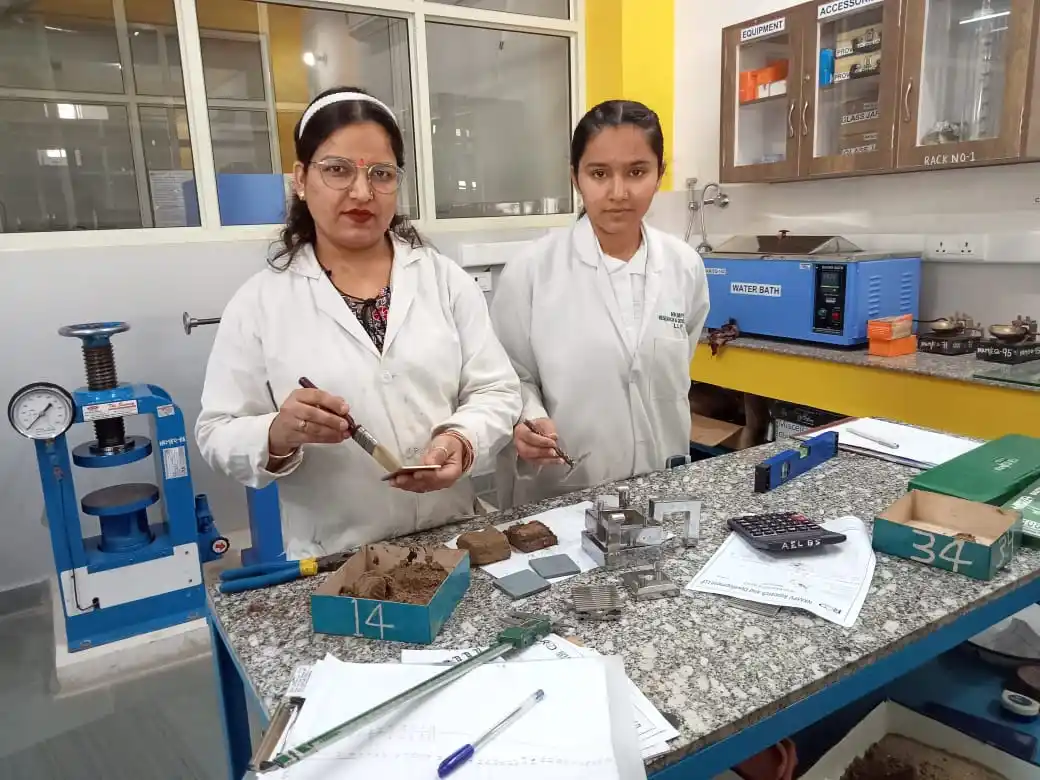
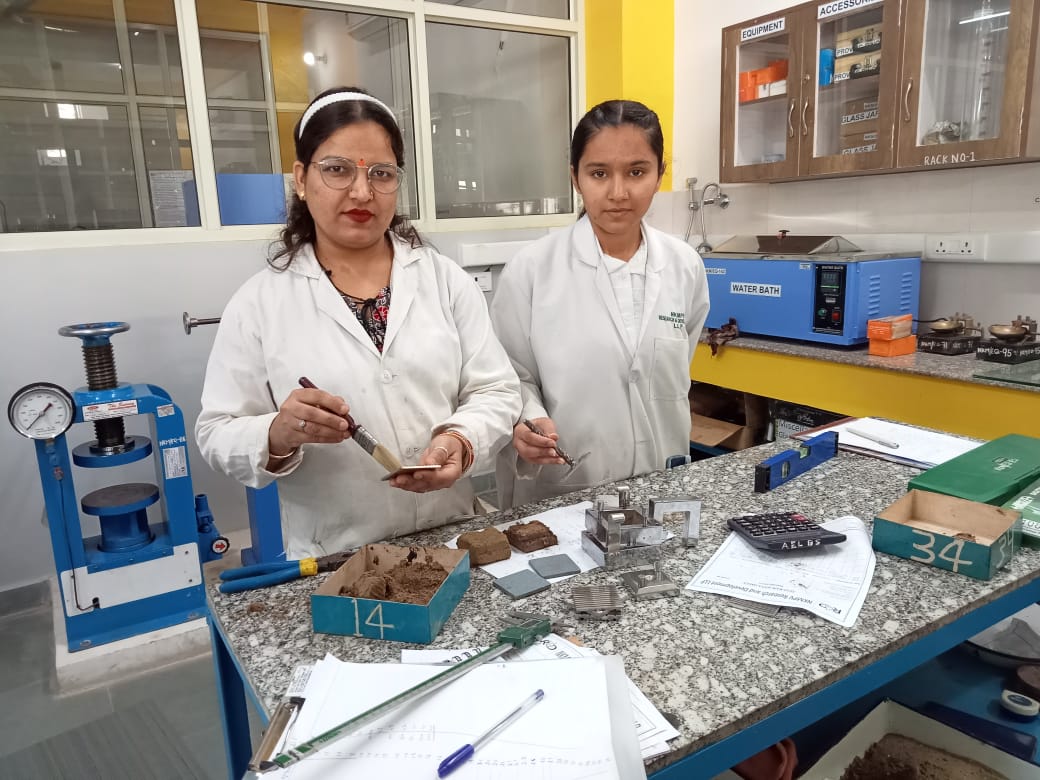
Cohesion and Angle of Internal Friction Test of Soil using direct shear machine for shear strength evaluation
Direct shear testing for determination of cohesion and internal friction angle of soil samples.

3. Methods for Determining Cohesion and Angle of Internal Friction

Cohesion and the angle of internal friction are typically measured using a range of laboratory tests. The most common tests for these parameters are the Direct Shear Test, Triaxial Shear Test, and Unconfined Compression Test. Each of these tests provides valuable data about the shear strength of soils under different conditions.
3.1 Direct Shear Test
The Direct Shear Test is one of the most commonly used methods for measuring both cohesion and the angle of internal friction in soil. This test applies shear force directly to a soil sample, causing it to fail along a specific shear plane. Test Procedure:
  1. A soil sample is prepared and placed inside a shear box apparatus. The sample is typically a small, rectangular or square specimen.
  2. A normal load is applied to the top of the sample to simulate the vertical stress acting on the soil in the field.
  3. A horizontal force is applied gradually to the sample to induce shear failure along the horizontal plane.
  4. As the shear force is applied, the displacement of the soil is recorded, and the shear stress at failure is calculated.
  5. The Mohr-Coulomb failure criterion is used to plot the relationship between the shear stress (τ) and normal stress (σ), which helps determine the soil’s cohesion and angle of internal friction.
Advantages:
  • Simple to conduct and inexpensive.
  • Provides quick results, making it useful for routine testing of soils.
  • Can be used for both cohesive and granular soils.
Disadvantages:
  • The test only measures the shear strength along a predefined failure plane, which might not represent the overall behavior of the soil.
  • Sample preparation and boundary effects can influence the results, especially when using undisturbed soil samples.
Applications: The direct shear test is commonly used in preliminary soil investigations, foundation designs, and in the study of the behavior of compacted soils under load.
3.2 Triaxial Shear Test
The Triaxial Shear Test is a more advanced method used to determine the shear strength of soils under more realistic, three-dimensional stress conditions. This test can provide detailed information about the soil's response to axial and radial stresses, and it is ideal for analyzing cohesive and non-cohesive soils under different drainage conditions.
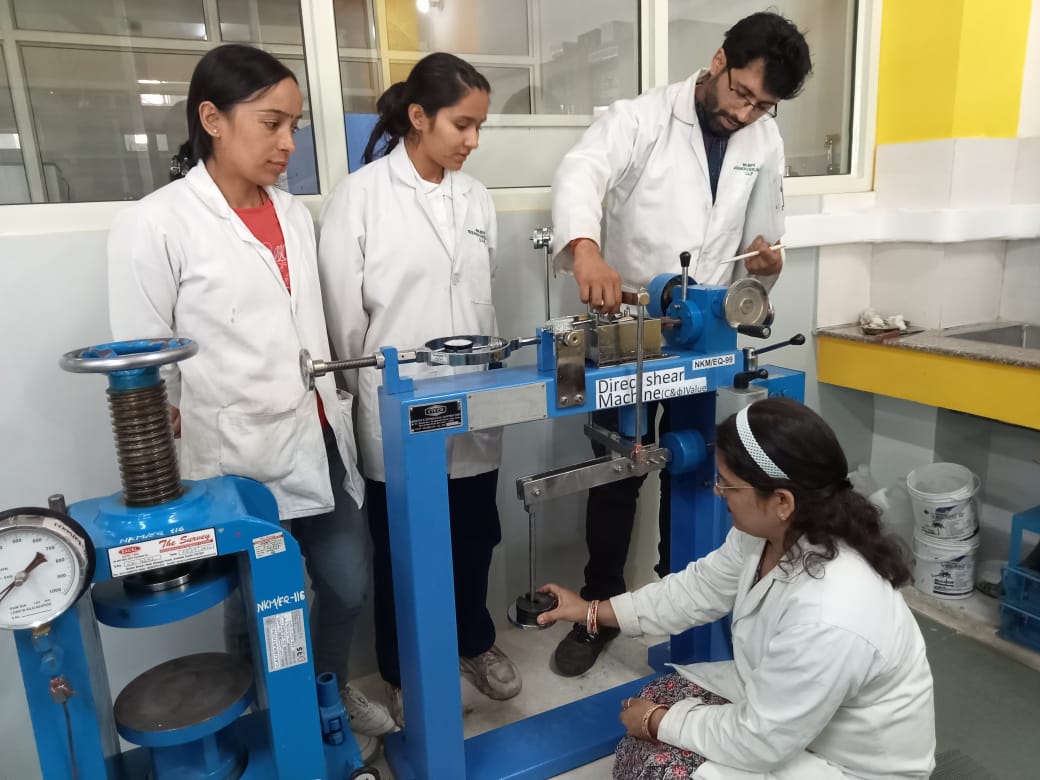
Cohesion and Angle of Internal Friction Test of Soil in progress under controlled shear loading conditions
Shear force application during cohesion and internal friction angle testing of soil.
Test Procedure:
  1. A cylindrical soil specimen is placed inside a rubber membrane and fitted within a triaxial chamber.
  2. The specimen is subjected to a confining pressure (σ₃) that simulates the lateral earth pressure on the soil.
  3. Axial load (σ₁) is applied to the specimen, increasing until the specimen fails.
  4. The failure is monitored by measuring the axial displacement and recording the stresses at different stages.
  5. The test is typically performed under drained or undrained conditions, depending on the type of soil being tested and the field conditions.
Advantages:
  • Provides a comprehensive analysis of soil behavior under realistic stress states.
  • Can simulate both drained and undrained conditions, which is important for understanding the effects of pore water pressure in cohesive soils.
  • Gives additional information about the modulus of elasticity, Poisson's ratio, and effective stress.
Disadvantages:
  • More complex and expensive than the direct shear test.
  • The test is time-consuming and requires careful sample preparation.
  • Not suitable for very fine-grained soils in some cases.
Applications: The triaxial shear test is commonly used for soil analysis in critical applications such as foundation design, slope stability, and the assessment of soil behavior in dams and embankments.
3.3 Unconfined Compression Test (For Cohesive Soils)
The Unconfined Compression Test is used primarily for cohesive soils, such as clays, which exhibit a high degree of cohesion. This test is simple to conduct and measures the compressive strength of a soil specimen when no lateral confinement is applied. Test Procedure:
  1. A cylindrical specimen of soil is prepared, usually in a natural or remolded state, and placed in a compression testing machine.
  2. The specimen is subjected to an axial compressive load until failure occurs.
  3. The axial stress at failure is recorded, and the maximum compressive strength is used to estimate the cohesion of the soil.
Advantages:
  • Simple and quick to perform.
  • Ideal for testing cohesive soils where the angle of internal friction is less significant.
  • Useful in assessing the shear strength of clays and other fine-grained soils.
Disadvantages:
  • Cannot be used for granular soils or soils that require lateral confinement.
  • Does not provide direct information about the angle of internal friction.
Applications: This test is used extensively in the evaluation of clays for foundation design, slope stability, and other geotechnical projects involving cohesive soils.

4. Standard Codes and Procedures

Several international standards and codes guide the testing and determination of cohesion and the angle of internal friction of soils. These standards provide guidelines for sample preparation, test procedures, and the reporting of results. Adhering to these standards ensures consistency, accuracy, and comparability of test results.
  • ASTM D3080– Standard Test Method for Direct Shear Test of Soils Under Consolidated Drained Conditions.
  • ASTM D4767– Standard Test Method for Consolidated Drained Triaxial Compression Test for Soils.
  • BS 1377 Part 7– British Standard for Shear Tests on Soils.
  • IS 2720 Part 10– Indian Standard for Direct Shear Test.
These codes outline the specific requirements for performing the tests, including equipment specifications, test conditions, and the methods of calculating shear strength parameters. Compliance with these standards ensures that test results are reliable and can be applied to real-world engineering problems.

5. Benefits of Cohesion and Angle of Internal Friction Testing

The testing of cohesion and the angle of internal friction provides several key benefits in geotechnical engineering, including:
  1. Informed Design Decisions: Accurate knowledge of soil shear strength enables engineers to design foundations, slopes, retaining walls, and embankments that are both safe and efficient. Proper testing ensures that the structures can withstand anticipated loads and stresses.
  2. Cost-Effective Solutions: By understanding soil behavior under stress, engineers can avoid overdesigning structures or using excessive materials. This leads to cost savings in material usage, construction methods, and labor.
  3. Risk Management: Soil failure, whether from landslides, foundation settlement, or erosion, poses significant risks to both safety and finances. By testing the shear strength parameters, engineers can assess these risks and mitigate them through appropriate design measures.
  4. Optimization of Construction Methods: Understanding the shear strength of soil helps determine the best construction techniques, such as soil stabilization, compaction methods, and foundation depth. These techniques can optimize the construction process and ensure the long-term stability of structures.
  5. Compliance with Regulations: Many construction codes and regulations require soil testing to ensure safety standards are met. Testing for cohesion and the angle of internal friction helps meet these regulatory requirements, ensuring the safety of infrastructure projects.

6. Applications of Cohesion and Angle of Internal Friction Tests

The results of cohesion and angle of internal friction tests are applied across various fields of geotechnical engineering. Some of the major applications include:
  1. Foundation Design: Accurate shear strength data is essential in determining the appropriate size and depth of foundations. Knowing the cohesion and friction angle helps engineers design foundations that can bear the load of the structure without excessive settlement or failure.
  2. Slope Stability Analysis: The stability of slopes, especially in hilly or mountainous terrain, relies heavily on the shear strength of the soil. By understanding these properties, engineers can design slopes and embankments that are resistant to sliding or failure.
  3. Retaining Wall Design: Retaining walls are designed to resist lateral earth pressure from soil behind them. The shear strength parameters of the soil behind the wall, including cohesion and internal friction, are vital in designing safe and stable walls.
  4. Pavement and Road Design: For roads and pavements, the shear strength of the subgrade is crucial in determining the required thickness of the pavement and ensuring that the road can support traffic loads without failure.
  5. Tunneling and Excavations: When excavating or constructing tunnels, understanding soil behavior under shear stress is essential for avoiding collapse or excessive deformation of the soil.

7. Conclusion

The determination of cohesion and the angle of internal friction through laboratory testing is absolutely crucial in the field of geotechnical engineering, as it provides the fundamental parameters for understanding how soil behaves under applied loads. The shear strength of soil, governed by these two properties, plays a central role in ensuring the safety and stability of civil engineering structures, particularly those that interact directly with the ground, such as foundations, slopes, embankments, retaining walls, and roadways. By accurately assessing these soil properties, engineers can design structures that are not only safe but also cost-effective. For instance, soil strength testing helps in optimizing foundation designs—avoiding overly conservative designs that may waste resources while also preventing the risk of foundation failure, which can lead to costly repairs and even catastrophic structural damage. Moreover, the ability to assess the shear strength of soil is crucial in risk management. Geotechnical engineers routinely assess slope stability and foundation conditions to predict the likelihood of failure in a variety of scenarios—whether from lateral movement or settlement under load. For example, a failure to account for poor cohesion in clayey soils or an overly high angle of internal friction in loose sand can lead to issues such as landslides, subsidence, or tilting of buildings and structures. Testing allows engineers to proactively implement safety measures, mitigating risks before construction begins. Beyond safety, the testing of these soil properties aids in the optimization of construction materials and techniques. By knowing the soil's shear strength, engineers can adjust design specifications to use the minimum necessary amount of materials. This contributes to environmental sustainability by reducing the overuse of concrete, steel, and other resources, thereby lowering the carbon footprint of construction projects. Furthermore, tests for cohesion and angle of internal friction are indispensable for regulatory compliance. Local and international building codes require that soil conditions be thoroughly tested to ensure compliance with standards related to foundation performance, slope stability, and earth-retaining structures. This is especially important in areas prone to seismic activity, flooding, or extreme weather conditions, where soil behavior can drastically change. Rigorous soil testing allows engineers to adjust designs to accommodate these variables, ensuring that structures remain stable and safe even under challenging environmental conditions. In terms of future advancements, as geotechnical engineering continues to evolve, the need for more accurate, efficient, and cost-effective testing methods becomes more critical. Innovations in soil testing equipment, including the use of automated testing systems and real-time data monitoring, are likely to make these tests faster and more precise. New technologies such as non-invasive soil testing methods, including geophysical surveys and remote sensing technologies, may also complement traditional lab-based tests, offering the potential to perform on-site tests at a larger scale, reducing costs and time for both preliminary investigations and ongoing monitoring during construction. As urbanization continues to increase, particularly in geologically complex or disaster-prone regions, the role of cohesion and angle of internal friction testing will become even more critical. With this knowledge, engineers can design and construct not only for safety and stability but also for resilience. Structures can be built to endure the impacts of climate change, including heavier rainfall, flooding, and shifting ground conditions. As global challenges such as soil erosion, landslides, and flooding become more prevalent due to climate change, understanding the shear strength of soil will be crucial in developing solutions to maintain the integrity of the built environment. Additionally, in regions with scarce or unreliable geotechnical data, advanced testing methods and the expansion of soil databases will become more critical. By creating detailed, site-specific profiles of soil strength characteristics, it will be possible to make more informed decisions not only for new construction but also for the retrofitting of existing infrastructure. In conclusion, the testing of soil's cohesion and angle of internal friction remains at the heart of modern geotechnical practice. It is indispensable for the design of stable and secure structures, minimizing risks, optimizing material usage, and ensuring that civil engineering projects are conducted in a sustainable and cost-effective manner. As our understanding of soil behavior deepens and testing methods evolve, the role of these tests in designing safer, more efficient, and resilient infrastructures will only increase. Future engineers will continue to rely on the fundamental principles of shear strength testing to meet the challenges posed by a rapidly changing world.

Why Choose NKMPV for Direct Shear Testing?

NABL Accredited Results

Our direct shear test reports carry NABL accreditation (ISO/IEC 17025:2017), accepted by NHAI, state PWDs, structural consultants, courts, and arbitration tribunals as definitive shear strength evidence.

Precision Strain-Controlled Equipment

Our motorised direct shear machine provides constant strain-rate shearing with adjustable speed, ensuring accurate peak and residual strength determination. The proving ring and dial gauges are NABL-calibrated for measurement traceability.

Both Peak and Residual Strength Reported

We report both peak shear strength (for first-time loading conditions) and residual shear strength (for previously sheared or reactivated surfaces). This distinction is critical for slope stability analysis in areas prone to landslides.

Complete Geotechnical Testing Package

We combine direct shear results with grain size analysis, Atterberg limits, MDD/OMC, and bearing capacity calculations to deliver a complete geotechnical characterisation in a single engagement — no need for multiple lab visits.

Experienced Geotechnical Team

Our laboratory technicians are trained in handling undisturbed soil specimens without disturbing the natural fabric — a critical skill for obtaining reliable shear strength data, especially for sensitive clays and silts.

Frequently Asked Questions

Cohesion (c) is the component of shear strength that exists even when no normal stress is applied — it represents the 'glue' between soil particles due to cementation, suction, or electrostatic forces. It is predominant in clays. The angle of internal friction (phi) represents the shear resistance that increases with the normal (confining) stress — it is caused by interlocking and frictional resistance between particles. Sandy soils have high phi (28-40 degrees) and low c, while clays have higher c and lower phi.
IS 2720 Part 13 (Methods of Test for Soils — Direct Shear Test) is the governing standard. It specifies the apparatus dimensions (60 mm x 60 mm shear box), specimen preparation, rate of shearing, and data recording procedures. The companion standard IS 2720 Part 11 covers the triaxial compression test, which is an alternative method for determining shear strength parameters.
A minimum of three specimens from the same soil sample are required for a single direct shear test. Each specimen is tested under a different normal stress (typically 50, 100, and 150 kPa). Three data points are the minimum needed to construct the Mohr-Coulomb failure envelope and determine c and phi values. For higher accuracy, four specimens may be tested.
The Mohr-Coulomb failure envelope is a straight-line graph plotting shear stress at failure (y-axis) against normal stress (x-axis). It is described by the equation tau = c + sigma tan(phi), where tau is shear stress, sigma is normal stress, c is cohesion, and phi is the angle of internal friction. Points below the line represent stable stress states, while points reaching the line indicate shear failure. This envelope is the foundation of all shear strength-based geotechnical design.
Peak shear strength is the maximum shear stress the soil can resist before failure — it is used for design of foundations and new slopes. Residual shear strength is the reduced, steady-state shear stress that the soil sustains after the failure surface has developed and large displacements have occurred. Residual strength is always lower than peak strength and is critical for analysing reactivated landslides, old slip surfaces, and soil-structure interfaces.
Yes, the direct shear test works well for both cohesive (clay, silt) and cohesionless (sand, gravel) soils. For sandy soils, the cohesion (c) value is typically zero or near-zero, and the angle of internal friction (phi) is the dominant parameter (typically 28-40 degrees for medium to dense sand). The shear rate may be higher for free-draining sands since excess pore pressure dissipation is not a concern.

Need Direct Shear Testing? Get a Quote Today.

+91-XXXXX-XXXXX