Non-Destructive Testing

Bridge Load Test

Proof load testing and structural adequacy assessment for bridges

IRC SP 51 IRC 112:2020 IS 1915:1961
The bridge load test is a full-scale proof loading procedure that evaluates the structural adequacy of a newly constructed or existing bridge by applying a known load and measuring the resulting deflections, strains, and recovery. It is the definitive method for confirming that a bridge can safely carry its design traffic loads before being opened to the public.

What Is the Bridge Load Test?

A bridge load test subjects the structure to controlled loading — typically using loaded trucks of known weight positioned at predetermined locations on the deck — and measures the structural response using precision instruments. The test verifies that deflections remain within permissible limits prescribed in IRC SP 51 and that the recovery ratio after load removal exceeds 75%, confirming that the structure is behaving elastically and has adequate reserve strength. Bridge load testing is mandated by NHAI and state PWD departments for all newly constructed bridges before opening to traffic, and for existing bridges when structural adequacy is in question due to ageing, overloading, accidental damage, or change in use. The test may be static (gradual load application and sustained hold), dynamic (moving vehicle loads to assess impact factors), or a combination of both. At NKMPV, we perform bridge load tests using calibrated load trucks conforming to IRC loading classes (Class AA, Class A, and Class 70R). Deflections are measured using LVDTs (Linear Variable Differential Transformers) and precision dial gauges positioned at mid-span, quarter-span, and support locations. Strain gauges are bonded to critical structural members to monitor stress distribution. Our team has tested RCC slab bridges, T-beam girder bridges, prestressed concrete bridges, and steel truss bridges across Haryana, Punjab, and Himachal Pradesh. We also complement load testing with ultrasonic pulse velocity and rebound hammer assessments to evaluate concrete quality in the bridge superstructure.

Test Parameters & Acceptance Criteria

The following parameters are measured during bridge load testing. Acceptance criteria are governed by IRC SP 51, IRC 112, and the bridge design specifications provided by the client.

Parameter Value / Range Unit Standard
Maximum Deflection Under Load ≤ Span/700 (RCC), ≤ Span/800 (PSC) mm IRC SP 51 Cl. 4.5
Recovery Ratio (Elastic Recovery) > 75% (minimum acceptable) % IRC SP 51 Cl. 4.6
Residual Deflection < 25% of maximum deflection mm IRC SP 51 Cl. 4.6
Test Load (Proof Load) Design live load (IRC Class AA/A/70R) kN or tonnes IRC SP 51 Cl. 3.2
Maximum Strain in Reinforcement Within elastic limit of steel grade microstrain IRC 112 Cl. 12
Crack Width Under Load ≤ 0.2 mm (PSC), ≤ 0.3 mm (RCC) mm IRC 112 Cl. 12.3.4
Impact Factor (Dynamic Test) As per IRC 6 Cl. 208 IS 1915 / IRC 6

Applicable Indian Standards

IRC SP 51

Guidelines for Load Testing of Bridges

IRC 112:2020

Code of Practice for Concrete Road Bridges

IS 1915:1961

Code of Practice for Determination of Load-Bearing Capacity of Bridges by Load Testing

IRC 6:2017

Standard Specifications and Code of Practice for Road Bridges — Loads and Load Combinations

IRC 78:2014

Standard Specifications and Code of Practice for Road Bridges — Foundations and Substructure

Equipment Used

Calibrated Load Trucks

Multi-axle trucks loaded to IRC Class AA / Class A / 70R configurations

Up to 70 tonnes per truck, weighed on calibrated weighbridge before testing

Calibrated

LVDT (Linear Variable Differential Transformer)

HBM WA Series

Measurement range 0-100 mm, resolution 0.001 mm, for mid-span and quarter-span deflection monitoring

Calibrated

Precision Dial Gauges

Mitutoyo 50 mm travel

Least count 0.01 mm, magnetic base mounting on independent reference frame

Calibrated

Electrical Resistance Strain Gauges

HBM LY Series foil strain gauges

120 ohm, gauge factor 2.0, bonded to reinforcement and concrete surfaces at critical sections

Calibrated

Data Acquisition System

HBM QuantumX MX1615

16-channel simultaneous recording of strain, displacement, and temperature at 100 Hz sampling rate

Calibrated

Crack Width Microscope

Peak Scale Loupe 25x magnification

Graduated scale reading to 0.02 mm for crack width measurement under load

Calibrated

Testing Process

1

Pre-Test Inspection & Planning

Day 1

A detailed visual inspection of the bridge is conducted to document existing cracks, spalling, corrosion stains, and any visible distress. The bridge drawings, design calculations, and loading specifications are reviewed. An instrumentation plan is prepared identifying the locations for LVDTs, dial gauges, and strain gauges. The load positions for each load case are marked on the deck per IRC SP 51. Reference benchmarks are established on immovable supports independent of the bridge structure.

2

Instrumentation Setup

Day 1

LVDTs and dial gauges are installed at mid-span, quarter-span, and near supports on the underside of the bridge deck. Strain gauges are bonded to exposed reinforcement or concrete surfaces at critical sections — typically mid-span bottom fibre and near supports. All instruments are connected to the data acquisition system and zeroed. An independent reference frame (scaffolding or ground-anchored frame) supports the deflection measuring devices to ensure readings are unaffected by bridge movement.

3

Load Truck Calibration & Positioning

Day 2

Loaded trucks are weighed on a calibrated weighbridge to confirm exact axle loads and gross vehicle weight. The truck configuration is verified to match the specified IRC loading class — Class AA (tracked or wheeled, 70 tonnes), Class A (55.4 tonnes train), or Class 70R (70 tonne single vehicle). Trucks are positioned on the bridge at predetermined locations to produce maximum bending moment or shear at the instrumented sections. Traffic on the bridge is stopped during the test period.

4

Static Load Application & Monitoring

Day 2

The load is applied in stages — typically 50%, 75%, and 100% of the design test load — with deflection and strain readings recorded at each stage after a stabilisation period of at least 15 minutes. At full load, readings are taken continuously for a minimum holding period specified by IRC SP 51 (typically 30 minutes to 1 hour). Crack widths are measured using the crack microscope. All readings are logged automatically by the data acquisition system with time stamps.

5

Load Removal & Recovery Measurement

Day 2-3

The load is removed in stages (reverse sequence), and deflection and strain readings are recorded at each unloading stage. After complete removal, the bridge is monitored for a minimum recovery period of 1 hour or until deflections stabilise. The recovery ratio is calculated as (maximum deflection minus residual deflection) divided by maximum deflection, expressed as a percentage. A recovery ratio greater than 75% indicates satisfactory elastic behaviour per IRC SP 51.

6

Dynamic Load Test (If Required)

Day 3

For dynamic assessment, a loaded truck crosses the bridge at speeds of 5 km/h, 25 km/h, and the normal traffic speed. Deflection time-history at mid-span is recorded by the data acquisition system at high sampling rate. The dynamic amplification factor (impact factor) is computed as the ratio of maximum dynamic deflection to maximum static deflection. The measured impact factor is compared with the theoretical value specified in IRC 6 Clause 208. Frequency and damping characteristics may also be extracted from the response data.

7

Analysis, Reporting & Certification

Day 3-4

Load versus deflection curves are plotted for each instrumented location. The maximum deflection is compared against permissible values (Span/700 for RCC, Span/800 for PSC). Recovery ratios, residual deflections, measured strains, and crack widths are tabulated and compared against acceptance criteria. The NABL-accredited test report includes all load-deflection plots, strain data, crack mapping, recovery analysis, photographs, and a clear pass/fail recommendation. The report is submitted to NHAI, PWD, or the client's structural consultant.

Where This Test Is Used

Bridge load testing is conducted at critical stages of a bridge's service life. Every newly constructed bridge on National Highways under NHAI must pass a proof load test before opening to traffic, as mandated by IRC SP 51. State PWD departments and municipal corporations require the same for state highways and urban flyovers. Existing bridges undergo load testing when their structural adequacy is questioned — due to visible distress, increase in traffic loading class, or after seismic events. Insurance and litigation cases involving bridge failures also require NABL-certified load test data. NKMPV complements bridge load testing with UPV testing to assess concrete quality, rebound hammer tests for in-situ strength estimation, and soil bearing capacity evaluation of the bridge foundation strata for a complete structural assessment.
Pre-commissioning proof load test for new NH and SH bridges per IRC SP 51 Structural adequacy assessment of ageing and distressed bridges Post-earthquake or post-flood damage evaluation of bridge structures Load rating and reclassification of existing bridges for heavier traffic Flyover and elevated corridor commissioning in urban areas Railway overbridge (ROB) load testing per RDSO specifications Forensic structural investigation for insurance claims and litigation Rehabilitation and strengthening verification of repaired bridges

Detailed Information

Bridge load test

Bridges are critical infrastructure elements that support transportation networks, often enduring high loads and harsh environmental conditions over extended periods. Regular assessments are required to ensure that these structures continue to function safely and efficiently. Bridge load testing is one of the most effective ways to evaluate a bridge’s performance under load, ensuring its structural integrity. This detailed report delves into the principles of bridge load testing, focusing on dial gauges and total stations as integral tools for measuring displacement, deflection, and structural response during testing. These tools allow engineers to gather precise data regarding the behavior of a bridge under various loading conditions, enabling informed decisions on rehabilitation or continued use.

Purpose of Bridge Load Testing

The principal goal of load testing is to confirm that a bridge can safely handle the traffic, loads, and forces it is expected to carry throughout its service life. The specific objectives of conducting bridge load testing include:
  • Confirming Load-Bearing Capacity: Ensuring the bridge can bear the maximum expected loads, including traffic, heavy vehicles, environmental forces (wind, snow, etc.), and natural disasters.
  • Identifying Structural Weaknesses: Assessing specific areas of the bridge where structural weaknesses or defects may be present, such as cracks, corrosion, or stress accumulation.
  • Validating Structural Models: Testing helps validate computational models and theoretical assumptions, which may not always reflect real-world conditions accurately.
  • Monitoring Performance Over Time: Over the life span of a bridge, periodic load testing can help track its performance under load, ensuring that it remains functional and safe.
  • Informing Maintenance and Rehabilitation Plans: Based on testing results, engineers can develop targeted maintenance or rehabilitation plans to extend the bridge’s life and prevent failure.
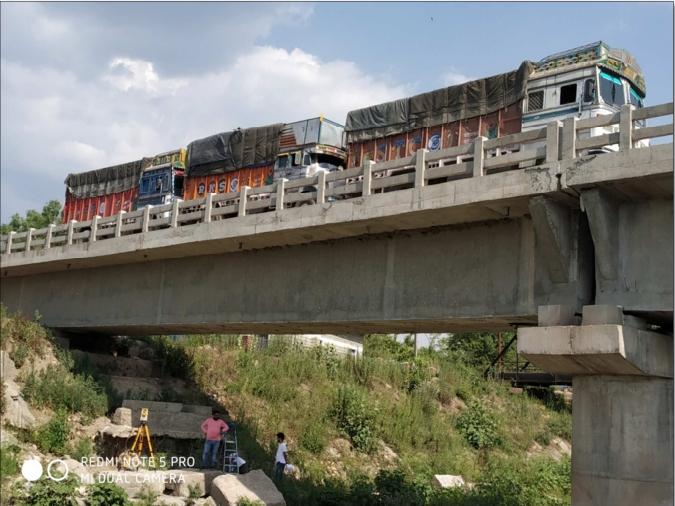
Bridge Load Test using total station to record displacement and movement
Total station setup during Bridge Load Test for precise displacement measurement

Tools and Methodology in Bridge Load Testing

In bridge load testing, the tools and methodology employed are critical for accurate measurement and evaluation. Commonly used tools include dial gauges, total stations, load cells, strain gauges, and displacement transducers. The following sections provide a more comprehensive understanding of how dial gauges and total stations are used to assess the bridge's behavior during testing.
Bridge Load Test with loaded trucks for static load evaluation
Static Bridge Load Test using calibrated trucks to apply design loads

Dial Gauge Testing in Bridge Load Testing

4.1. Dial Gauge Overview

A dial gauge (or dial indicator) is a precision measuring instrument used to measure small displacements, deflections, or dimensional changes. The primary function of a dial gauge during bridge load testing is to measure how much the bridge structure moves (deflects) when subjected to loads.
Components of Dial Gauges:
  • Dial Face: Displays the scale in millimeters or micrometers. The dial face is graduated in fine increments that allow measurement of tiny displacements.
  • Measuring Stem: The probe or stem comes into contact with the surface of the bridge to measure displacement. The stem moves vertically or horizontally depending on the direction of the applied force.
  • Needle: The needle on the dial rotates in response to the movement of the stem, pointing to the precise deflection value on the dial scale.
The dial gauge can provide real-time readings and is highly accurate, typically in the range of 0.01 mm to 0.1 mm, making it invaluable for identifying small changes in the bridge structure.

4.2. Setting Up Dial Gauges

Selection of Measurement Points
The placement of the dial gauge is a critical step in ensuring accurate measurements. Typically, dial gauges are positioned at specific locations where deflection is expected to be most pronounced. These locations include:
  • Mid-span of beams or decks: This is usually the point of maximum deflection for bridges subjected to loading.
  • Bridge supports or piers: Measuring deflection near the support points can help assess how the load is distributed.
  • Expansion joints or other critical areas: These locations are important for measuring structural movements due to temperature changes or load-induced stress.
Mounting the Dial Gauge
To ensure precise and stable readings:
  • The dial gauge should be mounted securely on a rigid surface or bracket.
  • The stem should be in contact with the bridge surface but without exerting any pressure.
  • The dial gauge should be adjusted to read zerobefore the load is applied to create a baseline measurement.

4.3. Measurement of Displacement

During the load testing phase, the dial gauge continuously measures the deflection of the bridge structure as test loads (usually in the form of trucks or test weights) are applied. The deflection recorded by the dial gauge gives an indication of how the bridge behaves under load, and how much it bends or shifts from its original position.
Static Load Testing:
Dial gauges are particularly useful for static load testing, where a constant load is applied to the bridge, and deflection measurements are taken at regular intervals to observe the structure’s response.
Dynamic Load Testing:
Although dynamic load testing generally requires more sophisticated instrumentation, dial gauges can still provide useful data when measuring vibrational deflections or settling effects in response to moving loads.

4.4. Benefits of Dial Gauge Testing

  1. High Precision: Dial gauges can measure minute deflections down to 01 mm, making them perfect for detecting small changes in structural behavior.
  2. Ease of Use: Dial gauges are simple to operate, with no need for complex setup or software. Readings can be taken directly from the dial.
  3. Cost-Effective: Compared to more sophisticated instruments, dial gauges are relatively inexpensive and accessible.
  4. Real-Time Monitoring: Engineers can continuously observe deflections and adjust testing conditions immediately as data is gathered.

4.5. Limitations of Dial Gauge Testing

  • Point-Specific Measurement: Dial gauges measure deflection at specific points only. To get a comprehensive understanding of the entire bridge's behavior, multiple gauges are needed.
  • Physical Contact: Since the dial gauge measures deflection by direct contact, it may not be suitable for all bridge types or areas where access is difficult.

Total Station Testing in Bridge Load Testing

A total station is a sophisticated instrument used for surveying, measuring distances, angles, and displacements with high accuracy. It combines an electronic theodolite (for angle measurement) and an electronic distance meter (for distance measurement) and is used in bridge load testing to monitor and record the structural movements in three dimensions.

5.1. Total Station Functionality

The total station functions by emitting a laser beam toward a reflective target placed on the bridge. The time it takes for the laser to travel to the target and return to the station is used to calculate the distance. By measuring angles and distances from the instrument to the target, the total station can determine the target's X, Y, and Z coordinates, allowing engineers to track movements in real time with millimeter precision.

5.2. Total Station Setup for Bridge Load Testing

Instrument Placement
The total station is set up at a fixed location, typically some distance from the bridge. The position of the instrument is carefully calibrated to ensure that it can measure the movements of reflective targets accurately. The setup involves:
  • Establishing control pointson the bridge that are used for reference.
  • Mounting the instrument in a stable position with an unobstructed line of sight to the bridge.
Target Installation
Reflective prisms or targets are placed on specific parts of the bridge where movement or deflection is expected. These targets are affixed securely to the bridge using mounting brackets, ensuring their position remains fixed throughout the test. The targets should be placed at:
  • Critical pointswhere deflection is expected to be highest, such as mid-span, near supports, or critical joints.
  • Even distributionacross the structure for a complete view of bridge behavior.

5.3. Measurement During Load Testing

As the test vehicles or loads are applied, the total station continuously measures the displacement of the targets. Unlike dial gauges, the total station can measure movements in three dimensions (X, Y, Z) and can track both vertical and horizontal displacements.
  • The vertical displacementhelps assess how much the bridge sags or deflects under load.
  • The horizontal displacementprovides information about lateral movement or shifts, which can indicate how the structure responds to uneven loading or forces.

5.4. Advantages of Total Station Testing

  1. High Precision: Total stations can measure movements with sub-millimeter precision, ensuring highly accurate data collection.
  2. Non-Contact Measurement: Since the total station measures displacement remotely via laser, it does not require contact with the bridge, making it ideal for measuring hard-to-reach or sensitive areas.
  3. Real-Time Data Collection: Engineers receive real-time measurements, which allows for immediate data analysis and adjustments during the testing phase.
  4. Comprehensive Coverage: Multiple targets can be measured simultaneously, providing a more holistic view of the bridge’s behavior under load.

5.5. Limitations of Total Station Testing

  • Line of Sight: The total station requires an unobstructed line of sightbetween the instrument and the reflective targets, which may be difficult to maintain if there are large structures or traffic between the instrument and the bridge.
  • Setup Complexity: Setting up a total station requires careful calibration and precise placement of both the instrument and the targets. Skilled technicians are often required for this task.
  • Cost: Total stations can be relatively expensive, making them less cost-effective for small-scale testing or where only limited data is required.
Bridge Load Test engineers monitoring structural response on site
Engineering team conducting Bridge Load Test with field instrumentation

Benefits of Bridge Load Testing

Through the use of tools like dial gauges and total stations, engineers can conduct thorough bridge load testing that provides a wealth of information, leading to numerous benefits, including:
  • Safety Assurance: Testing helps ensure that bridges are safe to use, preventing accidents caused by unexpected failures or weak points in the structure.
  • Informed Structural Decisions: Data gathered from the load test enables engineers to make informed decisions on maintenance, rehabilitation, or replacement.
  • Cost-Efficiency: Identifying potential structural problems early through load testing allows for targeted repairsrather than costly emergency interventions.
Incorporating tools such as dial gauges and total stations into bridge load testing allows for highly accurate and detailed assessments of the bridge’s deflection and overall behavior under load. These methods provide engineers with precise data that can inform maintenance, safety assessments, and long-term planning for infrastructure management. By conducting thorough load testing, bridge operators can ensure the safety and reliability of these critical structures, safeguarding both public and operational interests.

Duration of Bridge Load Testing

The duration of bridge load testing can vary depending on several factors, including the complexity of the bridge structure, the types of tests being performed, and the specific tools used. Here’s a breakdown of how long each phase might take and the factors that influence the total testing period: 8.1. Factors Affecting Duration Several factors influence how many days a bridge load test will take. These include:
  • Size and Complexity of the Bridge: Larger and more complex bridges (such as multi-span or suspension bridges) typically require more time to test due to their size, number of structural components, and the variety of load positions tested.
    • Type of Load Testing: The type of load testing being performed also influences the time required. Static load testing(where loads are applied and monitored at specific points) may take longer than dynamic testing (where moving loads are used to simulate real-world conditions).
    • Number of Measurement Points: The number of measurement points where dial gaugesor reflective targets are placed can add time to the setup and testing phase. More measurement points provide more detailed data, but also require more installation time and data collection.
    • Testing Equipment: The use of sophisticated instruments such as total stationsand the associated setup time for calibration and alignment can also affect how long the test takes. For example, a total station setup requires careful calibration to ensure accurate measurements across multiple targets.
    • Weather and Environmental Conditions: Adverse weather (rain, snow, high winds) may delay or interrupt testing. While testing equipment like total stations and dial gauges are generally resilient, poor weather conditions can affect worker safety and logistical processes.
    • Traffic Control: If the bridge is in use by vehicular traffic, it may be necessary to block lanes or completely close the bridge for safety. Coordination with local authorities to manage traffic or reroute it can also add time to the process.
  • 8.2. Typical Duration of Testing Here’s a general breakdown of the time required for different stages of the testing:
    1. Pre-Test Preparation:
    • Duration: 1 to 2 days.
    • Activities: Initial surveys, site assessments, equipment setup, and planning. During this phase, engineers will inspect the bridge, identify measurement points, install preliminary equipment (such as reflective targets or baseline dial gauges), and calibrate instruments (especially total stations).
      1. Setup and Instrumentation:
    • Duration: 1 to 2 days.
    • Activities: The setup phase can take up to 2 daysdepending on the complexity of the bridge and the number of measurement points. During this time, the dial gauges and total stations (or other instruments like strain gauges) are mounted at strategic locations on the bridge. Multiple reflective targets are typically positioned, and equipment calibration is performed.
      1. Static Load Testing:
    • Duration: 1 to 2 days.
    • Activities: Static load testing involves applying heavy loads to the bridge (usually by positioning trucks or other load-bearing equipment) in incremental steps. Data collection occurs throughout this phase, with engineers measuring deflectionsand displacements at multiple points on the bridge. This phase typically lasts for 1 to 2 days, depending on the complexity of load application and the number of measurement points.
      1. Dynamic Load Testing (if applicable):
    • Duration: 1 to 2 days.
    Activities: If dynamic load testing is part of the plan (simulating moving traffic), this can take an additional 1 to 2 days. The total station or other measuring equipment will track the displacement of targets as moving vehicles
    • cross the bridge. This phase tests how the bridge behaves under real-world, dynamic conditions. It often requires several runs to ensure comprehensive data collection, which can extend the testing period.
      1. Post-Test Data Analysis and Reporting:
    • Duration: 1 to 3 days.
    • Activities: After the data is collected, engineers analyze the results to evaluate the deflection, displacement, and overall behavior of the bridge. This analysis may require several days to ensure accuracy. If there is a need to perform additional calculations or run simulations based on the data, this phase could take longer. Final reports, recommendations for repairs, or validation of design assumptions will also be created.
  • 8.3. Total Time for Bridge Load Testing
    • For smaller bridges or simpler tests, the total duration of bridge load testingcould take 3 to 5 days. This includes setup, testing, and initial analysis.
    • For more complex bridges or if multiple tests (e.g., static and dynamic testing) are involved, the process can take up to 7 to 10 days.
    8.4. Breakdown of Time for a Typical Bridge Load Test
    1. Day 1: Pre-test preparation and site survey.
    2. Day 2: Equipment setup, calibration of total stations and dial gauges.
    3. Day 3: Static load testing and initial data collection.
    4. Day 4: Static load testing continues, more measurements are taken.
    5. Day 5: Dynamic load testing (if applicable) and data collection.
    6. Day 6: Post-test data analysis, including reviewing deflections and displacement data.
    7. Day 7-8: Report generation and recommendations.
    The duration of a bridge load test can vary based on multiple factors, but for a typical test using both dial gauges and total stations, it generally takes between 3 to 7 days. The complexity of the test, size of the bridge, weather conditions, and the specific goals of the testing program all contribute to the time required to complete the entire process. Proper planning, equipment calibration, and efficient data collection and analysis can help ensure that the test is completed within a reasonable timeframe, providing engineers with the crucial data they need to evaluate the safety and integrity of the bridge.

Why Choose NKMPV for Bridge Load Testing?

NABL Accredited Results

Our bridge load test reports carry NABL accreditation (ISO/IEC 17025:2017), accepted by NHAI, state PWDs, IRC, courts, and arbitration tribunals as definitive evidence of structural adequacy or deficiency.

Advanced Multi-Channel Instrumentation

We deploy LVDTs, electrical strain gauges, and a 16-channel data acquisition system for simultaneous real-time monitoring of deflections and strains at multiple critical locations — providing comprehensive structural response data, not just single-point measurements.

IRC-Compliant Loading Configurations

Our load trucks are calibrated on certified weighbridges and configured to precisely match IRC Class AA, Class A, and Class 70R loading patterns. Accurate load application is the foundation of a valid bridge load test — we ensure every axle load matches the specification.

Comprehensive Structural Assessment Package

Beyond load testing, we offer UPV testing, rebound hammer tests, core extraction, carbonation depth measurement, and half-cell potential surveys on the same bridge visit — delivering a complete structural health report in one engagement.

Experienced Field Engineering Team

Our engineers have conducted load tests on RCC slab bridges, T-beam girder bridges, prestressed concrete box girders, and steel truss bridges across multiple states. This experience ensures safe test execution, correct instrumentation placement, and accurate interpretation of results.

Frequently Asked Questions

A bridge load test verifies that the bridge structure can safely carry its design traffic load without excessive deflection, cracking, or permanent deformation. It confirms the structural adequacy of the bridge before commissioning (for new bridges) or assesses the residual load-carrying capacity (for existing bridges). The test is mandated by IRC SP 51 and accepted by NHAI and state PWDs as the definitive proof of structural performance.
IRC SP 51 (Guidelines for Load Testing of Bridges) is the primary standard governing the procedure, load application, acceptance criteria, and reporting requirements for bridge load tests in India. IS 1915:1961 provides the general code of practice. IRC 112:2020 specifies the design and serviceability criteria for concrete bridges, including permissible deflection and crack width limits that serve as acceptance benchmarks during load testing.
The recovery ratio is the percentage of deflection that recovers after the test load is removed. It is calculated as (maximum deflection minus residual deflection) divided by maximum deflection, multiplied by 100. A recovery ratio greater than 75% per IRC SP 51 indicates that the bridge is behaving elastically and has adequate strength. A low recovery ratio suggests permanent structural damage, plastic deformation, or overstressing of the structure.
A typical bridge load test takes 2-4 days on site. Day 1 covers visual inspection, instrumentation setup, and zeroing of instruments. Day 2 is the actual loading, monitoring, and unloading cycle for the static test. Day 3 covers dynamic testing (if required) and additional load cases. Reporting takes an additional 3-5 working days after the field test. For multi-span bridges or complex structures, the field testing phase may extend to 5-7 days.
NKMPV performs load tests on all common bridge types in India — RCC slab culverts, T-beam and slab bridges, prestressed concrete (PSC) girder bridges, box girder bridges, steel-concrete composite bridges, and steel truss bridges. The test procedure is adapted based on the bridge type, span length, and design loading class. Both simply supported and continuous span bridges can be tested. We have experience with spans ranging from 6-metre slab culverts to 45-metre PSC girder bridges.
In a static load test, trucks are positioned at fixed locations on the bridge deck, and deflections are measured after the structure reaches equilibrium — this evaluates the load-carrying capacity and elastic behaviour. In a dynamic load test, a loaded truck crosses the bridge at various speeds, and the deflection time-history is recorded to determine the dynamic amplification (impact) factor. Most bridge commissioning tests include both static and dynamic components as per IRC SP 51.

Need Bridge Load Testing? Get a Quote Today.

+91-XXXXX-XXXXX