
Our team travels to your site
For field work, our engineers and instruments mobilise anywhere in India — highway corridors, bridges, plants and greenfield alignments included.
7-day video-AI ATCC surveys to IRC SP 19 — classified vehicle counts, ADT/AADT and design-traffic inputs for IRC 37 pavement design and highway DPRs
ATCC stands for Automatic Traffic Counter cum Classifier — a survey that automatically counts and classifies vehicles into the 17 IRC categories over a 7-day, 24-hour period. It follows IRC SP 19 and provides AADT and design-traffic (msa) data for highway DPRs. NKMPV performs video-AI ATCC surveys across India.
An ATCC (Automatic Traffic Counter Classifier) survey records and classifies every vehicle passing a highway section continuously for 7 days × 24 hours, sorted into the 17-class IRC SP 19 vehicle scheme. NKMPV runs ATCC surveys using video-based AI classification — faster and more accurate than manual counters or pneumatic tubes — with reports accepted by NHAI, BoT/HAM concessionaires, and state PWDs across India.
The following parameters are recorded and computed from a 7-day continuous ATCC video-AI survey. Outputs are formatted to comply with IRC SP 19, IRC SP 84 (Manual for Concessioning), IRC 37, and NHAI DPR requirements.
| Parameter | Value / Range | Unit | Standard |
|---|---|---|---|
| Vehicle Classification Scheme | 17-class per IRC SP 19 (2W, 3W, car/jeep/van, mini-bus, bus, LCV-pax, LCV-goods, 2-axle truck, 3-axle, 4/5/6/7+-axle MAV, tractor with 1/2 trailers, ADV, bicycle) | categories | IRC SP 19 Cl. 4.3 / Annexure 4-1 |
| Survey Duration | 7 consecutive days × 24 hours continuous (per IRC SP 19 / SP 84 minimum) | days | IRC SP 19 Cl. 4.2 |
| Classification Accuracy (video-AI vs ground-truth) | ≥ 95% (validated against 10% manual ground-truth sample per station) | % | Internal QA per IRC SP 19 validation protocol |
| Time Resolution (raw data) | Per-vehicle event log with timestamp, direction, lane, speed; aggregated to 15-min and hourly bins | minutes | IRC SP 19 Cl. 4.4 |
| Average Daily Traffic (ADT) | Computed from 7-day total / 7 | vehicles/day | IRC SP 19 / IRC 37 Cl. 5.2 |
| Annual Average Daily Traffic (AADT) | ADT × seasonal correction factor (per IRC region) × day-of-week factor | vehicles/day | IRC 37 Cl. 5.2 / IRC 9 |
| Vehicle Damage Factor (VDF) | Computed per class from paired axle load survey, fourth-power law | dimensionless | IRC 37 Table 2 / IRC 81 |
| Design Traffic (Cumulative MSA) | 10/15/20/30-year cumulative standard axles, per IRC 37 formula | msa | IRC 37 Cl. 5.3 |
| Directional Distribution Factor | Computed per direction from 7-day data | dimensionless | IRC 37 Cl. 5.1 |
| Peak Hour Factor | AM peak / PM peak / overall peak (volume-to-capacity ratio per IRC 106) | dimensionless | IRC 106 |
Manual for Survey, Investigation and Preparation of Road Projects — defines the 17-class vehicle classification and ATCC survey methodology
Manual of Specifications and Standards for Six-Laning of National Highways — traffic data requirements for BoT/HAM concession projects
Guidelines for the Design of Flexible Pavements — design traffic MSA computation methodology
Traffic Census on Non-Urban Roads — establishes seasonal correction factors and AADT estimation
Guidelines for Capacity of Urban Roads in Plain Areas — peak-hour volume and capacity analysis
MoRTH circulars on traffic data acceptance for NHAI DPRs and BoT/HAM concession monitoring
High-resolution roadside camera + edge-compute classifier
Continuous 7-day recording at 30 fps; on-edge AI classifies into IRC SP 19 17 categories with timestamp, direction, lane, and speed; ≥ 95% accuracy benchmarked against manual ground-truth
CalibratedDeep-learning vehicle classifier trained on Indian fleet imagery (auto-rickshaws, MAVs, tractor-trailers, ADVs)
Per-vehicle event log; 17-class scheme; handles night vision, monsoon, and partial-occlusion scenarios; validated against IRC SP 19 visual classifier reference set
ValidatedActive IR illuminator with CMOS sensor
Maintains classification accuracy in zero-ambient-light conditions across the 18:00-06:00 window when classification is hardest for human counters
CalibratedHeavy-duty rubber tube + multi-channel data logger
Backup axle-count and speed measurement deployed when video sight-lines are obstructed; classification limited to axle-based scheme (5-6 categories) per IRC SP 19 Annexure
CalibratedTrained surveyors with handheld tally counters
Conducts a minimum 10% ground-truth sample (typically 16 hours per 7-day station, distributed across day/night/weekend) for independent validation of AI classification accuracy per IRC SP 19 QA protocol
Trained per IRC SP 19Solar + battery backup with 4G/LTE upload capability
Zero-power-failure 7-day continuous recording; raw video archived locally and to cloud; client receives full unedited footage for independent verification
TestedThe team visits the project corridor to identify ATCC station locations per IRC SP 19 spacing requirements (typically every 25-50 km on long corridors, plus traffic-influence-area stations near intersections, settlements, and agricultural belts). Each station is selected on a straight, level mid-block section away from intersections, bus stops, and toll plazas. GPS coordinates and lane configuration are recorded.
Cameras are mounted on roadside poles or temporary masts at the height and angle that gives unobstructed view of all lanes in both directions. The AI system runs a 30-minute calibration sweep — sample frames are reviewed for plate visibility, occlusion patterns, sun-glare windows, and headlight bloom. If sight-lines are compromised, a backup pneumatic-tube ATCC is laid as a redundant counter.
Cameras record continuously for 7 consecutive days × 24 hours per IRC SP 19 minimum survey duration. The AI classifier runs in real-time on the edge device and uploads per-vehicle event logs to the cloud every 15 minutes. The field team conducts daily QA visits to verify camera integrity, IR illumination, power supply, and to download raw footage.
A trained classification team conducts manual counts for a stratified 10% sample (typically four 4-hour windows distributed across day/night/peak/weekend). AI-classified output is compared event-by-event against manual records; any class with < 95% match triggers re-training of the AI model on that class's frames before final classification is locked.
After the 7-day recording closes, the full footage is re-processed in batch mode with the validated model. Any frames flagged low-confidence are visually verified by the analyst team. Output is the per-vehicle event log: timestamp, direction, lane, IRC SP 19 class, speed, and frame reference for audit trail.
ADT is computed from the 7-day total. AADT is derived using IRC 37 / IRC 9 seasonal correction factors. Combined with paired axle load survey data, Vehicle Damage Factor (VDF) is calculated per class using the fourth-power law. Design traffic in cumulative MSA is computed for the specified design life using N = 365 × A × D × F × [(1+r)^n − 1] / r per IRC 37 Cl. 5.3. Hourly distribution charts, peak-hour factors, and class-distribution pies are generated.
The final ATCC report includes: (1) classified hourly and daily volume tables for all 17 IRC classes, (2) ADT/AADT computation worksheets, (3) directional distribution and peak-hour analysis, (4) VDF and design-traffic MSA worksheets, (5) per-station class-distribution charts, (6) sample video frames per class as classification evidence, (7) raw per-vehicle event log in CSV, and (8) an executive summary formatted to NHAI DPR / BoT concession requirements.
Further reading: ATCC vs Manual Traffic Count — Why Video-AI Wins on Accuracy, Speed and Evidence — head-to-head comparison of video-AI, pneumatic-tube and manual classified-count methods on Indian highway projects.
NKMPV provides video-AI ATCC (Automatic Traffic Counter Classifier) survey services across India for highway, expressway, and urban infrastructure projects. Our surveys deliver classified, continuous, 7-day × 24-hour traffic data per IRC SP 19, accepted by NHAI, NHIDCL, state PWDs, and BoT/HAM concessionaires.
NKMPV's ATCC method uses high-resolution roadside cameras with edge-deployed deep-learning classifiers — faster than manual counts and substantially more accurate than pneumatic-tube counters. Every classified vehicle is linked to a video frame for permanent evidence trail.
Accuracy. Our AI classifier consistently delivers ≥ 95% per-class accuracy against manual ground-truth, validated on a 10% stratified sample per station. Human counters typically drop to 80-88% accuracy over a 24-hour fatigue cycle. Pneumatic-tube ATCCs can count axles reliably but cannot visually distinguish vehicle types (e.g., 2-axle truck vs. mini-bus vs. LCV-goods).
Speed. AI processes the entire 7-day record in 2-3 days. Manual transcription of an equivalent volume takes weeks. Total mobilisation-to-report turnaround for a 5-station corridor: 14-18 days.
Coverage. AI handles parallel deployment of 5-10 stations across a corridor without proportionally increasing field staff cost.
Evidence trail. Every classified vehicle is linked to a video frame timestamp. Clients receive full unedited 7-day footage. Useful in arbitration, toll-revenue audit, and independent re-verification.
Night accuracy. IR night-vision modules maintain classification accuracy through 18:00-06:00, when human counters and even pneumatic tubes degrade most.
NKMPV classifies every vehicle into the full 17-class scheme prescribed by IRC SP 19, not the simplified 5-7 axle-based bins typical of pneumatic-tube ATCC. The classes:
Per-vehicle event log (CSV) with timestamp, direction, lane, IRC SP 19 class, speed, and frame reference for audit trail.
Hourly classified volume tables for all 17 IRC classes across the full 7-day window.
ADT and AADT worksheets with IRC 37 / IRC 9 seasonal correction factor application.
Vehicle Damage Factor (VDF) and cumulative MSA worksheets per IRC 37 Cl. 5.3 — directly usable as IRC 37 / IRC 58 design-traffic input.
Class-distribution charts (pie + hourly histogram) and peak-hour factor analysis per IRC 106.
Sample frame archive showing one classified video frame per IRC class as classification-evidence.
Full 7-day unedited video footage on hand-over media.
Summary report formatted to NHAI DPR or BoT/HAM concession requirements.
Contact NKMPV today for an ATCC survey quote:
We respond to ATCC quote requests within one working day with a station-by-station scope, indicative cost, and IRC SP 19 deliverable list.

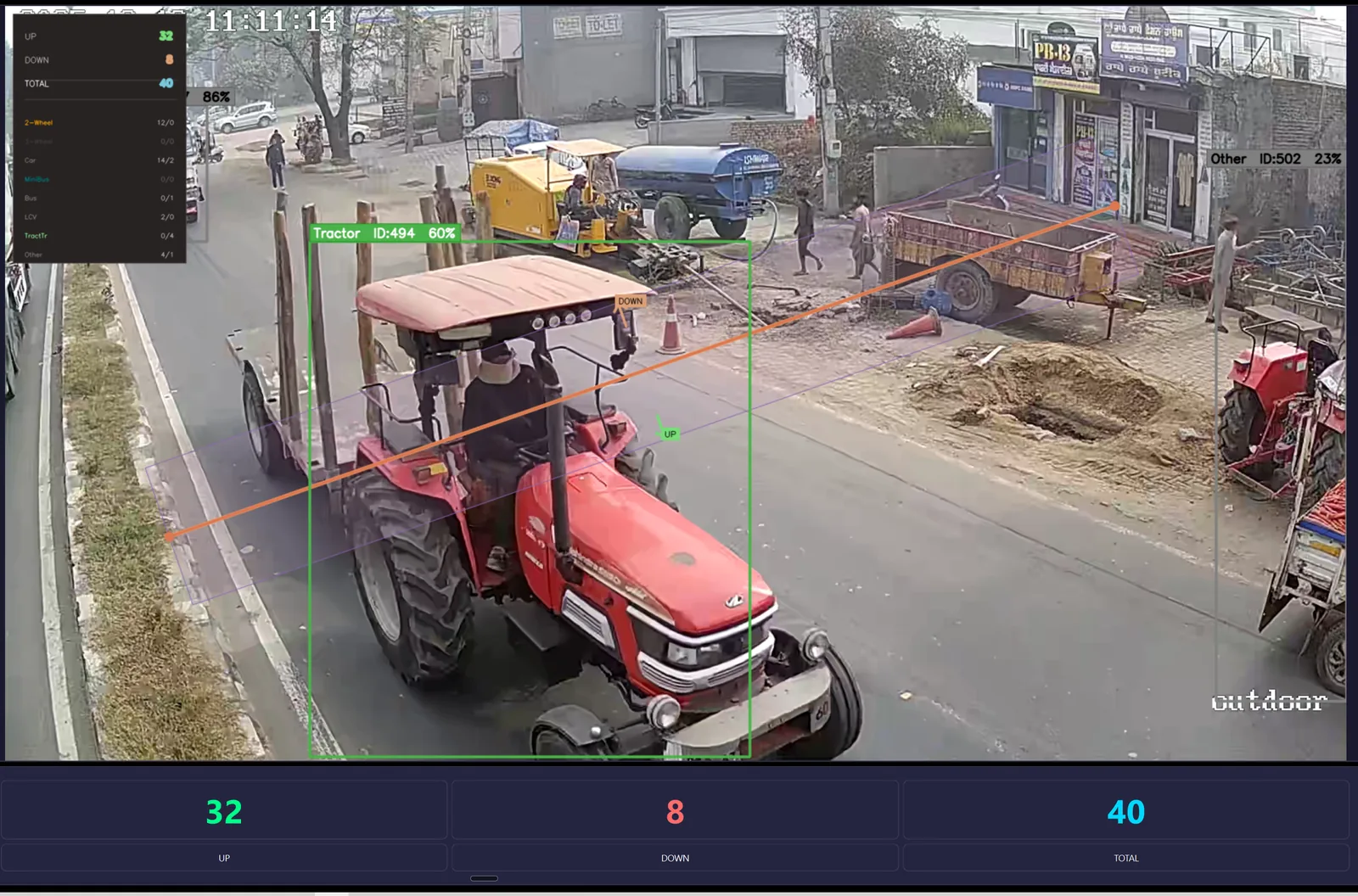
Our in-house AI classifier consistently delivers ≥ 95% per-class accuracy against manual ground-truth, even at night and in monsoon conditions. Human counters typically drop to 80-88% accuracy over a 24-hour fatigue cycle. AI processes the entire 7-day record in 2-3 days vs. weeks for manual transcription, with no shift-change classification drift.
We classify into the full 17-class scheme prescribed by IRC SP 19, not the simplified 5-7 axle-based bins typical of pneumatic-tube ATCC. This means the data is directly accepted for NHAI DPR submission, BoT/HAM concession reporting, and IRC 37 design-traffic computation without re-classification work.
Subgrade CBR and material tests for the same corridor are run in NKMPV's NABL-accredited laboratory (TC-14144), so traffic and pavement inputs come from one team.
Every classified vehicle is linked to a video frame timestamp. Clients receive the full unedited 7-day footage along with the classification log, providing a permanent audit trail for toll-revenue disputes, arbitration cases, or independent re-verification.
Our ATCC team has deployed for NHAI corridor surveys across North India. We understand NHAI report formats, IRC SP 19 station-spacing requirements, and the seasonal-correction-factor application patterns expected by NHAI consultants.
We bundle ATCC with paired <a href="/services/axle-load-test">axle load surveys</a> for VDF computation, <a href="/services/nsv-testing-service">NSV pavement-condition surveys</a>, and <a href="/services/falling-weight-deflectometer-fwd-test">FWD structural evaluation</a> in a single mobilisation — delivering all four IRC 37 / IRC 115 inputs from one team, reducing co-ordination cost for DPR consultants.
ATCC stands for Automatic Traffic Counter-cum-Classifier. In highway, expressway, and toll-plaza projects it is an automated system — video-AI cameras (or axle/loop sensors) — that continuously counts every vehicle and classifies it into the IRC SP 19 17-class scheme, 24×7, without manual surveyors. NKMPV delivers ATCC survey data accepted by NHAI, MoRTH, and state PWDs for DPR preparation and toll studies.
Yes — these are different names for the same deliverable. NKMPV runs the ATCC as a video traffic survey: roadside cameras record the corridor 24×7 and AI classifies every vehicle, so the output is a classified volume count (CVC) — the traffic volume broken down by the 17 IRC SP 19 vehicle classes. In practice, ATCC survey, video traffic survey, classified traffic volume count survey, and automatic traffic classifier counter all refer to the same continuous 7-day × 24-hour classified count.
An ATCC survey per IRC SP 19:2001 uses automated equipment — either video-AI cameras, inductive loops, piezo sensors, or pneumatic tubes — to count and classify vehicles 24/7 without manual surveyors. Modern AI-based ATCC (used by NKMPV) classifies vehicles into 17 categories per IRC SP 19: 2-wheeler, 3-wheeler, car/jeep/van, LCV, mini-bus, bus, 2-axle truck, 3-axle truck, multi-axle truck (3 classes), tractor with trailer, tractor without trailer, cycle, cycle rickshaw, animal-drawn, and miscellaneous. Output: hourly and daily counts per class, peak-hour identification, ADT (Average Daily Traffic), AADT (Annual Average Daily Traffic with seasonal correction).
Per IRC SP 19:2001, ATCC surveys must run for a minimum of 7 consecutive 24-hour days to capture weekday/weekend variation. For NHAI feasibility studies and concession agreements, MoRTH typically asks for 14 days minimum. For projects requiring seasonal correction (tourist corridors, harvest-cycle freight routes, monsoon-impact assessment), surveys at 3-6 month intervals over a year may be required. Modern video-AI ATCC automates the 24-hour observation, so longer durations cost only marginally more (crew mobilisation is the dominant cost, not observation time). See our companion IRC SP 19 procedure guide.
Manual traffic count — surveyors with tally sheets at the roadside, observing and classifying each passing vehicle. Labour-intensive, accuracy varies with surveyor fatigue, limited to daylight + good visibility. Cost-effective for short (1-2 day) surveys at low-traffic locations. Video-AI ATCC — camera capturing the traffic stream, AI vision model classifying each vehicle. Runs 24/7, high accuracy (95-98%), capable of capturing night-time and adverse-weather traffic. Higher per-day cost but lower cost-per-hour-of-observation; the only viable option for >3-day surveys. NKMPV uses video-AI ATCC with IRC SP 19-compliant 17-class output. Comparison detail in our ATCC vs manual count blog.
Coverage
Wherever your project is, there are two ways to work with NKMPV on ATCC Survey.
For field work, our engineers and instruments mobilise anywhere in India — highway corridors, bridges, plants and greenfield alignments included.
Distance is not a constraint for laboratory testing. Send samples to our Pinjore laboratory and receive the digital report on completion — the route most of our out-of-region clients use.
These are locations where we have completed projects — not the boundary of our service area. We mobilise across India on request. See full coverage & project locations →
ATCC Survey is carried out to IRC SP 19, IRC SP 84, IRC 37:2018 and IRC 9, as listed in the Applicable Standards section of this page. Tell us the specification your project must comply with and the quotation will state the standard the work follows.
Our laboratory is at Pinjore, Haryana, within same-day reach of Chandigarh, Panchkula, Mohali, Ambala and the wider Tri-City. If you are further away, distance is not a constraint: our field team travels to site anywhere in India for on-site work, and for laboratory tests you can courier samples to the Pinjore lab and receive the report digitally. Clients across Punjab, Haryana, Himachal Pradesh, Delhi-NCR, Uttarakhand, Rajasthan, Uttar Pradesh, Jammu and Kashmir and Ladakh already work with us this way.
Yes. NKMPV operates pan-India. We have delivered projects across Chandigarh, Panchkula, Mohali, Ambala, Karnal, Kurukshetra, Yamunanagar, Hisar and beyond, and we mobilise to greenfield and remote corridors on request. The 18 locations listed on our site are the places we have already worked — not the limit of where we go.
Send us the project details — location, quantity, and the standard you need to comply with — and you get a written quotation, usually within one working day. Pricing depends on sample count, site access and mobilisation distance, so we quote per project rather than publishing a fixed rate. Call +91-82953-60108 or use the quote form; every quotation states the applicable IS/IRC standard.
Need ATCC Survey for your project?