
Our team travels to your site
For field work, our engineers and instruments mobilise anywhere in India — highway corridors, bridges, plants and greenfield alignments included.
Network Survey Vehicle surveys to IRC SP 16 — IRI roughness, rut depth, cracking and texture depth as GPS-referenced data for highway condition assessment
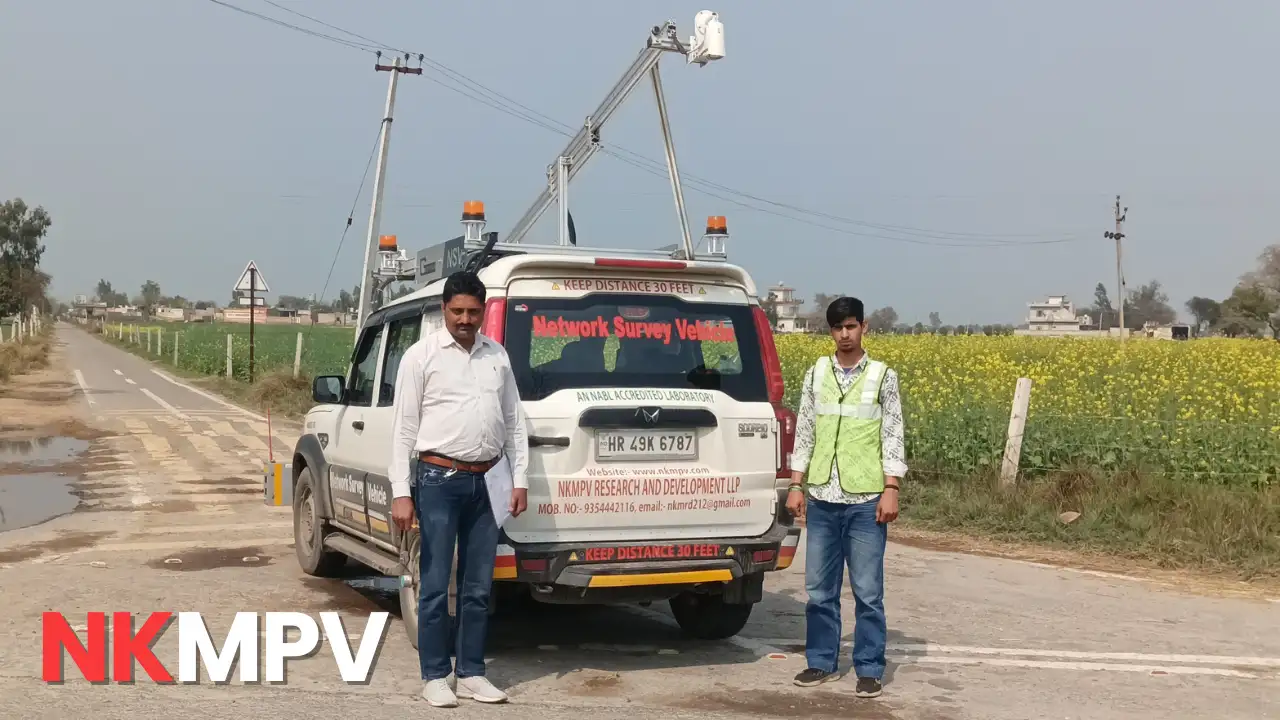
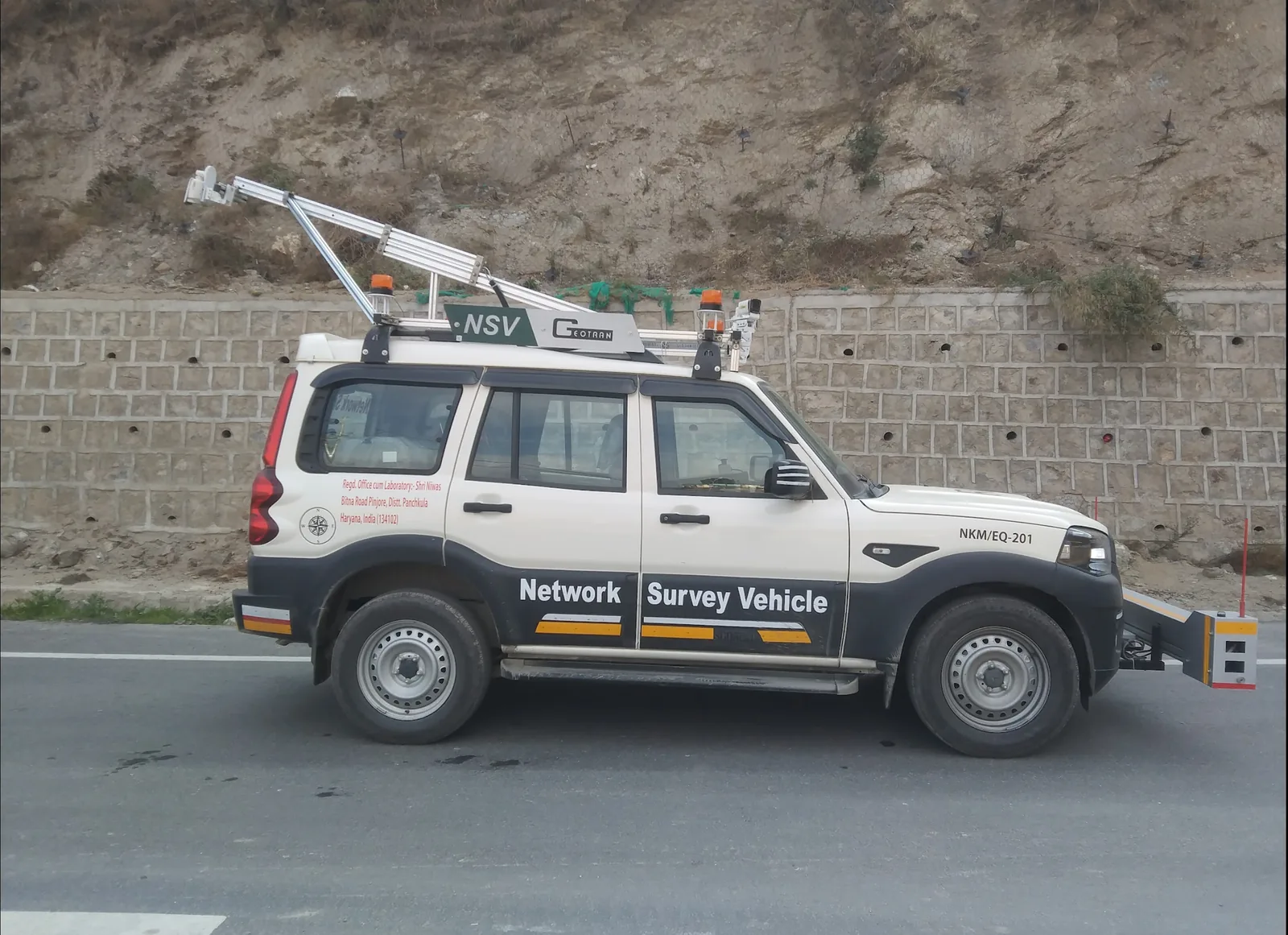
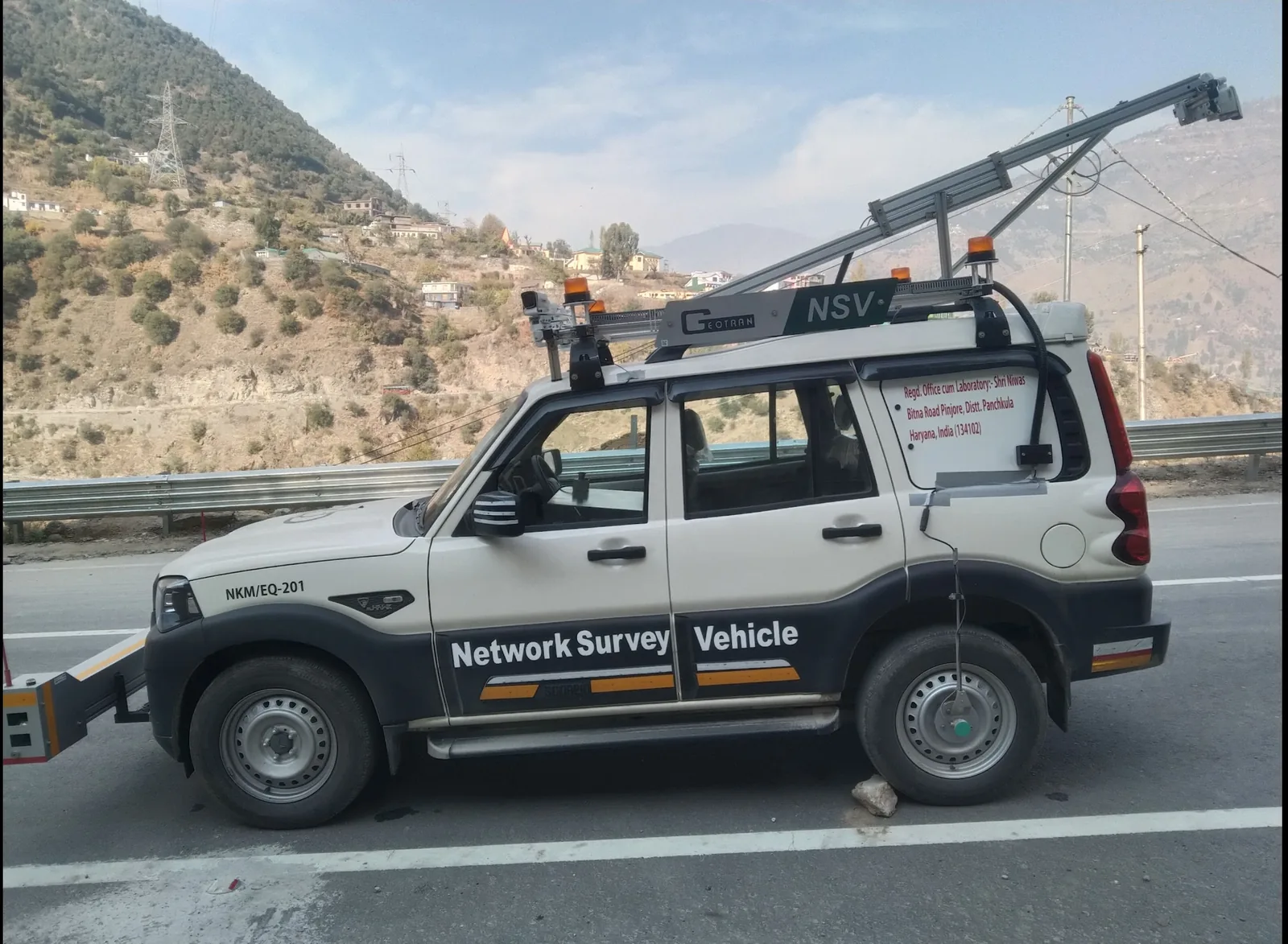
NSV stands for Network Survey Vehicle — an instrumented vehicle that measures road condition at traffic speed, capturing roughness (IRI), rutting, cracking and texture. It is used for MoRTH and NHAI pavement condition surveys as per IRC SP 16. NKMPV provides NSV survey services to IRC SP 16.
A Network Survey Vehicle (NSV) survey is the MoRTH-mandated automated road condition assessment that records IRI roughness, rutting, cracking, texture and geometry per IRC SP 16 and policy RW/NH-33044/32/2019. NKMPV is NABL-accredited (TC-14144 under ISO/IEC 17025:2017) for NSV surveys accepted by NHAI, BRO, state PWDs and BoT/HAM concessionaires across India.
The following parameters are captured simultaneously during an NSV run. Acceptance thresholds are governed by IRC SP 16 and MoRTH maintenance guidelines for national and state highways.
| Parameter | Value / Range | Unit | Standard |
|---|---|---|---|
| International Roughness Index (IRI) | < 2.0 m/km (new construction), < 2.5 m/km (overlay) | m/km | IRC SP 16 Table 3 |
| Rut Depth (Left & Right Wheel Path) | < 10 mm (acceptable), > 20 mm (critical) | mm | IRC SP 16 |
| Cracking (Area Affected) | Classified as Low (<5%), Medium (5-20%), High (>20%) | % area | IRC SP 16 |
| Mean Texture Depth (MTD) | ≥ 0.7 mm (new BC surface) | mm | IRC SP 16 / IRC SP 72 |
| Gradient | Recorded continuously | % | IRC SP 16 |
| Crossfall | 2.0-2.5% (desirable for drainage) | % | IRC SP 16 |
| GPS Accuracy | Sub-metre with DGPS correction | m | IRC SP 16 |
Guidelines for Surface Evenness of Highway Pavements
Guidelines for the Design of Flexible Pavements for Low Volume Rural Roads
Specifications for Road and Bridge Works — Section 900 (Quality Control and Pavement Evaluation)
Guidelines for Structural Evaluation and Strengthening of Flexible Road Pavements Using Falling Weight Deflectometer (FWD) Technique
Vehicle-mounted multi-sensor platform
Simultaneous IRI, rutting, cracking, texture, and geometry measurement at 40-80 km/h
CalibratedClass 1 laser, multiple point measurement
17-point transverse profile for rut depth, longitudinal profile for IRI at 1 mm resolution
CalibratedLine-scan camera with LED illumination
1 mm pixel resolution for automated crack detection and classification
CalibratedDual-frequency GNSS receiver
Sub-metre positional accuracy with real-time correction
CalibratedHD video camera with GPS time-stamp overlay
Continuous video at 30 fps with chainage and GPS coordinate overlay
CalibratedInertial Measurement Unit
Gradient, crossfall, and curvature measurement at 100 Hz sampling rate
CalibratedThe survey scope is defined based on the client's road network. Route plans are prepared with start and end chainages, lane configurations, and survey directions. GPS waypoints are loaded into the NSV navigation system. Traffic management and safety clearances are coordinated with the local highway authority.
Before each survey session, the laser profilers are calibrated using certified calibration blocks. The DGPS base station is set up and checked for satellite lock and correction signal quality. A validation run is conducted on a control section with known IRI and rut depth values to verify sensor accuracy against reference measurements per IRC SP 16 requirements.
The NSV traverses the designated road sections at 40-80 km/h, recording all parameters simultaneously. Each lane is surveyed in the direction of traffic. The operator monitors real-time sensor feeds on an in-cab display. For divided carriageways, both directions are surveyed. Data is recorded at 10-metre intervals for roughness and rutting, and continuously for cracking and video.
Raw sensor data is downloaded and processed through proprietary software. GPS trajectories are post-processed with DGPS corrections. Quality checks verify data completeness (no gaps), sensor consistency (IRI values within expected range), and GPS accuracy. Any sections with data quality issues are flagged for resurvey.
Downward camera images are processed using automated crack detection algorithms. Cracks are classified by type (longitudinal, transverse, alligator, block), severity (low, medium, high), and extent (percentage of area affected). The classification follows IRC SP 16 distress identification protocols. Results are linked to chainage and GPS coordinates.
Final reports include chainage-wise IRI profiles, rut depth profiles, crack maps, texture depth summaries, road geometry data, and geo-tagged video. Data is delivered in spreadsheet format compatible with pavement management systems, along with GIS shapefiles. A summary report highlights sections requiring immediate maintenance, rehabilitation, or reconstruction per MoRTH criteria.
Further reading: What Is a Network Survey Vehicle (NSV)? — MoRTH Compliance Guide — a complete reference to IRC SP 16 thresholds, RW/NH-33044/32/2019 policy, and what NHAI accepts in NSV deliverables.

Highway Condition Surveys Complete pavement assessment for national highways, state roads, and expressways. Our NSV testing captures roughness, rutting, cracking, and surface distress across your entire road network.
Airport Pavement Testing Runway, taxiway, and apron condition evaluation following Airport Authority of India guidelines. Our Network Survey Vehicle technology ensures minimal disruption to airport operations.
Pre-Construction Baseline Surveys Document existing pavement conditions before rehabilitation projects begin. Establish accurate baselines for future performance comparison.
Post-Construction Quality Verification Verify that newly constructed or rehabilitated pavements meet specified standards. Our NSV testing services provide objective data for project acceptance.
Annual Network Monitoring Regular condition monitoring programs that track pavement performance over time. Build historical databases to optimize maintenance planning and budgets.
Project Scoping Surveys Detailed condition assessment to support accurate project scope definition and cost estimation for rehabilitation programs.

High-Speed Data Collection Our Network Survey Vehicle operates at traffic speeds (50-80 km/hr), surveying hundreds of kilometers per day with zero traffic disruption. This means faster project completion and lower costs compared to traditional manual surveys.
Multi-Parameter Assessment A single NSV survey captures multiple pavement parameters simultaneously: • International Roughness Index (IRI) for ride quality • Rut depth measurements across pavement width • Comprehensive crack mapping and classification • Surface distress inventory (potholes, raveling, patches) • High-definition video documentation
Quality System All NSV testing is performed by our NABL-accredited laboratory following ISO/IEC 17025:2017 standards. You receive internationally recognized test results that stand up to audit and regulatory review.
NHAI Compliant Our testing procedures strictly follow National Highways Authority of India specifications and Ministry of Road Transport and Highways guidelines.
Complete Service Package From initial survey planning through final reporting, we handle every aspect. You get comprehensive deliverables including condition reports, GIS maps, video documentation, and maintenance recommendations.

Our specialized Network Survey Vehicle features state-of-the-art instrumentation:
Laser Profilometers Multiple high-precision laser sensors measure pavement surface profile with millimeter accuracy, automatically calculating IRI values that indicate ride quality and pavement serviceability.
High-Definition Cameras 360-degree camera systems capture detailed imagery of the pavement surface. Advanced image processing software identifies and classifies cracks, potholes, and other distresses.
Transverse Profiling System Laser-based sensors measure rutting depth across the full pavement width, detecting structural deformation in wheel paths that indicates load-related distress.
GPS Geo-Referencing High-accuracy GPS systems tag every measurement with precise location coordinates, enabling detailed mapping and GIS integration.
Real-Time Processing Onboard computers process data during the survey, providing immediate quality assurance and preliminary condition assessment.
Every NSV testing project includes comprehensive documentation:
Detailed Condition Report Complete analysis with IRI values, distress quantities, and Pavement Condition Index (PCI) scores for each surveyed section. Reports follow NHAI format requirements.
Interactive GIS Maps Digital maps showing the location and severity of all identified distresses. Export to your existing GIS platform or use our web-based viewer.
Video Log High-resolution video footage of the entire surveyed length provides visual evidence and allows remote inspection of pavement conditions.
Maintenance Prioritization Data-driven recommendations identifying which sections need immediate attention versus routine maintenance. Helps optimize limited budgets.
Remaining Service Life Analysis Predictive modeling estimates how long pavements will perform adequately before requiring major rehabilitation.
Raw Data Files Complete datasets in standard formats compatible with pavement management systems and analysis software.
Our NSV testing services support various infrastructure stakeholders:
Objective Decision-Making Eliminate guesswork with accurate, repeatable measurements. Automated data collection removes subjective judgment from condition assessment.
Cost Optimization Identify maintenance needs before they become expensive rehabilitation projects. Target interventions where they're needed most.
Safety First NSV testing at traffic speeds eliminates dangerous work zones and protects survey crews from traffic exposure.
Comprehensive Coverage Survey your entire road network systematically. Don't miss critical distresses that develop between inspected sections.
Historical Performance Tracking Build condition databases that reveal performance trends. Understand which pavement types and treatments deliver best value.
Regulatory Compliance Meet NHAI monitoring requirements and demonstrate responsible asset stewardship to funding agencies and stakeholders.
Step 1: Project Planning We discuss your objectives, review the road network, and develop a customized survey plan including sections to be tested, parameters to measure, and reporting requirements.
Step 2: Site Mobilization Our team mobilizes the Network Survey Vehicle to your location. We conduct equipment calibration and coordinate with traffic management as needed.
Step 3: Field Survey The NSV survey is conducted at traffic speeds with continuous data collection. Real-time quality checks ensure data integrity during fieldwork.
Step 4: Data Processing Our engineers process the survey data, classify distresses, calculate condition indices, and generate GIS maps showing pavement conditions.
Step 5: Reporting You receive comprehensive reports with condition assessment, maintenance recommendations, and budget estimates for rehabilitation needs.
Step 6: Presentation We present findings to your team, answer questions, and provide technical support for implementing recommendations.
Proven Experience Since 2012, we've conducted NSV surveys on thousands of kilometers of highways and airport pavements across India. Our team understands the unique challenges of Indian infrastructure.
Latest Technology We continuously invest in advanced survey equipment to provide the most accurate and detailed condition data available.
Certified Quality NABL accreditation and ISO/IEC 17025:2017 compliance ensure that our testing meets international quality standards.
Fast Turnaround Efficient processes deliver reports quickly without compromising accuracy. We understand that project schedules matter.
Competitive Pricing Professional NSV testing services at rates that fit infrastructure budgets. Request a quote to see our value proposition.
Complete Support From survey planning through data interpretation, our team provides expert guidance at every stage.
Network-Level Pavement Management Establish and maintain pavement management systems with regular condition surveys that track network performance and identify maintenance priorities.
Project Development Support DPR (Detailed Project Report) preparation with accurate existing condition data that improves rehabilitation design and cost estimates.
Performance Monitoring Track how pavements perform under actual traffic and environmental conditions. Validate pavement design assumptions and material specifications.
Contract Compliance Verify that contractors deliver pavements meeting specified quality standards. Document conditions for warranty and defect liability periods.
Budget Justification Demonstrate maintenance needs to funding agencies with objective condition data. Support budget requests with documented deterioration.
Survey Speed: 50-80 km/hr (traffic speed) IRI Measurement Range: 0-20 m/km Rut Depth Accuracy: ±1 mm Longitudinal Accuracy: ±10 cm Video Resolution: Full HD (1080p) GPS Accuracy: Sub-meter (DGPS) Data Sampling Rate: Continuous
All measurements traceable to national standards through NABL accreditation.How long does an NSV survey take? Survey speed is 50-80 km/hr, so a 100 km section typically takes 2-3 hours of field time. Report delivery is 7-10 business days after field completion.
Do you need lane closures? No. NSV testing survey is conducted at traffic speeds in normal traffic flow. No lane closures or traffic control required.
What road types can you survey? We survey highways, expressways, urban roads, rural roads, and airport pavements. Both asphalt and concrete surfaces.
Is the data compatible with our PMS? Yes. We provide data in standard formats (CSV, shapefile, etc.) compatible with most pavement management systems.
How often should we conduct NSV surveys? NHAI recommends annual surveys for high-traffic corridors. Lower-volume roads may be surveyed every 2-3 years.
Ready to get comprehensive pavement condition data for your road network? Our team is prepared to discuss your specific requirements and provide a detailed proposal.
Contact NKMPV today for professional NSV testing services:
Request a free consultation and competitive quote for your next pavement survey project.
Learn More: Read our Complete Guide to NSV Survey in India under MoRTH RW/NH-33044/32/2019 for detailed technical information about Network Survey Vehicle testing methodology, equipment, and applications.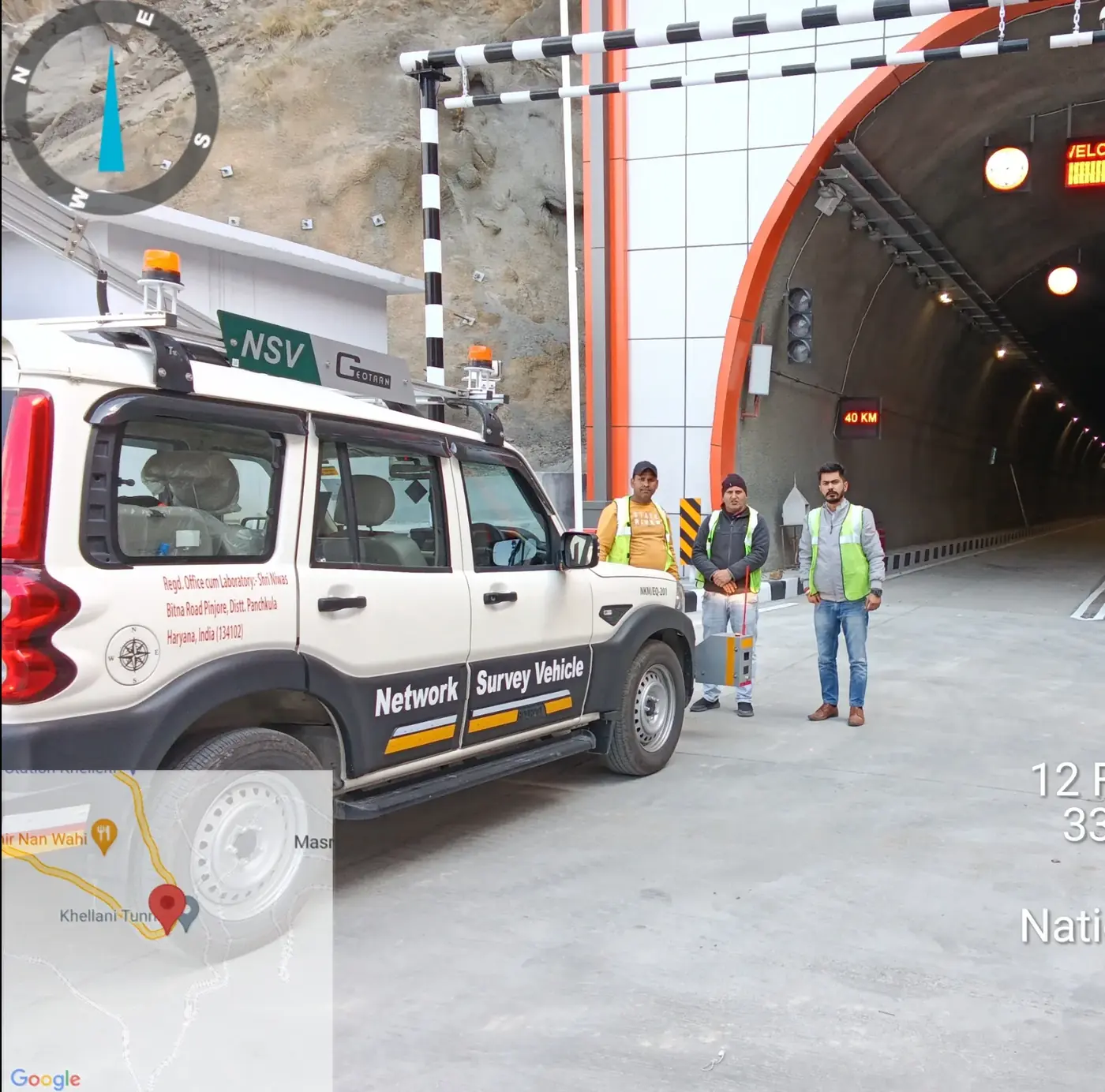


Our NSV survey reports carry NABL accreditation (ISO/IEC 17025:2017), ensuring acceptance by NHAI, state PWDs, World Bank-funded projects, and concession agreement auditors without additional verification.
Our NSV platform records IRI, rutting, cracking, texture, geometry, and video in a single pass — eliminating the need for multiple mobilisations and reducing survey time by up to 80% compared to manual methods.
Every data point is geo-referenced using DGPS with sub-metre accuracy, enabling direct import into GIS-based pavement management systems and precise location of distressed sections for maintenance crews.
Our survey team has conducted NSV assessments on national highways, state highways, and expressways across North India. We understand MoRTH reporting requirements and deliver data in formats accepted by NHAI and state agencies.
We combine NSV surface-condition data with FWD structural capacity data to provide a complete pavement evaluation — surface distress plus structural adequacy — enabling optimal overlay and rehabilitation design.
NSV testing (Network Survey Vehicle testing) per IRC SP 16 and MoRTH RW/NH-33044/32/2019 is the MoRTH-mandated automated road condition assessment for National Highways. A multi-sensor instrumented vehicle captures pavement roughness (IRI), rutting, surface cracking, texture depth, and geometric features simultaneously while travelling at 40-80 km/h. The deliverable feeds NHAI's project handover acceptance, periodic monitoring of operating highways, and concession milestone verification under DBFOT/HAM contracts. See our complete NSV explainer for the technical detail.
NSV replaces all traditional manual road surveys — bump integrator runs, visual distress mapping, straight-edge rutting measurement, chain-and-sand patch texture tests — with a single integrated automated pass at traffic speed. Key advantages: (1) Productivity — 200-400 km/day vs <50 km/day manual; (2) Consistency — automated measurements eliminate operator subjectivity; (3) Comprehensive — five parameters simultaneously; (4) Safety — no surveyors on live traffic; (5) MoRTH compliance — only NSV meets RW/NH-33044/32/2019 requirements for NH assessment. Cost is 30-40% lower than equivalent manual survey at network scale.
NKMPV's NSV report deliverable includes: (1) Chainage-referenced data tables for IRI, rutting, cracking %, texture depth at 100 m or 200 m intervals. (2) Colour-coded IRI strip chart for rapid visual assessment of corridor health. (3) Per-km summary tables with mean, 80th, 90th percentile values. (4) IRC SP 16 threshold comparison with pass/fail flags per parameter. (5) Surface distress catalogue with representative camera frames. (6) Raw data files in CSV/text and GPS track in KML. (7) Forward-facing video referenced to chainage. (8) Calibration certificate traceable to NPL. Standard turnaround: 7-10 working days from field completion for corridors up to 200 km; 12-15 days for networks >200 km.
Coverage
Wherever your project is, there are two ways to work with NKMPV on NSV Survey.
For field work, our engineers and instruments mobilise anywhere in India — highway corridors, bridges, plants and greenfield alignments included.
Distance is not a constraint for laboratory testing. Send samples to our Pinjore laboratory and receive the digital report on completion — the route most of our out-of-region clients use.
These are locations where we have completed projects — not the boundary of our service area. We mobilise across India on request. See full coverage & project locations →
NSV Survey is carried out to IRC SP 16, IRC SP 72, MoRTH 5th Revision and IRC 115, as listed in the Applicable Standards section of this page. Tell us the specification your project must comply with and the quotation will state the standard the work follows.
Our laboratory is at Pinjore, Haryana, within same-day reach of Chandigarh, Panchkula, Mohali, Ambala and the wider Tri-City. If you are further away, distance is not a constraint: our field team travels to site anywhere in India for on-site work, and for laboratory tests you can courier samples to the Pinjore lab and receive the report digitally. Clients across Punjab, Haryana, Himachal Pradesh, Delhi-NCR, Uttarakhand, Rajasthan, Uttar Pradesh, Jammu and Kashmir and Ladakh already work with us this way.
Yes. NKMPV operates pan-India. We have delivered projects across Chandigarh, Panchkula, Mohali, Ambala, Karnal, Kurukshetra, Yamunanagar, Hisar and beyond, and we mobilise to greenfield and remote corridors on request. The 18 locations listed on our site are the places we have already worked — not the limit of where we go.
Send us the project details — location, quantity, and the standard you need to comply with — and you get a written quotation, usually within one working day. Pricing depends on sample count, site access and mobilisation distance, so we quote per project rather than publishing a fixed rate. Call +91-82953-60108 or use the quote form; every quotation states the applicable IS/IRC standard.
Need NSV Survey for your project?