
Our team travels to your site
For field work, our engineers and instruments mobilise anywhere in India — highway corridors, bridges, plants and greenfield alignments included.
Axle load surveys with portable weigh pads to IRC SP 19 — axle load spectrum, overloading against legal limits and VDF for IRC 37 / IRC 81 pavement design
An axle load survey weighs the axles of commercial vehicles to establish the traffic loading on a pavement. From it, the Vehicle Damage Factor (VDF) — the number of standard 80 kN axles equivalent to one commercial vehicle — is computed per IRC SP 19 and IRC 81. NKMPV conducts axle load surveys and VDF analysis across India.
An axle load survey measures the actual wheel and axle loads of commercial vehicles using portable weigh pads deployed on the highway. The resulting axle load spectrum is the critical input for computing the Vehicle Damage Factor (VDF) and converting mixed traffic into Equivalent Standard Axle Loads (ESALs) for pavement design.
The following parameters are recorded and computed from the axle load survey. Legal axle load limits per Motor Vehicles Act and MoRTH specifications are used as acceptance benchmarks.
| Parameter | Value / Range | Unit | Standard |
|---|---|---|---|
| Single Axle Load (Legal Limit) | 10.2 tonnes (100 kN) | tonnes | Motor Vehicles Act / IRC 37 |
| Tandem Axle Load (Legal Limit) | 19.0 tonnes (186 kN) | tonnes | Motor Vehicles Act / IRC 37 |
| Tridem Axle Load (Legal Limit) | 24.0 tonnes (235 kN) | tonnes | Motor Vehicles Act / IRC 37 |
| Gross Vehicle Weight (2-axle truck) | 16.2 tonnes (legal maximum) | tonnes | CMVR Rule 93 |
| Vehicle Damage Factor (VDF) | 1.5-5.5 (typical range) | dimensionless | IRC 37 Cl. 5.2 |
| Standard Axle Load | 80 kN (8.16 tonnes) | kN | IRC 37 Cl. 2.1 |
| Minimum Sample Size | ≥ 300 commercial vehicles per direction | vehicles | IRC SP 72 Annexure-A |
| Overloading Percentage | Typically 40-70% vehicles exceed legal limits | % | Survey observation |
Tentative Guidelines for Strengthening of Flexible Road Pavements Using Benkelman Beam Deflection Technique — defines fourth-power law for VDF
Manual for Survey, Investigation and Preparation of Road Projects — axle load survey methodology and 17-class scheme
Guidelines for the Design of Flexible Pavements for Low Volume Rural Roads (Annexure-A: Axle Load Survey Methodology)
Guidelines for the Design of Flexible Pavements
Central Motor Vehicle Rules — Rule 93 (Maximum Permissible Axle Loads and GVW)
Specifications for Road and Bridge Works — Section 900 (Traffic and Transportation)
Guidelines for the Design of Plain Jointed Rigid Pavements for Highways
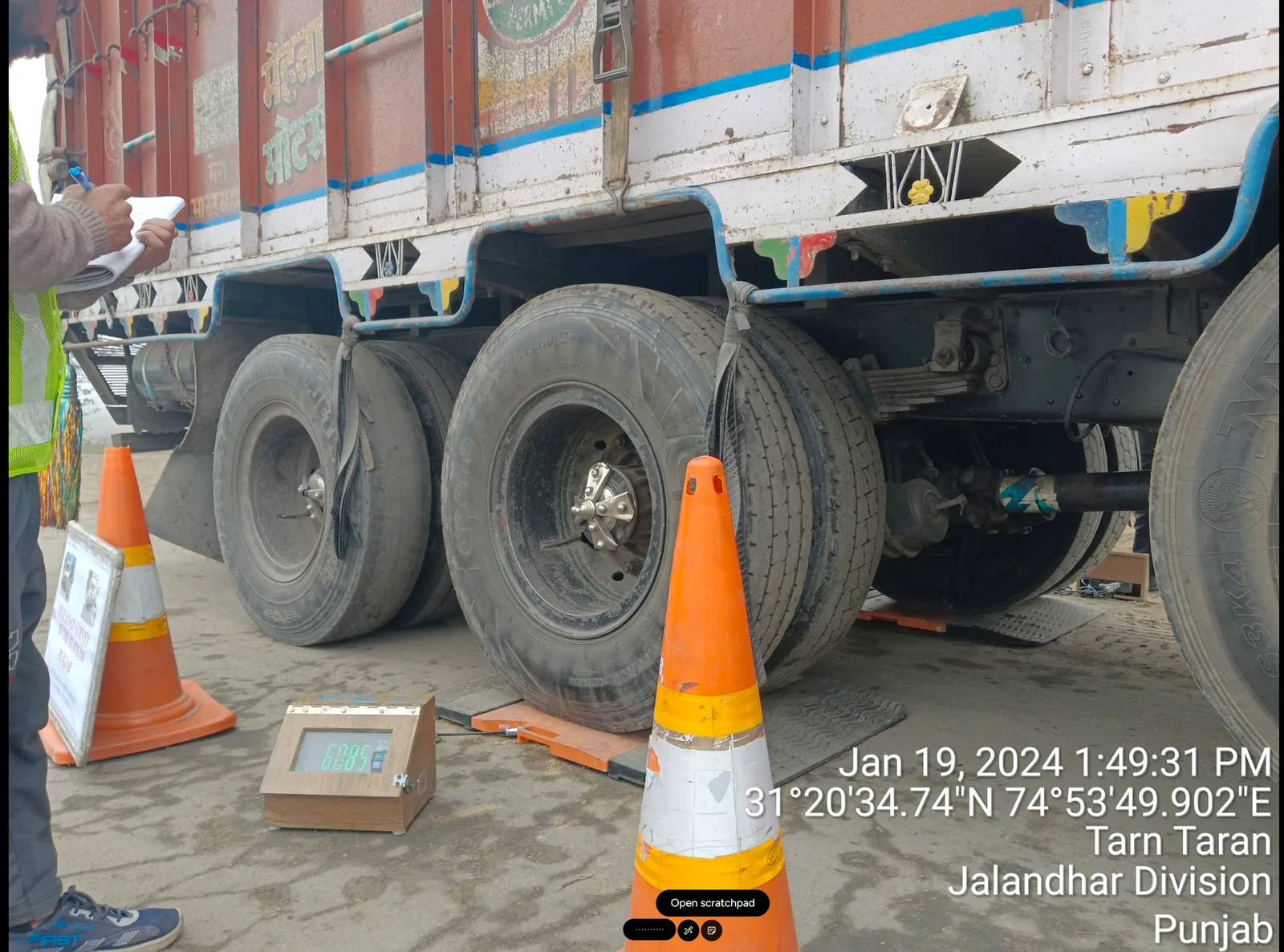
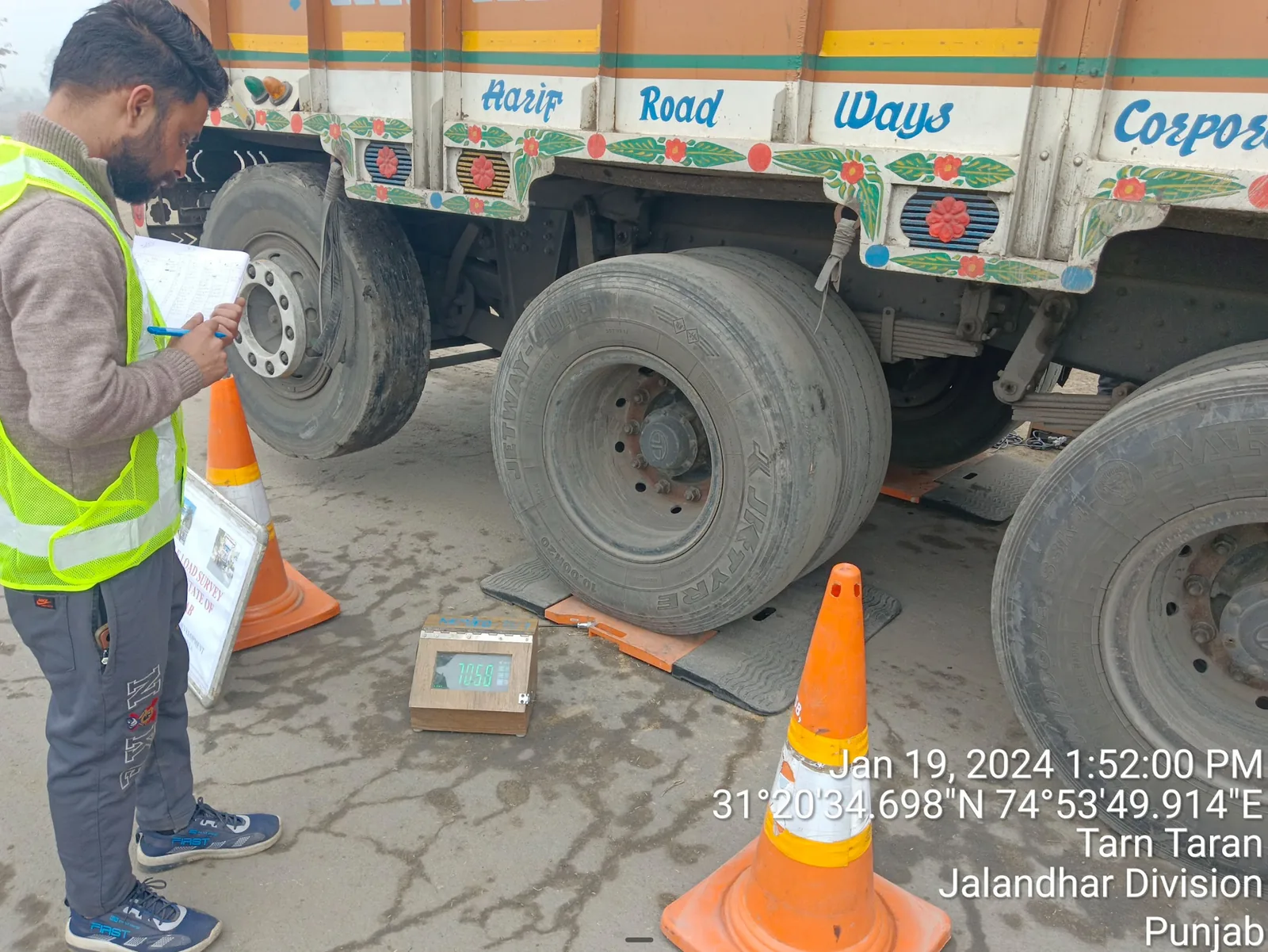
Low-profile axle weighing pads (pair)
20 tonnes per pad, resolution 10 kg, suitable for single/tandem/tridem axle configurations
CalibratedHandheld wireless display unit
Displays individual axle loads, tandem/tridem group loads, and gross vehicle weight simultaneously
CalibratedApproach and departure ramps (pair per pad)
Gradual incline to pad surface, prevents impact loading and ensures accurate static weighment
CalibratedField laptop with custom axle load data entry software
Records vehicle type, axle configuration, individual axle loads, GVW, registration number, and commodity type
CalibratedCones, sign boards, and safety jackets
Traffic diversion and safety setup for vehicle stopping and weighing operations on live carriageway
CalibratedA suitable weighing location is identified on the project highway — typically a straight, level section with sufficient shoulder width for vehicles to queue and be diverted for weighing. Coordination with local traffic police and highway authorities is arranged for traffic control during the survey. The site must be away from toll plazas and weigh bridges to avoid biased samples of vehicles that have already adjusted their loads.
Portable weigh pads are placed on a level pavement surface with approach ramps. The system is calibrated using known calibration weights and cross-verified by weighing a reference vehicle with known axle loads. Traffic control measures including cones, sign boards, and flagmen are deployed. The team is briefed on vehicle classification, axle configuration identification, and data recording protocols.
Commercial vehicles (trucks, trailers, buses, multi-axle vehicles) are randomly intercepted from the traffic stream — targeting a minimum of 300 commercial vehicles per direction as per IRC SP 72. Each vehicle is directed over the weigh pads one axle at a time. The load on each individual axle is recorded, along with the vehicle type, axle configuration (single, tandem, tridem), number of tyres, registration number, and commodity carried.
Field data is entered into spreadsheets and validated for consistency. Gross Vehicle Weight is cross-checked against the sum of individual axle loads. Outliers and erroneous readings are flagged and verified against field notes. Vehicles are grouped by IRC classification categories: two-axle rigid trucks, three-axle rigid trucks, four-axle semi-trailers, five-axle articulated vehicles, multi-axle vehicles, and buses.
Axle loads are tabulated into frequency distribution tables (axle load spectrum) separately for single axles, tandem axles, and tridem axles within each vehicle class. The spectrum shows the percentage of axles falling in each 1-tonne or 2-tonne load interval. Overloading percentage is computed as the proportion of axles exceeding legal limits.
The Vehicle Damage Factor (VDF) is calculated for each vehicle class using the fourth-power law: VDF = summation of (individual axle load / standard 80 kN axle load)^4 across all axles. The weighted average VDF across the fleet is then multiplied by the AADT of commercial vehicles from the traffic survey to compute total Equivalent Standard Axle Load repetitions over the design life in million standard axles (MSA).
The final axle load survey report includes individual vehicle data sheets, axle load frequency distributions, axle load spectra charts, VDF calculations by vehicle class and overall fleet, overloading analysis, and design traffic computation in MSA. Reports are formatted per NHAI DPR requirements and IRC SP 72 guidelines. Digital and hard copies are delivered to the client.
Further reading: Axle Load Survey vs Static Weighbridge vs WIM — Methodology Comparison — head-to-head comparison of random roadside survey, weighbridge data, and Weigh-In-Motion sensors for Indian highway projects.
Axle Load Testing is a critical field investigation used to measure the actual axle-wise load carried by commercial vehicles operating on highways. These measurements are essential for pavement design, pavement performance evaluation, traffic studies, and compliance with IRC and MoRTH specifications. NKMPV Lab provides professional axle load test services for highways to support NHAI projects, expressways, state highways, and urban road infrastructure.
Our axle load surveys help engineers understand real traffic loading conditions, which directly influence pavement thickness design, remaining life assessment, and maintenance planning.
An axle load test is the process of measuring the load carried by individual axles of vehicles passing over a roadway. Each axle load contributes differently to pavement stress, fatigue, and long-term deterioration. Unlike gross vehicle weight alone, axle-wise load distribution provides accurate input for pavement engineering analysis.
Axle load data is collected using calibrated weighing systems installed temporarily or permanently on the roadway, ensuring precise and repeatable measurements under live traffic conditions.
Axle load testing plays a vital role in highway planning, design, and asset management. Real-world traffic loading often differs from assumed design values, making field-based axle load measurement essential.
Key benefits include:
Accurate input for pavement thickness design
Assessment of overloading trends on highways
Evaluation of pavement deterioration and fatigue life
Support for traffic and transport studies
Compliance with IRC and MoRTH guidelines
Without axle load data, pavement designs may be either overdesigned (increasing cost) or underdesigned (leading to premature failure).
Axle load testing is widely used across various highway and infrastructure projects, including:
National Highway Authority of India (NHAI) projects
Expressways and access-controlled highways
State highways and major district roads
Pavement rehabilitation and strengthening projects
Traffic impact assessment studies
Overloading enforcement and policy studies
The test results are often combined with traffic volume data to calculate cumulative traffic loading in terms of standard axles.
The axle load test is carried out using calibrated load measurement equipment placed on the carriageway. Vehicles are guided to pass over the weighing system at controlled speeds to ensure accurate readings.
The test records:
Individual axle loads
Axle configuration
Vehicle class
Gross vehicle weight
Load distribution patterns
Multiple vehicle passes are recorded to develop a statistically reliable axle load spectrum for the project corridor.
Axle load testing services are conducted in accordance with applicable Indian road standards and guidelines, including:
IRC guidelines for traffic loading and pavement design
MoRTH specifications for highway works
Relevant provisions used in NHAI projects
All testing procedures and reporting formats are aligned with standard engineering practices accepted by government authorities and consultants in India.
Axle load data is a key input for both flexible and rigid pavement design. The measured axle load spectrum is used to calculate cumulative standard axle repetitions, which directly influence pavement thickness and material selection.
Accurate axle load data helps:
Predict pavement fatigue and rutting
Estimate remaining pavement life
Design overlays and strengthening measures
Improve long-term pavement performance
Axle load testing is often conducted alongside other highway evaluation studies such as traffic surveys, pavement condition surveys, and network-level assessments. When combined with these studies, axle load data provides a comprehensive understanding of road performance under actual traffic conditions.
Using professional axle load test services ensures:
Reliable and repeatable measurements
Compliance with project specifications
Accurate traffic loading inputs
Reduced risk of pavement design errors
Better decision-making for maintenance planning
Field data collected under real traffic conditions is far more dependable than assumed or theoretical loading values.
NKMPV Lab provides axle load test services with a focus on accuracy, compliance, and engineering reliability. Our testing approach supports consultants, contractors, and government agencies involved in highway and infrastructure development.
We deliver clear, structured test reports suitable for use in:
DPR preparation
Pavement design calculations
NHAI and state highway submissions
Technical audits and reviews
Axle Load Test Services for Highways are essential for understanding real traffic loading and ensuring safe, durable, and cost-effective pavement designs. Accurate axle load measurement helps engineers assess overloading impacts, predict pavement life, and design highways that perform reliably under actual operating conditions.
By conducting axle load testing as per IRC and MoRTH practices, highway authorities and project stakeholders can make informed decisions that improve road safety, optimize construction costs, and extend pavement service life.
Subgrade CBR and material tests for the same corridor are run in NKMPV's NABL-accredited laboratory (TC-14144), so traffic and pavement inputs come from one team.
Our electronic weigh pads are calibrated with NABL-traceable standards and cross-verified before each survey deployment. The 10 kg resolution ensures accurate axle load readings even for lightly loaded vehicles.
We deploy ATCC traffic counters and axle load survey teams simultaneously, providing both traffic volume and axle load spectrum data from a single mobilisation — saving time and cost for DPR-level highway projects.
We ensure a minimum of 300 commercial vehicles per direction are weighed, covering all vehicle classes proportional to their traffic share. This exceeds the minimum requirements of IRC SP 72 and ensures statistically reliable VDF values.
Our teams have conducted axle load surveys on major highway corridors including NH-44, NH-5, NH-7, and NH-152 across Haryana, Punjab, Himachal Pradesh, Uttarakhand, and Rajasthan, handling diverse traffic compositions from heavily overloaded mining trucks to multi-axle container carriers.
An axle load survey per IRC 81:1997 measures the actual wheel and axle loads of commercial vehicles using portable weigh pads deployed on the highway. The resulting axle load spectrum (frequency distribution of axle loads in each vehicle class) is the critical input for: (1) computing the Vehicle Damage Factor (VDF) per IRC 81 — the fourth-power conversion of mixed traffic into equivalent 80 kN standard axles; (2) flexible pavement design per IRC 37:2018 — pavement thickness depends directly on VDF; (3) overload enforcement for state PWDs and tolling authorities; (4) commercial vehicle policy formulation by MoRTH. Without a current axle load survey, pavement design is based on assumed VDF — typically over-conservative (excess cost) or under-conservative (premature failure).
Per MoRTH Notification GSR 142(E) of 16 July 2018 (revised axle load limits): Single axle, dual tyre — 11.5 tonnes (114.5 kN). Single axle, single tyre — 6 tonnes. Tandem axle — 21.0 tonnes. Tridem axle — 27.0 tonnes. Gross Vehicle Weight (GVW) limits vary by vehicle configuration: 2-axle rigid 18 tonnes, 3-axle rigid 28.5 tonnes, 4-axle rigid 36 tonnes, multi-axle articulated up to 55 tonnes. These are the upper bounds — actual surveyed axle loads frequently exceed legal limits, especially on freight corridors. The survey results feed both pavement design (technical) and overload-policy decisions (regulatory).
Per IRC 81:1997 sampling guidelines: minimum 5% of total vehicles in each commercial-vehicle class over a 7-day continuous observation. For practical adequacy, this typically translates to: 200-500 sampled axles per direction on heavy-traffic NH corridors (~50,000 commercial AADT); 100-200 axles per direction on moderate-traffic state highways. The sample must cover all commercial vehicle classes — 2-axle truck, 3-axle truck, multi-axle articulated, tractor-trailer — proportional to their share in the traffic stream. Survey is paired with a parallel ATCC count to establish vehicle-class proportions. See our complementary ATCC survey service.
Coverage
Wherever your project is, there are two ways to work with NKMPV on Axle Load Survey.
For field work, our engineers and instruments mobilise anywhere in India — highway corridors, bridges, plants and greenfield alignments included.
Distance is not a constraint for laboratory testing. Send samples to our Pinjore laboratory and receive the digital report on completion — the route most of our out-of-region clients use.
These are locations where we have completed projects — not the boundary of our service area. We mobilise across India on request. See full coverage & project locations →
Axle Load Survey is carried out to IRC 81:1997, IRC SP 19, IRC SP 72:2015 and IRC 37:2018, as listed in the Applicable Standards section of this page. Tell us the specification your project must comply with and the quotation will state the standard the work follows.
Our laboratory is at Pinjore, Haryana, within same-day reach of Chandigarh, Panchkula, Mohali, Ambala and the wider Tri-City. If you are further away, distance is not a constraint: our field team travels to site anywhere in India for on-site work, and for laboratory tests you can courier samples to the Pinjore lab and receive the report digitally. Clients across Punjab, Haryana, Himachal Pradesh, Delhi-NCR, Uttarakhand, Rajasthan, Uttar Pradesh, Jammu and Kashmir and Ladakh already work with us this way.
Yes. NKMPV operates pan-India. We have delivered projects across Chandigarh, Panchkula, Mohali, Ambala, Karnal, Kurukshetra, Yamunanagar, Hisar and beyond, and we mobilise to greenfield and remote corridors on request. The 18 locations listed on our site are the places we have already worked — not the limit of where we go.
Send us the project details — location, quantity, and the standard you need to comply with — and you get a written quotation, usually within one working day. Pricing depends on sample count, site access and mobilisation distance, so we quote per project rather than publishing a fixed rate. Call +91-82953-60108 or use the quote form; every quotation states the applicable IS/IRC standard.
Need Axle Load Survey for your project?