
Falling Weight Deflectometer (FWD) Test
Non-destructive structural evaluation of pavements for overlay design and remaining life assessment
What is the FWD (Falling Weight Deflectometer) test?
FWD stands for Falling Weight Deflectometer — a non-destructive test that drops a known load onto the pavement and measures the deflection bowl to back-calculate layer moduli and residual life. It is used for overlay design per IRC 115. NKMPV performs FWD testing and overlay design with NABL-accredited reporting.
FWD (Falling Weight Deflectometer) testing measures pavement structural capacity by applying a calibrated impulse load and recording the deflection basin across multiple geophones, per IRC 115 and ASTM D4694. NKMPV is NABL-accredited (TC-14144 under ISO/IEC 17025:2017) for FWD surveys with back-calculated layer moduli reports accepted by NHAI, state PWDs and World Bank-funded overlay-design programmes across India.
What Is the FWD (Falling Weight Deflectometer) Test?
Test Parameters & Acceptance Criteria
The following parameters are measured and derived during FWD testing. Acceptance criteria and design thresholds are governed by IRC 115, IRC 37, and project-specific specifications.
| Parameter | Value / Range | Unit | Standard |
|---|---|---|---|
| Standard Load Pulse | 40 kN (adjustable 20-120 kN) | kN | ASTM D4694 Cl. 6.2 |
| Load Pulse Duration | 25-30 milliseconds | ms | ASTM D4694 Cl. 6.3 |
| Loading Plate Diameter | 300 mm (standard) / 450 mm (optional) | mm | ASTM D4694 Cl. 6.1 |
| Maximum Centre Deflection (D0) | Varies — typically 200-1500 microns | microns | IRC 115 Cl. 5.3 |
| Number of Geophones | 7-9 sensors at 0, 300, 600, 900, 1200, 1500, 1800 mm offsets | ASTM D4694 Cl. 6.4 | |
| Geophone Resolution | 1 micron (0.001 mm) | micron | ASTM D4694 Cl. 6.4 |
| Backcalculated Subgrade Modulus (MR) | 20-200 MPa (typical Indian subgrades) | MPa | IRC 115 Cl. 6 |
| Pavement Surface Temperature | Recorded for bituminous layer modulus correction | Degrees Celsius | IRC 115 Cl. 5.5 |
Applicable Standards
Standard Test Method for Deflections with a Falling-Weight-Type Impulse Load Device
Guidelines for Structural Evaluation of Flexible Pavements by Falling Weight Deflectometer
Guidelines for Design of Flexible Pavements (Overlay Design Using FWD Data)
Guidelines for Design of Plain Jointed Rigid Pavements for Highways
Standard Guide for General Pavement Deflection Measurements
Specifications for Road and Bridge Works — Section 900 (Quality Control and Pavement Evaluation)
Equipment Used
Falling Weight Deflectometer
Dynatest 8002
Load range 7-120 kN, 300 mm load plate, 9 geophones, trailer-mounted for highway-speed deployment
CalibratedGeophone Sensor Array
Dynatest velocity transducers (9 sensors)
Resolution 1 micron, measurement range 0-2500 microns, radial offsets 0 to 1800 mm
CalibratedOn-Board Data Acquisition System
Dynatest integrated controller with GPS
Real-time data logging of deflections, load, temperature, and GPS coordinates per ASTM D4694
CalibratedPavement Surface Temperature Sensor
Infrared non-contact thermometer
Range -20 to 200 degrees Celsius, accuracy +/- 1 degree, for bituminous layer temperature correction
CalibratedBackcalculation Software
ELMOD / KGPBACK / IITRigid
Layered elastic analysis for backcalculation of pavement layer moduli from measured deflection basins
N/ADistance Measuring Instrument (DMI)
Vehicle-mounted DMI with pulse encoder
Chainage measurement accuracy +/- 0.1%, synchronised with FWD test points for precise location referencing
CalibratedTesting Process
Project Planning & Test Interval Selection
1-2 days (pre-mobilisation)The test programme is planned based on project requirements, pavement length, and evaluation purpose (network-level screening vs. project-level detailed assessment). Test intervals are typically 50-100 metres for project-level evaluation and 200-500 metres for network-level surveys per IRC 115. A site reconnaissance is conducted to identify lane markings, chainage references, traffic management requirements, and any pavement sections requiring special attention (distressed areas, bridge approaches, intersections).
Equipment Setup & Calibration
45-60 minutesThe trailer-mounted FWD is deployed to the project site and the equipment is powered on for a warm-up period. A relative calibration check is performed by conducting 5 drops at a reference point and verifying that deflection readings are repeatable within 2% coefficient of variation. The load cell, geophones, and distance measuring instrument (DMI) are verified against factory calibration certificates. GPS coordinates are synchronised and the surface temperature sensor is checked.
Field Deflection Measurement
2-3 minutes per test pointAt each test point, the FWD loading plate is positioned on the pavement surface in the outer wheel path (most critical trafficking zone). Typically, 3 seating drops followed by 3 test drops at the standard 40 kN load are applied. The seating drops ensure proper plate contact, while the test drops are recorded. The 7-9 geophones simultaneously measure the deflection basin at radial distances of 0, 300, 600, 900, 1200, 1500, and 1800 mm from the load centre. Pavement surface temperature is recorded at each point.
Data Quality Screening
2-3 hours (post-field)Raw deflection data is screened for anomalies including non-decreasing deflection basins, excessive sensor noise, load variation beyond +/- 5% of target, and sensor malfunction. The coefficient of variation among the 3 test drops at each point is checked — points exceeding 5% CV are flagged for re-testing. Deflections are normalised to the standard 40 kN load if actual loads vary. Temperature corrections are applied to bituminous layer deflections using pavement temperature records.
Backcalculation of Layer Moduli
1-2 daysThe screened deflection basins are processed through backcalculation software (ELMOD or equivalent) using a layered elastic model. The software iteratively adjusts the elastic modulus of each pavement layer (bituminous surface, granular base, granular subbase, and subgrade) until the computed deflection basin matches the measured basin within acceptable error limits (typically RMS error < 2%). The backcalculated moduli represent the in-situ structural condition of each layer.
Structural Assessment & Overlay Design
2-3 daysUsing the backcalculated layer moduli, the effective structural number (SN) of the existing pavement is computed and compared with the required SN based on projected traffic loading. The remaining structural life is estimated in terms of cumulative standard axle loads (CSA). Where the remaining life is insufficient, overlay thickness is designed per IRC 37:2018 methodology. The analysis segments the road into homogeneous sections based on cumulative difference approach (CDA) of deflection data.
Report Preparation & Delivery
3-5 daysA comprehensive NABL-accredited report is prepared containing raw deflection data, normalised deflection basins, backcalculated layer moduli for each test point, homogeneous section delineation, structural adequacy assessment, remaining life analysis, and overlay design recommendations with chainage-wise thickness schedules. The report includes deflection profiles, moduli variation plots, and GPS-referenced location maps. Typical report delivery is within 7-10 working days of field testing completion.
Where This Test Is Used
Further reading: FWD vs Benkelman Beam — Pavement Evaluation Methods Compared — accuracy, productivity, IRC 115 vs IRC 81, and which method to choose for highway overlay design.
- NSV vs FWD vs Benkelman Beam — Three-Way Comparison — complete decision matrix covering surface-condition vs structural-capacity methods.
- FWD Test Cost in India — Per-Test-Point Pricing Guide — per-point rates, scope variables, deliverable tiers, and how to budget FWD work in your overlay-design DPR.
- IRC 115 Overlay Design via FWD Back-Calculation — Step-by-Step Guide — from FWD deflection-basin capture through layer-moduli back-calculation to overlay-thickness output.
Detailed Information
Falling Weight Deflectometer (FWD) Test
Pavement management is a critical aspect of road infrastructure development and maintenance, as it ensures that roads can withstand the stresses induced by traffic, weather conditions, and time. Pavement evaluation methods have evolved over the years to provide engineers with the tools necessary to assess the strength, durability, and structural integrity of pavements in a non-destructive and efficient manner. One such technique is the Falling Weight Deflectometer (FWD) test, a widely accepted method for assessing the structural condition of both flexible and rigid pavements. The Falling Weight Deflectometer (FWD) is a mobile device used to evaluate the pavement’s response to a load that simulates the impact of a moving vehicle. The test measures the deflection of the pavement surface when a weight is dropped from a predetermined height onto the surface of the road. This deflection provides key insights into the underlying layers of the pavement structure, including the surface, base, and subgrade materials. FWD testing is critical for engineers and pavement management systems, helping them understand the pavement’s ability to carry traffic loads and identifying areas that may require rehabilitation or maintenance. This test mimics real-world traffic conditions by replicating the load exerted by a moving vehicle, typically using a controlled, falling weight that impacts the pavement through a loading plate. The data collected from the deflection measurements is used to assess the overall structural capacity of the pavement, determine whether the subgrade is adequately supporting the pavement, and evaluate the need for repairs or upgrades. The FWD test also assists in the back-calculation of material properties for pavement design, providing engineers with essential data to predict the remaining service life of a pavement structure. The FWD test is unique in its ability to provide valuable information about the condition of both the surface and underlying layers of the pavement. The deflection profile generated during the test can be used to evaluate the strength and stiffness of the pavement’s individual layers, such as the surface course, base course, and subbase, as well as the modulus of elasticity of the underlying subgrade. This allows for the identification of weak spots or distress in the pavement that could lead to failures like cracking, rutting, or potholes. In the context of India, the National Highways Authority of India (NHAI) has adopted FWD testing as part of its guidelines for pavement evaluation. The NHAI has set specific standards for the number of tests, test locations, frequency, and interpretation of results to ensure the longevity and safety of the national highways. This adherence to standards ensures that the FWD test not only assesses the present condition of pavements but also helps inform future maintenance and rehabilitation strategies, preventing premature deterioration and optimizing pavement management. The growing demands for road infrastructure, combined with increasing traffic loads and environmental stress, make the FWD test indispensable for pavement management, as it enables early detection of structural problems and facilitates cost-effective decision-making for repairs and rehabilitation. As a non-destructive, reliable, and efficient method, the FWD test has become an essential tool for evaluating the long-term performance and safety of pavements on highways, urban roads, and other transportation networks. This report delves deeper into the FWD test's equipment, procedure, analysis of deflection data, and its alignment with the NHAI guidelines. Understanding the significance of this test in pavement management and maintenance is crucial for ensuring the sustainability and safety of road infrastructure in India and beyond. By analyzing the deflection responses generated through FWD testing, engineers can make data-driven decisions about pavement rehabilitation, design improvements, and load-carrying capacity to ensure a more durable and cost-effective road network. In this context, the FWD test is not just a tool for measuring pavement conditions, but a vital part of ensuring the long-term resilience of road networks in the face of increasing traffic volumes and changing environmental conditions.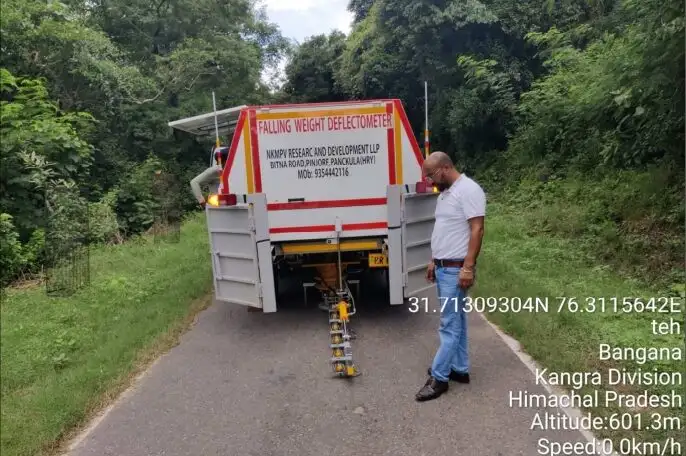
FWD Test Equipment and Components
The Falling Weight Deflectometer consists of several essential components designed to simulate the impact of traffic loads and measure the pavement's deflection response. These include:- Falling Weight: Typically weighing between 4.5 and 15 tons, the falling weight is calibrated to replicate the load exerted by moving vehicles, especially heavy trucks.
- Release Mechanism: A hydraulic or mechanical device controls the release of the weight. It is designed to ensure that the weight falls consistently, simulating real traffic-induced forces.
- Loading Plate: A circular steel plate (commonly 300 mm or 450 mm in diameter) is used to distribute the falling weight over the pavement surface. The plate’s uniform shape ensures that the force is applied consistently to the pavement.
- Deflection Sensors (Geophones): Multiple deflection sensors are placed radially around the loading plate to measure the pavement's deflection at different distances from the point of impact. These sensors are highly sensitive and capable of recording minute deflections.
- Control Unit: The control unit governs the operation of the FWD test by initiating the release of the weight and recording the deflection data from the sensors. Modern FWD systems also provide real-time data display and analysis.
Test Procedure
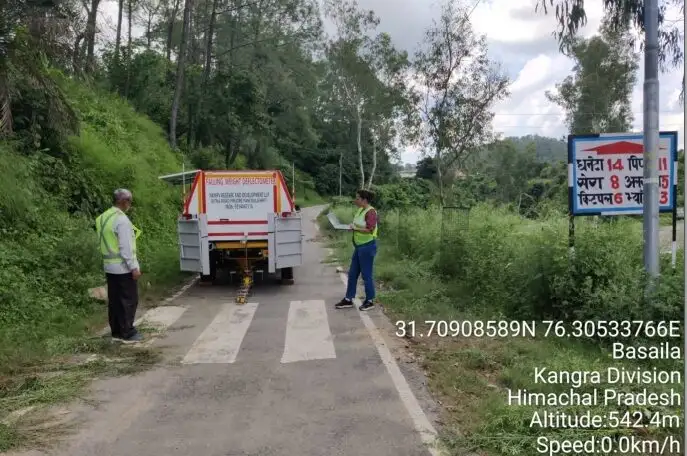
The FWD test is conducted in the following steps, as per industry standards and NHAI guidelines:- Site Selection and Preparation: The location for testing is chosen based on the project requirements. The area must be cleared of debris, and the pavement surface should be clean and dry. The test is generally conducted at regular intervals along the test section to obtain comprehensive data.
- Calibration of the Equipment: Before testing, the FWD system is calibrated according to the manufacturer’s instructions to ensure accurate measurements. Calibration involves adjusting the release mechanism and confirming the weight's dropping height and velocity.
- Positioning the Equipment: The FWD equipment is positioned at predetermined locations along the pavement surface. The position of the equipment should ensure that the load is applied uniformly to the pavement. Multiple test points are chosen to account for variations in pavement conditions.
- Data Acquisition: The equipment operator releases the weight, causing it to fall onto the loading plate. The deflection at different radial distances is recorded by the geophones. The deflection measurements are taken at various load levels and are repeated at several locations along the pavement.
- Test Repetition: A minimum of three drops is usually required at each test location to ensure consistency and reliability of the data. Each drop will produce a unique deflection profile.
Deflection Data and Analysis
The data collected during the FWD test includes the deflection at various points around the load application. This deflection data is crucial in assessing the pavement structure’s performance and can be used to derive several important parameters, including:- Deflection Basin or Bowl: This refers to the graphical representation of deflection values at different radial distances from the loading point. The deflection is highest at the center and decreases as the distance from the load increases. The shape of the deflection basin provides insights into the structural condition of the pavement.
- Subgrade Modulus (k-value): The k-value is a measure of the stiffness of the underlying subgrade material. This value is essential for understanding the overall support the subgrade provides to the pavement. Higher deflections may indicate weaker subgrades.
- Layer Moduli: By performing a back-calculation using deflection data, the moduli of individual pavement layers (surface, base, and subbase) can be determined. These moduli are crucial for evaluating the material strength and structural capacity of the pavement layers.
- Pavement Performance Evaluation: Based on the deflection profiles, engineers can evaluate whether the pavement is exhibiting early signs of distress, such as cracking, rutting, or other structural failures. The data also helps predict the remaining life of the pavement under current traffic loads.
- Structural Number (SN): The Structural Number is derived from the deflection data and is used to quantify the overall strength of the pavement structure. The SN is a key parameter used in pavement design and rehabilitation decisions.
NHAI Guidelines and Standards for FWD Testing
The National Highways Authority of India (NHAI) provides specific guidelines for the use of FWD testing in highway projects. These guidelines ensure consistency, accuracy, and reliability of the data collected. Some important NHAI guidelines and industry codes for FWD testing include:- Test Locations: NHAI requires that FWD testing be carried out at regular intervals along the test section. The frequency and location of testing depend on the project requirements and the extent of the pavement.
- Number of Drops: A minimum of three drops must be performed at each test location. This ensures that any variability in deflection measurements is accounted for and that the data is reliable.
- Distance Between Sensors: NHAI guidelines specify the placement of deflection sensors at various distances from the loading point. Common distances are 0, 150, 300, 450, and 600 mm, with additional sensors placed at greater distances for highly flexible pavements.
- Calibration Requirements: FWD equipment must be calibrated periodically to ensure that it provides accurate and reliable results. Calibration standards, including the equipment’s release mechanism and sensor calibration, must be followed as per NHAI specifications.
- Data Reporting: The deflection data must be compiled and presented in a clear and detailed report. This report includes the deflection basin, pavement condition analysis, and any recommendations for maintenance or rehabilitation.
- Quality Control: NHAI mandates that FWD testing be conducted by qualified personnel who have undergone proper training in the operation of FWD equipment and the interpretation of deflection data.
Applications of FWD Testing
FWD testing is widely applied in various stages of pavement management and highway infrastructure projects. Its primary applications include:- Pavement Condition Assessment: FWD testing is used to assess the structural integrity of existing pavements. By measuring the deflection response, engineers can evaluate whether a pavement is capable of supporting the current and future traffic loads.
- Pavement Rehabilitation and Maintenance: FWD results are crucial in determining whether a pavement requires rehabilitation, strengthening, or resurfacing. If the deflection exceeds permissible limits, remedial measures such as milling, overlaying, or base strengthening may be required.
- Pavement Design and Structural Evaluation: In new pavement construction, FWD testing helps assess the structural capacity of the designed pavement and validate its ability to carry the expected traffic loads. Engineers can use FWD data to back-calculate layer moduli and refine the pavement design.
- Traffic Load Analysis: FWD testing helps evaluate whether the pavement can carry the load exerted by vehicular traffic, particularly in areas with high heavy truck traffic. The test results assist in designing pavements that can withstand future traffic loads.
- Post-Construction Monitoring: After a new pavement is constructed, FWD testing can be used for post-construction performance monitoring. The data helps determine whether the pavement has been constructed as per the design specifications and if it is performing optimally.
Advantages of FWD Testing
- Non-Destructive: FWD testing is a non-destructive evaluation method, meaning it does not damage or disturb the pavement being tested.
- Rapid Data Collection: Multiple measurements can be obtained quickly, making it possible to test large sections of pavement in a short time frame.
- In-Situ Testing: The FWD test provides real-world data directly from the pavement, making it highly relevant to actual pavement performance under traffic loads.
- Comprehensive Results: The data collected from the FWD test gives a detailed assessment of both the surface and sub-surface conditions of the pavement structure.
- Cost-Effective: Although the initial cost of the equipment may be high, the FWD test is cost-effective compared to other traditional testing methods, especially for large-scale projects.
Limitations of FWD Testing
- Limited Depth Information: FWD testing primarily measures the deflection at the surface and provides indirect information about deeper pavement layers. The test cannot directly measure conditions at greater depths without additional analysis techniques.
- Weather Sensitivity: Extreme weather conditions such as rain or snow can affect the accuracy of the measurements.
- Equipment Cost: FWD devices are expensive to procure and maintain, which can be a limitation for smaller projects.
- Data Interpretation: Proper interpretation of deflection data requires skilled personnel and can be complex, particularly in situations where back-calculation of moduli is required.
Conclusion
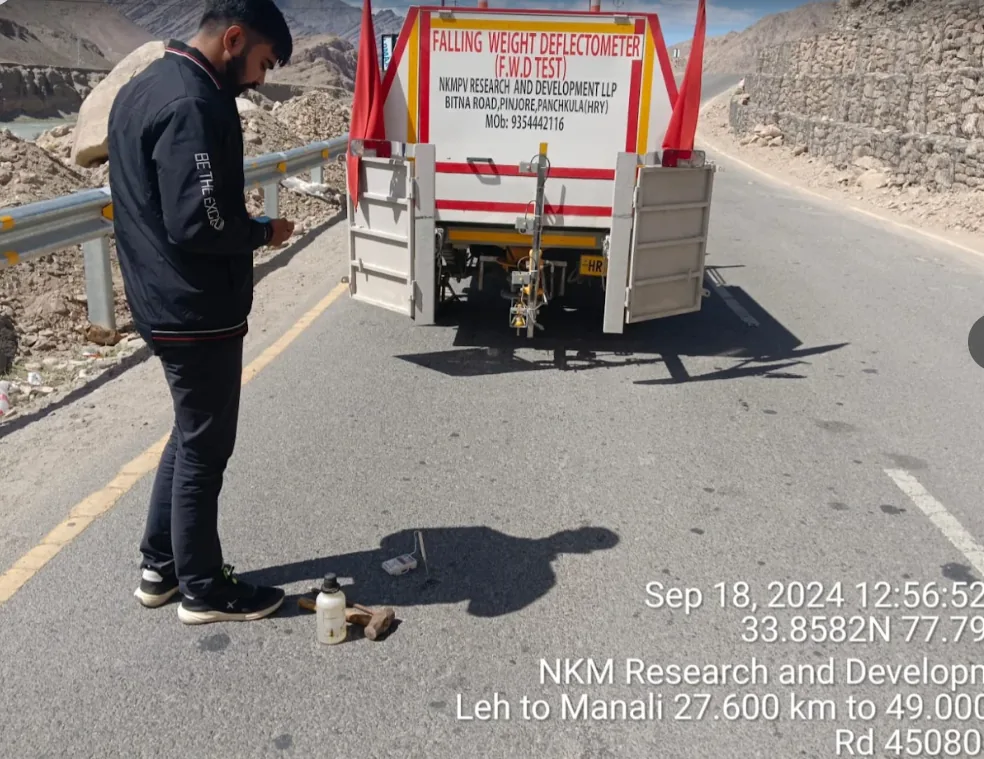
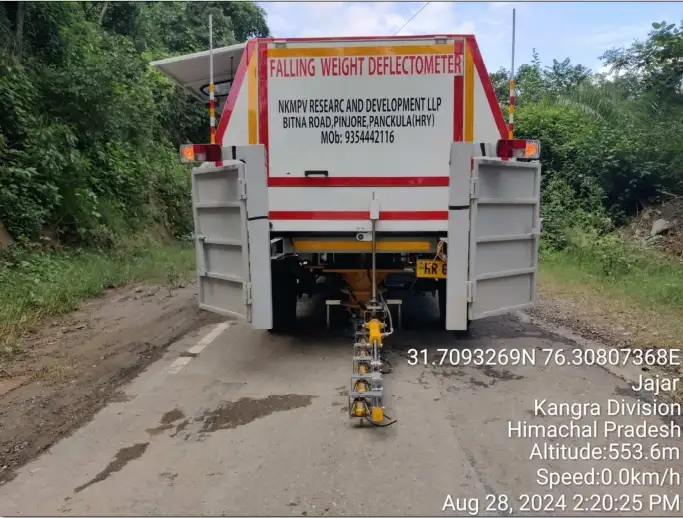
Falling Weight Deflectometer (FWD) test is an essential tool for evaluating the structural performance of pavements in highway and infrastructure projects. It provides valuable insights into the condition of pavement surfaces and substructures, allowing engineers to make informed decisions about maintenance, rehabilitation, and design. Adherence to NHAI guidelines and industry standards ensures that FWD testing provides reliable and accurate data, which is crucial for maintaining the safety, longevity, and performance of road networks. FWD testing, with its non-destructive nature and rapid data acquisition capabilities, plays a key role in pavement management systems. As infrastructure demands increase, the application of FWD testing in regular pavement evaluations becomes increasingly important for the sustainability of road networks.Photos & Lab Images



Why Choose NKMPV for FWD Testing?
NABL Accredited Reports
Our FWD test reports carry NABL accreditation under ISO/IEC 17025:2017 and are accepted by NHAI, state PWDs, concessionaires, and independent engineers for overlay design, dispute resolution, and compliance verification.
Dynatest FWD Equipment
We operate the Dynatest 8002 trailer-mounted FWD with 9-sensor geophone array, GPS integration, and automated data acquisition — capable of testing 200-300 points per day on highway projects with minimal traffic disruption.
In-House Backcalculation Expertise
Our pavement engineers perform backcalculation analysis using ELMOD and KGPBACK software with experience in Indian pavement conditions, subgrade types, and IRC design methodology — ensuring technically sound and practically implementable overlay recommendations.
Comprehensive Pavement Evaluation Package
We integrate FWD structural data with NSV functional data (roughness, rutting, texture), core extraction results, and traffic surveys to deliver a complete pavement condition assessment and prioritised rehabilitation strategy.
Pan-India Highway Experience
Our team has conducted FWD surveys on national highway, state highway, and expressway projects across Haryana, Punjab, Himachal Pradesh, Rajasthan, and Uttar Pradesh, covering thousands of lane-kilometres of pavement evaluation.
Frequently Asked Questions about FWD Pavement Testing
The FWD test (Falling Weight Deflectometer test) is a non-destructive structural evaluation of an in-service pavement. A calibrated impulse load (typically 40–65 kN, simulating one wheel of a standard truck axle) is dropped onto the pavement, and the resulting deflection basin is captured by 7–9 geophones at known offsets. The shape of the deflection basin is then back-calculated using software (BACKGA, ELMOD, EVERCALC) per IRC 115 to derive the elastic modulus of each pavement layer (subgrade, sub-base, base, surface). The layer moduli feed pavement-rehabilitation design under IRC 115 / IRC 81.
FWD is the only field test that measures pavement structural capacity without coring or excavation. NHAI mandates FWD-based evaluation under IRC 115 for: (1) overlay-design data input for periodic maintenance of National Highways, (2) acceptance testing of newly constructed pavements before defect-liability period commences, (3) condition-based handover assessments at concessionaire milestone gates, and (4) forensic investigation of premature pavement failure. State PWDs commonly use FWD for State Highway and Major District Road overlay programmes. The non-destructive nature means traffic disruption is limited to slow-moving cones, with no closure required.
The FWD test measures the deflection basin — vertical pavement movement at the load point and at 6–8 offset distances (typically 0, 200, 300, 450, 600, 900, 1200, 1500, 1800 mm). The peak deflection at the load point indicates overall pavement stiffness; the deflection at outer geophones reflects subgrade strength; intermediate-geophone deflections reflect base and sub-base layer moduli. Software back-calculation transforms the deflection basin into elastic modulus values per layer — these become the inputs to IRC 115 mechanistic-empirical overlay design.
Benkelman Beam measures only a single deflection point under a slow-moving truck load — sufficient for the older IRC 81:1997 overlay design which used only peak deflection. FWD captures the full deflection basin across multiple geophones, which is required for IRC 115:2014 mechanistic-empirical layer-moduli back-calculation. FWD is the IRC-current standard; Benkelman Beam is still permitted under IRC 81 but is being phased out. NKMPV operates both. See our FWD vs Benkelman Beam comparison for a head-to-head technical breakdown.
FWD pricing is per-test-point or per-km. Typical 2026 rates: Rs. 350–650 per test point for project-level work, Rs. 2,500–4,500 per km for highway corridor surveys (typically tests every 50–100 m), and Rs. 25,000–40,000/day for daily-rate engagements. NHAI projects sit at the upper end because of IRC 115 documentation requirements and the back-calculation deliverable. NABL accreditation adds ~15–20%. See our FWD test cost guide for project-specific pricing scenarios.
Field FWD productivity is high — 200–400 test points per day in plain terrain with a single FWD unit, equivalent to 20–40 km of highway corridor at 100 m test spacing. Hilly terrain drops to 150–250 points/day. A typical 50 km NHAI corridor (500 test points at 100 m spacing) takes 2–3 days field + 4–5 days back-calculation and IRC 115 report, total 7–10 working days. Project-level work (testing 50–100 points at a critical section) can be a single day field + 2 days report.