
Our team travels to your site
For field work, our engineers and instruments mobilise anywhere in India — highway corridors, bridges, plants and greenfield alignments included.
Centimetre-accuracy DGPS / RTK surveys — control-point networks, highway alignment and L-section / cross-section surveys to IRC SP 19 for DPRs, bridges and land acquisition
DGPS stands for Differential Global Positioning System — a satellite survey method that achieves centimetre-level accuracy using a base station and RTK corrections. It is used to establish control points and capture highway, corridor and boundary surveys to MoRTH/NHAI standards. NKMPV provides DGPS survey services across India.
DGPS (Differential GPS) survey delivers sub-metre to centimetre-grade positional accuracy for highway alignment, control-point establishment and corridor mapping, per MoRTH and NHAI DPR specifications. NKMPV carries out DGPS-based survey work with deliverables accepted by NHAI, state PWDs and DPR consultants across North India. For site-level topography, contour mapping, and architectural / DPR surveys, see our dedicated <a href='/services/topographic-survey'>Topographic Survey service</a>.
The following parameters define the accuracy requirements and deliverables for DGPS surveys. Specifications vary by project type — NHAI DPR, state highway, or cadastral surveys each have distinct requirements.
| Parameter | Value / Range | Unit | Standard |
|---|---|---|---|
| Horizontal Accuracy (RTK Mode) | 10-20 mm + 1 ppm | mm | Survey of India Guidelines |
| Vertical Accuracy (RTK Mode) | 15-30 mm + 1 ppm | mm | Survey of India Guidelines |
| Static Survey Accuracy | 3-5 mm + 0.5 ppm | mm | Survey of India Guidelines |
| L&CB Cross-Section Interval | 25-50 m (typical for NH/SH) | m | IRC SP 19 |
| Control Point Spacing | 500-1000 m along alignment | m | IRC SP 19 |
| Cross-Section Width | 25-50 m either side of centreline | m | NHAI DPR Guidelines |
| Geoid Model Reference | EGM-2008 or local geoid | Survey of India Guidelines |
Guidelines for DGPS and GNSS Surveys — Survey of India (Geodetic & Research Branch)
Manual for Survey, Investigation and Preparation of Road Projects
NHAI Guidelines for Preparation of Detailed Project Reports for National Highways
Manual of Specifications and Standards for Expressways
Specifications for Road and Bridge Works — Section 100 (Preliminary Investigation)
Trimble R8s / Leica GS18
GPS + GLONASS + BeiDou reception, 220-channel tracking, internal UHF radio transmitter
CalibratedTrimble R8s / Leica GS18 T
RTK accuracy 8 mm + 1 ppm (H), integrated tilt compensation, Bluetooth-enabled
CalibratedPacific Crest ADL Vantage 35W
UHF radio range 5-10 km line-of-sight, NTRIP GSM backup for urban corridors
CalibratedTrimble TSC5 / Leica CS20
Runs Trimble Access / Leica Captivate software, real-time stakeout and L&CB coding
CalibratedTrimble Business Center (TBC) / Leica Infinity
Baseline processing, network adjustment, coordinate transformation, DTM generation
CalibratedSokkia B40A
Accuracy 1.0 mm per km double run, used for benchmark verification
CalibratedThe survey team reviews project drawings, alignment sheets, and satellite imagery to plan base station locations, control point networks, and daily survey coverage. Existing Survey of India benchmarks and GTS (Great Trigonometrical Survey) pillars in the project area are identified for datum reference. A reconnaissance visit confirms terrain accessibility and radio link feasibility.
Permanent control points (CPs) are established at 500-1000 metre intervals along the project corridor using static GNSS observation. Each CP is observed for a minimum of 1 hour with dual-frequency receivers. Baselines are processed using post-processing software, and a least-squares network adjustment is performed to achieve 3-5 mm positional accuracy. All CPs are monumented with concrete pillars and referenced to Survey of India datum.
A base station receiver is set up on a known control point with a clear sky view (elevation mask 15 degrees). The base station broadcasts differential corrections via UHF radio or NTRIP over cellular network to the rover. RTK initialisation is verified by occupying a second known CP to confirm that real-time coordinates match within the specified tolerance of 20 mm horizontal and 30 mm vertical.
The rover operator walks or drives along the proposed highway alignment, collecting centreline coordinates, edge-of-carriageway points, and cross-section profiles at 25-50 metre intervals as per IRC SP 19. At each cross-section, points are recorded at every significant break in grade extending 25-50 metres on either side of the centreline. Existing structures, utilities, and drainage features are also surveyed and coded.
Field data is downloaded and checked for completeness, duplicate points, and positional outliers. Where RTK fix quality was degraded due to tree canopy or terrain obstruction, static observation data is post-processed against base station files to recover centimetre-level accuracy. All coordinates are transformed to the project coordinate system (typically UTM Zone 43N / 44N for Haryana-Punjab region).
Processed survey data is imported into AutoCAD Civil 3D or equivalent software to generate the Digital Terrain Model (DTM), contour maps at 0.5 m or 1.0 m intervals, alignment plan-profile sheets, and cross-section drawings. Earthwork quantities are computed from the DTM. All deliverables are prepared in formats specified by the client — DWG, DXF, KML, and PDF.
The final survey report includes a narrative describing methodology, control point coordinates with accuracy statements, equipment calibration certificates, cross-section sheets, DTM files, and earthwork volume calculations. All coordinate data is delivered in both hard copy and digital formats. A KML overlay file is provided for client verification against Google Earth imagery.
Further reading: DGPS vs Total Station Survey — When to Use Each for Highway Projects — a side-by-side comparison covering accuracy, productivity, terrain suitability, and what NHAI / MoRTH expect in DPR submissions.
NKMPV Research & Development LLP provides professional DGPS survey services for highways, infrastructure projects, and land development across India. Using RTK DGPS receivers, we deliver centimeter-level accuracy in geospatial data collection.
Our services meet the stringent requirements of NHAI, MoRTH, and state PWD projects. Whether you need highway alignment surveys, topographic mapping, or control point establishment, our experienced team delivers reliable results.
Our services meet the stringent requirements of NHAI, MoRTH, and state PWD projects. Whether you need highway alignment surveys, topographic mapping, or control point establishment, our experienced team delivers reliable results.
DGPS (Differential Global Positioning System) survey is an advanced positioning technique that achieves centimeter-level accuracy for engineering and infrastructure projects. Unlike standard GPS with 5-10 meter accuracy, DGPS uses ground-based reference stations to correct satellite signal errors.
System works through a base station at a known location that calculates correction signals in real-time. These corrections eliminate errors caused by atmospheric interference, satellite clock drift, and orbital variations. The rover unit in the field receives these corrections instantly.
For highway projects and infrastructure development, DGPS survey provides the precision required to meet project specifications. Government agencies like NHAI and state PWDs mandate this accuracy level for road construction and land acquisition surveys.
Highway Alignment & Corridor Survey
We provide precise alignment surveys for national highways, state highways, and expressways. Our team captures centerline coordinates, cross-section data, and corridor boundaries with centimeter-level accuracy. This data supports DPR preparation, land acquisition, and construction activities.
Topographic Survey & Contour Mapping
Our DGPS survey captures detailed ground surface data including elevation, natural features, and existing structures. We generate accurate contour maps essential for drainage design, earthwork estimation, and project planning. Contour intervals are customized based on project requirements.
Control Point Establishment
We establish permanent ground control points (GCPs) and benchmarks connected to the national geodetic framework maintained by Survey of India. These reference points serve as the foundation for all subsequent survey and construction activities.
Right of Way (ROW) Survey
Our boundary demarcation and ROW mapping supports land acquisition in highway and infrastructure projects. We provide legally defensible boundary coordinates for revenue records and compensation assessments as per government requirements.
Construction Layout & Setting Out
We transfer design coordinates to ground for construction activities with high precision. Our setting out services cover road centerlines, structure locations, utility corridors, and bridge foundations. This ensures structures are built at exact design positions.
As-Built Survey
Post-construction documentation verifies actual built positions against design. Our DGPS as-built surveys create permanent records of completed infrastructure for maintenance planning and future reference. This data is essential for project handover and compliance verification.
Cross-Section & Longitudinal Survey
Post-construction documentation verifies actual built positions against design. Our DGPS as-built surveys create permanent records of completed infrastructure for maintenance planning and future reference. This data is essential for project handover and compliance verification.
GIS Data Collection
Post-construction documentation verifies actual built positions against design. Our DGPS as-built surveys create permanent records of completed infrastructure for maintenance planning and future reference. This data is essential for project handover and compliance verification.
NABL-Accredited Testing Laboratory
NKMPV's testing laboratory holds ISO/IEC 17025:2017 accreditation from the National Accreditation Board for Testing and Calibration Laboratories — Certificate TC-14144, renewed in 2026. Soil and material testing for the same project can be done in-house.
Centimeter-Level Accuracy
Our methodology achieves horizontal accuracy of ±10-20mm and vertical accuracy of ±20-30mm under optimal conditions. This precision exceeds requirements specified by NHAI and MoRTH for highway projects. Static observations achieve millimeter-level accuracy for control networks.
Experienced Survey Team
Our field teams include qualified surveyors with extensive experience in highway projects and infrastructure development. They understand project requirements thoroughly. Learn more about our team and capabilities.
NHAI & MoRTH Compliance
All surveys follow guidelines specified by National Highways Authority of India and Ministry of Road Transport and Highways. Our procedures, documentation, and deliverables meet requirements for government project submissions and audits.
Quick Turnaround
DGPS technology enables rapid data collection compared to traditional methods. We cover large project areas efficiently while maintaining accuracy. A typical 50-100 km highway corridor survey completes in 1-2 weeks including processing.
Complete Deliverables Package
You receive comprehensive outputs including coordinate tables, CAD drawings, contour maps, and detailed reports. All data comes in formats compatible with your project requirements and software systems.
Our operations utilize survey-grade equipment and proven methodologies for reliable results:
Real-Time Kinematic (RTK) DGPS
For projects requiring immediate results, we deploy RTK systems providing centimeter-level coordinates in real-time. The base station transmits corrections via radio or cellular network to rover units. This enables efficient data collection with instant quality verification.
Post-Processed Kinematic (PPK) DGPS
For remote areas or highest accuracy requirements, we use PPK methodology. Raw satellite data is collected and processed later using precise ephemeris data. This achieves optimal accuracy independent of real-time communication constraints in difficult terrain.
Static DGPS for Control Points
Primary control networks use static observation sessions with extended occupation times. Multiple receivers observe simultaneously to achieve millimeter-level accuracy. These permanent reference points anchor all subsequent project surveys.
Multi-Constellation Receivers
Our equipment tracks GPS, GLONASS, and other satellite systems simultaneously. Multi-constellation capability improves positioning reliability in challenging environments. This ensures consistent accuracy even with limited sky visibility.
Upon completion, clients receive a comprehensive data package:
Need testing for other parameters? Explore our soil testing and NDT services.
Alignment surveys, corridor mapping, and ROW demarcation for national highways, state highways, and expressways. We support NHAI, NHIDCL, and state PWD projects across India with compliant documentation.
Bridge & Structure Surveys
Precise positioning for bridge foundations, abutment locations, and structural elements. DGPS ensures structures are built at exact design coordinates meeting safety and engineering standards.
Railway Projects
Track alignment surveys, station area mapping, and corridor surveys for railway infrastructure. We support gauge conversion projects and new line construction with required accuracy levels.
Airport Development
Runway surveys, airside infrastructure mapping, and obstacle surveys for aviation projects. High-precision data meets Airport Authority of India requirements for safety compliance.
Urban Infrastructure
Road network surveys and utility corridor mapping for smart city projects. Our data supports urban planning, traffic management systems, and infrastructure development initiatives.
Pipeline & Transmission Lines
Route surveys for oil/gas pipelines, water transmission mains, and power transmission lines. We provide corridor mapping with terrain analysis for optimal route selection.
We follow a systematic approach ensuring quality and accuracy:
DGPS survey typically achieves horizontal accuracy of ±10-20mm and vertical accuracy of ±20-30mm using RTK methodology. Static observations for control points can achieve millimeter-level accuracy with extended occupation times. This precision meets requirements for most highway and infrastructure projects.
Standard GPS provides accuracy of 5-10 meters, while DGPS uses differential corrections from a base station to achieve centimeter-level accuracy. The base station calculates errors and transmits corrections to the rover unit in real-time. This makes DGPS essential for engineering surveys where precision is critical.
Survey duration depends on project size and complexity. A typical highway corridor of 50-100 km can be surveyed in 1-2 weeks including control establishment, field work, and data processing. Larger networks or difficult terrain may require additional time for thorough coverage.
We deliver data in any required coordinate system including UTM (Universal Transverse Mercator), Indian coordinate systems, state plane coordinates, or project-specific local grids. Coordinate transformation is performed using established parameters and verified control points.
Yes, DGPS survey is widely accepted and often required by NHAI for highway projects. Our survey methodology and documentation comply with NHAI specifications and MoRTH guidelines. All deliverables meet requirements for government project submissions and third-party audits.
DGPS requires clear sky visibility for satellite signals. In challenging terrain with dense tree cover or deep valleys, we use PPK processing or additional control points to maintain accuracy. Our experienced teams have successfully completed surveys in Himalayan regions and forested corridors.
DGPS survey cost depends on project scope, terrain difficulty, accuracy requirements, and deliverables needed. Highway alignment surveys are typically priced per kilometer while topographic surveys may be priced per hectare. Contact us with your project details for accurate quotation.
Yes, NKMPV provides DGPS survey services throughout India. Our teams have completed projects in plains, hilly terrain, coastal areas, and remote locations. We mobilize equipment and personnel to your project site regardless of location.
Contact NKMPV Research & Development LLP for professional DGPS survey services. Share your project details including location, area extent, accuracy requirements, and deliverable specifications.
Our team will review your requirements and provide a detailed proposal with timeline and pricing.
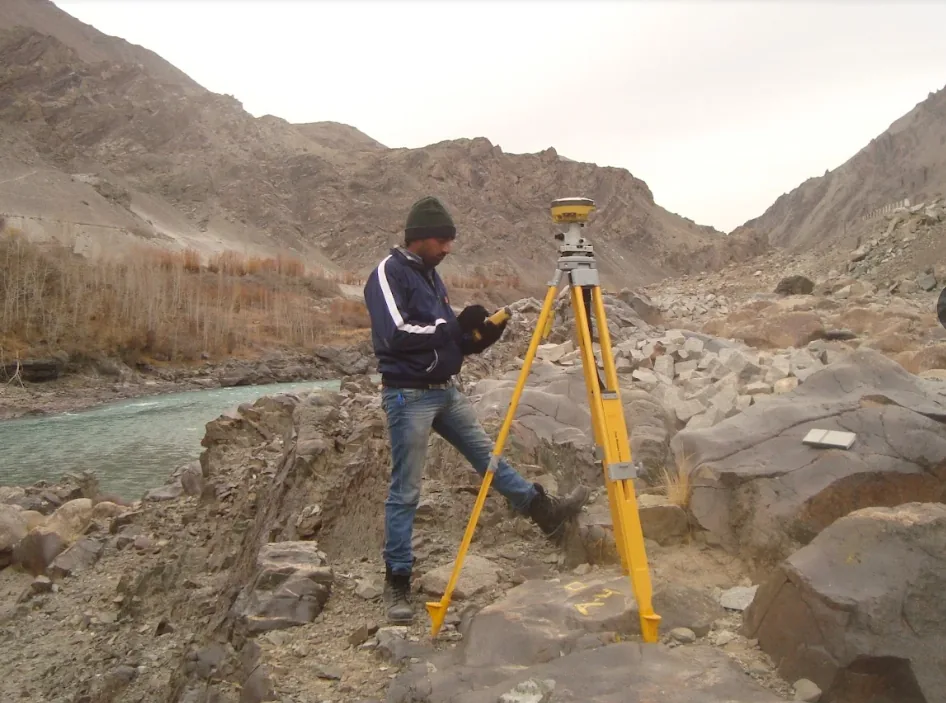
Our GNSS equipment tracks GPS, GLONASS, and BeiDou satellites simultaneously, ensuring reliable RTK fix even in partially obstructed terrain — critical for hill-road corridors in Himachal Pradesh and Shivalik foothills.
All control points are referenced to Survey of India benchmarks and GTS pillars, with network-adjusted coordinates meeting the positional accuracy requirements specified by NHAI and state PWD departments.
We provide not just raw survey data but finished deliverables — AutoCAD Civil 3D drawings, DTM files, cross-section sheets, earthwork volumes, and KML overlays — ready for direct use in DPR preparation and pavement design.
Our field crews have surveyed over 500 km of highway corridors across Haryana, Punjab, and Himachal Pradesh, including NH-44, NH-5, and Atal Tunnel approach roads. They are familiar with NHAI and state PWD submission formats.
Unlike standalone survey firms, NKMPV combines DGPS survey with geotechnical investigation, pavement evaluation, and material testing — giving you a single-window solution for complete highway project investigation.
A DGPS survey (Differential Global Positioning System survey) uses two GPS receivers — a base station at a coordinate-known control point and a rover at the surveyed location — to deliver positional accuracy of 1–5 cm with RTK or 0.3–1.0 m with code-differential. The base computes the satellite-signal error at its known position and transmits the correction to the rover, which subtracts the error from its own measurements. This is the IRC SP 19 / NHAI-mandated method for highway alignment, topographical mapping, and control-point establishment across India. For cost reference, see our DGPS survey cost guide.
In construction, DGPS survey is used for: highway and expressway alignment (centerline, RoW boundary, cross-sections), land acquisition mapping (per-corner positioning with revenue-record overlay), permanent control-point establishment at 1–2 km intervals along project corridors, topographical mapping for DPR submissions, as-built verification for concessionaire milestone payments, power transmission line tower positioning, and setting-out / stake-out for foundation and pavement construction. NKMPV provides DGPS-based control surveys for NHAI, state PWD, and DBFOT/HAM/BOT concessionaires across India.
NKMPV operates DGPS survey crews across Punjab, Haryana, Himachal Pradesh, Delhi NCR, Uttarakhand, Uttar Pradesh, Jammu & Kashmir, Ladakh, and Rajasthan. Crew dispatch is typically same-week from our Pinjore (Haryana) base for projects within 800 km. Long-deployment projects (Leh, J&K, hill stations) are scheduled with 2–3 week mobilisation. All DGPS data is delivered with chainage-referenced coordinates in the project datum (WGS84 or local) and is accepted by NHAI, MoRTH, state PWDs, and World Bank-funded projects without additional verification.
The standard NKMPV DGPS survey procedure: (1) Pre-survey planning — agree project datum, chainage start/end, required accuracy tier, control-point spacing, deliverable format. (2) Base-station setup at a coordinate-known control point or temporary benchmark with multi-hour static observation. (3) Rover field survey walking the corridor at 5–15 km/day (full topographical) or 15–25 km/day (centerline-only), with RTK corrections from base. (4) Quality control — re-occupation of every 5th point, redundancy checks, base-rover baseline verification. (5) Data processing — datum transformation, coordinate adjustment, point-cleaning. (6) Deliverable preparation — AutoCAD .dwg, GIS shapefile, cross-sections, DTM, calibration certificate. Standard turnaround 7–10 working days from field-survey completion.
Field productivity depends on terrain and survey density. Plain terrain (Punjab, Haryana, central UP): 5–10 km/day for full topographical surveys; 15–25 km/day for centerline-only. Hilly terrain (Himachal, J&K, Uttarakhand): drops to 2–5 km/day for full topographical due to satellite obstruction and access constraints. A 50 km highway DPR-grade topographical survey typically takes 5–8 days of field work + 5–7 days for processing and deliverables, total 10–15 working days. Permanent control-point establishment adds 30–60 minutes per point of multi-hour static observation.
Neither is universally better — they are complementary. DGPS dominates for long-corridor highway alignment, dense-vegetation areas, and remote terrain (high productivity, no line-of-sight constraint). Total station dominates for short-corridor work, urban areas with satellite obstruction, and high-precision construction stake-out (line-of-sight requirement is fine in clear areas). Modern projects combine both: DGPS for the corridor backbone, total station for built-up areas and detailed structure work. See our full DGPS vs Total Station comparison.
Coverage
Wherever your project is, there are two ways to work with NKMPV on DGPS Survey.
For field work, our engineers and instruments mobilise anywhere in India — highway corridors, bridges, plants and greenfield alignments included.
Distance is not a constraint for laboratory testing. Send samples to our Pinjore laboratory and receive the digital report on completion — the route most of our out-of-region clients use.
These are locations where we have completed projects — not the boundary of our service area. We mobilise across India on request. See full coverage & project locations →
DGPS Survey is carried out to Survey of India Guidelines, IRC SP 19:2001, NHAI DPR Guidelines and IRC SP 84:2014, as listed in the Applicable Standards section of this page. Tell us the specification your project must comply with and the quotation will state the standard the work follows.
Our laboratory is at Pinjore, Haryana, within same-day reach of Chandigarh, Panchkula, Mohali, Ambala and the wider Tri-City. If you are further away, distance is not a constraint: our field team travels to site anywhere in India for on-site work, and for laboratory tests you can courier samples to the Pinjore lab and receive the report digitally. Clients across Punjab, Haryana, Himachal Pradesh, Delhi-NCR, Uttarakhand, Rajasthan, Uttar Pradesh, Jammu and Kashmir and Ladakh already work with us this way.
Yes. NKMPV operates pan-India. We have delivered projects across Chandigarh, Panchkula, Mohali, Ambala, Karnal, Kurukshetra, Yamunanagar, Hisar and beyond, and we mobilise to greenfield and remote corridors on request. The 18 locations listed on our site are the places we have already worked — not the limit of where we go.
Send us the project details — location, quantity, and the standard you need to comply with — and you get a written quotation, usually within one working day. Pricing depends on sample count, site access and mobilisation distance, so we quote per project rather than publishing a fixed rate. Call +91-82953-60108 or use the quote form; every quotation states the applicable IS/IRC standard.
Need DGPS Survey for your project?